
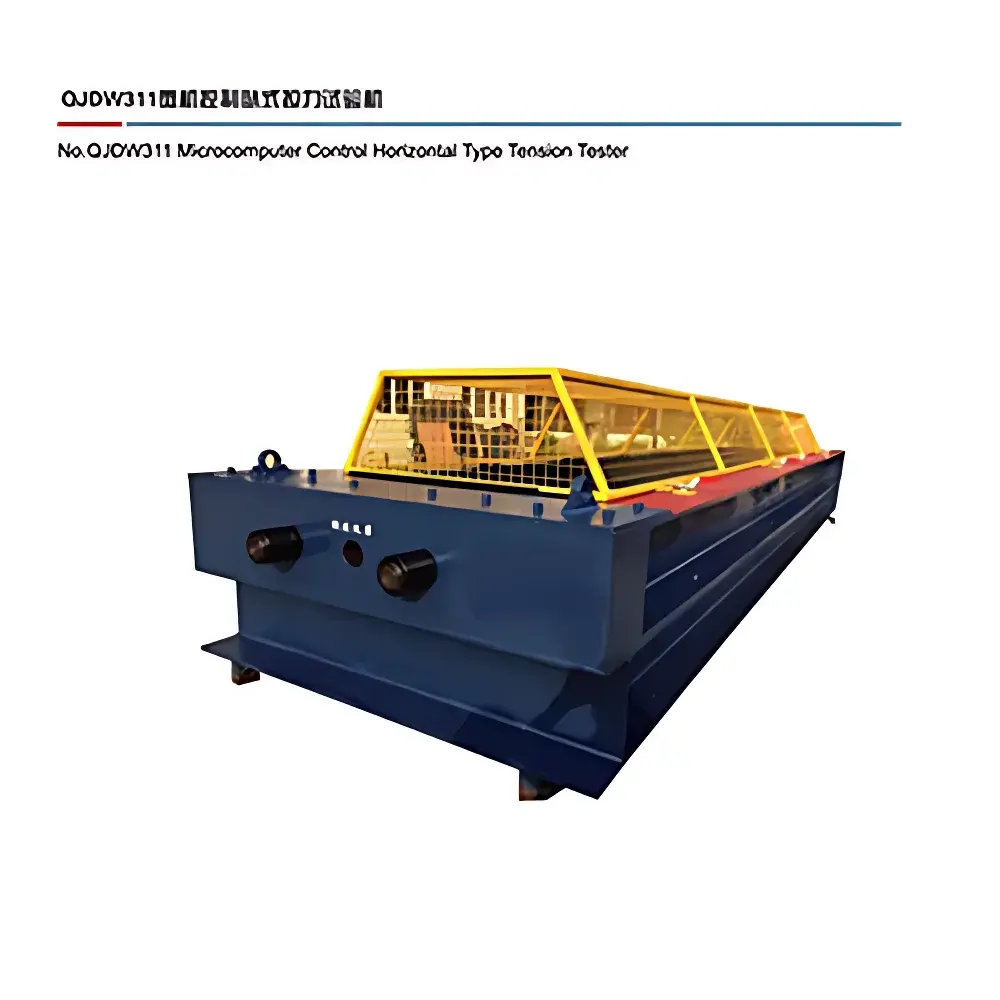
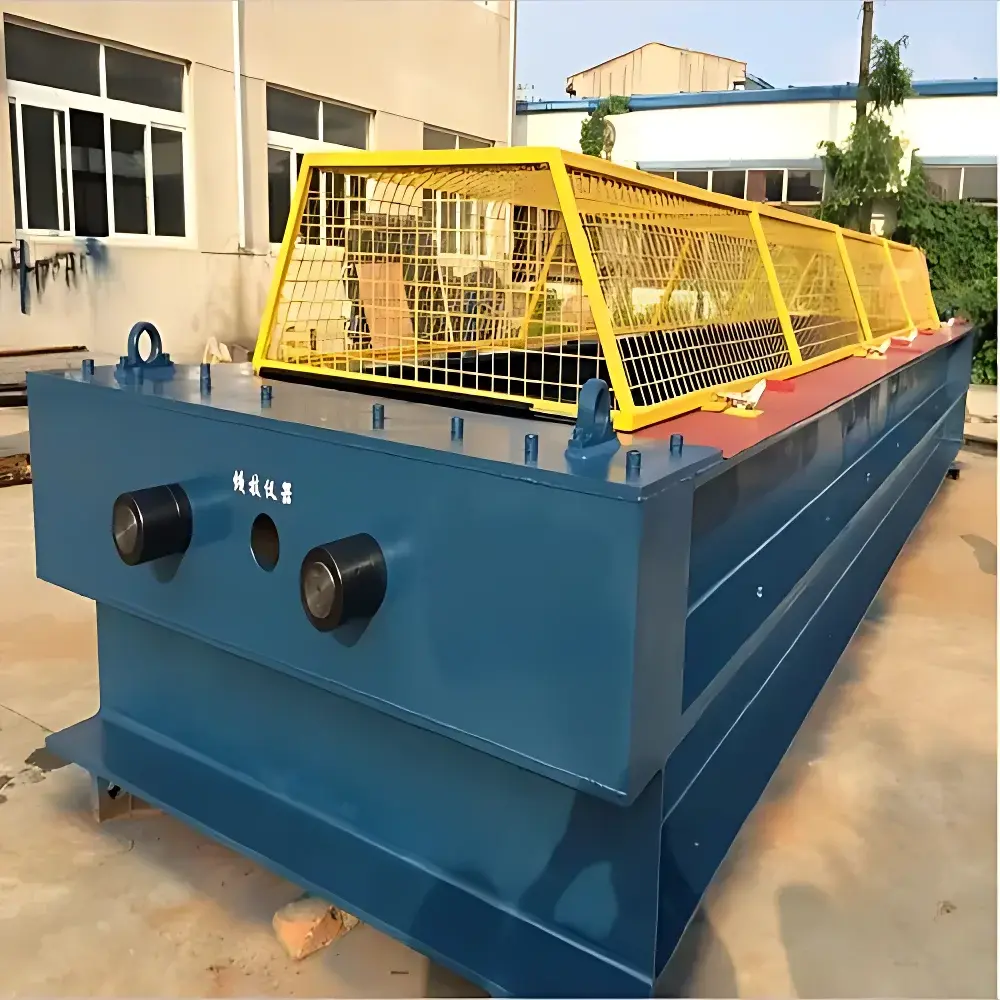
QJ-DW311 Horizontal Tensile Testing Machine
| Brand | Qinsun |
|---|---|
| Origin | Shanghai, China |
| Model | QJ-DW311 |
| Type | Hydraulic Tensile Testing Machine |
| Max Test Force | 50,000 kN |
| Force Range | 0–50,000 kN (full-scale) |
| Force Accuracy Class | Class 1 (per ISO 7500-1 / ASTM E4) |
| Displacement Resolution | ≤1% of full scale |
| Force Sensor Accuracy | ±0.01% FS |
| Repeatability | ≤1% |
| Deformation Measurement Accuracy | ≤1% |
| Control System | Fully PC-controlled |
| Compliance | GB/T 228.1, ISO 6892-1, ASTM E8/E21, JIS Z 2241, DIN 50125 |
Overview
The QJ-DW311 Horizontal Tensile Testing Machine is a heavy-duty, hydraulically actuated static testing system engineered for high-capacity tensile evaluation of elongated, low-stiffness, or flexible specimens—particularly optical fibers, fiber optic cables, armored communication cables, and other quasi-one-dimensional structural materials requiring extended gauge lengths and controlled axial loading. Unlike vertical frame configurations, its horizontal architecture eliminates gravitational sag effects and enables stable, low-friction specimen alignment over extended test lengths (up to several meters), making it uniquely suited for compliance with international standards governing cable mechanical integrity, such as IEC 60794-1-2, Telcordia GR-20, and ITU-T L.22. The system operates on the principle of servo-controlled hydraulic force application, with closed-loop load regulation maintained via high-bandwidth pressure control valves and precision load cell feedback (±0.01% FS). Force measurement conforms to ISO 7500-1 Class 1 accuracy requirements, ensuring traceable, repeatable results under GLP and GMP-aligned laboratory environments.
Key Features
- Hydraulic actuation system delivering up to 50,000 kN maximum static tensile force with smooth, stepless speed control across defined strain-rate ranges
- Horizontal dual-column rigid frame with reinforced base plate and adjustable anchoring points for secure mounting of large-diameter or pre-tensioned cable reels
- Integrated high-resolution displacement transduction using linear variable differential transformers (LVDTs) and encoder-based crosshead position tracking (≤1% FS resolution)
- Class 1 force measurement certified per ISO 7500-1 and ASTM E4, supported by NIST-traceable calibration documentation
- Full PC-based control interface with real-time data acquisition at ≥1 kHz sampling rate, supporting multi-channel synchronization (load, displacement, extensometer, temperature if equipped)
- Modular gripping system accommodating wedge-type, pneumatic, or custom-designed fixtures for fragile or high-strength fiber bundles and armored cables
Sample Compatibility & Compliance
The QJ-DW311 accommodates specimens ranging from single-mode optical fibers (125 µm cladding) to multi-core armored submarine cables (diameters >100 mm), with effective test lengths configurable from 1 m to 20+ m depending on installation layout. It supports standardized test methods including tensile strength, proof testing, elongation at break, modulus of elasticity, and creep behavior under sustained load. The system meets mechanical testing requirements specified in GB/T 228.1–2021 (Metallic Materials – Tensile Testing), ISO 6892-1:2019, ASTM E8/E21 (metals), ASTM D412/D638 (elastomers/plastics), and IEC 60794-1-2 (optical fiber cables). All hardware and software components are designed to support audit-ready documentation per FDA 21 CFR Part 11 when paired with validated software modules.
Software & Data Management
The proprietary test control software provides ISO/IEC 17025-compliant workflow management, including user role-based access control, electronic signature capability, and full audit trail logging for all test parameters, calibrations, and result modifications. Raw data is exported in ASCII (.csv) and universal binary formats compatible with MATLAB, Python (NumPy/Pandas), and third-party statistical analysis platforms. Automated report generation includes customizable templates aligned with ISO/IEC 17025 clause 7.8.2, supporting inclusion of uncertainty budgets, calibration certificates, and environmental monitoring logs. Data archiving complies with long-term retention policies required under GLP (OECD Principles) and internal quality management systems.
Applications
- Mechanical qualification of optical fiber and cable assemblies prior to field deployment
- Proof testing of high-tensile-strength synthetic ropes, mooring lines, and composite tendons
- Tensile characterization of geotextiles, conveyor belts, and flexible pipe reinforcement layers
- Development and validation of aerospace-grade braided harnesses and thermal protection system tethers
- Research into stress–strain behavior of novel polymer composites under slow-strain-rate conditions
- Conformance testing for telecommunications infrastructure suppliers subject to EN 1870-1 or UL 1581 Annex F
FAQ
What is the maximum specimen length supported by the QJ-DW311?
Standard configurations support up to 10 m; extended-length variants accommodate up to 30 m with reinforced anchoring and dynamic tension compensation.
Does the system include extensometry options?
Yes—non-contact video extensometers and clip-on mechanical extensometers (with gauge lengths from 10 mm to 500 mm) are available as optional accessories.
Can the machine perform cyclic or fatigue testing?
No—the QJ-DW311 is optimized for static and quasi-static tensile evaluation only; fatigue applications require dedicated servo-hydraulic systems with higher bandwidth actuators.
Is third-party calibration certification included?
A factory calibration certificate traceable to CNAS-accredited laboratories is provided; on-site ISO/IEC 17025 calibration services are available upon request.
How is software validation handled for regulated industries?
IQ/OQ documentation packages and 21 CFR Part 11 compliance add-ons—including electronic signatures, audit trails, and password-protected configuration locks—are offered as optional deliverables.



