
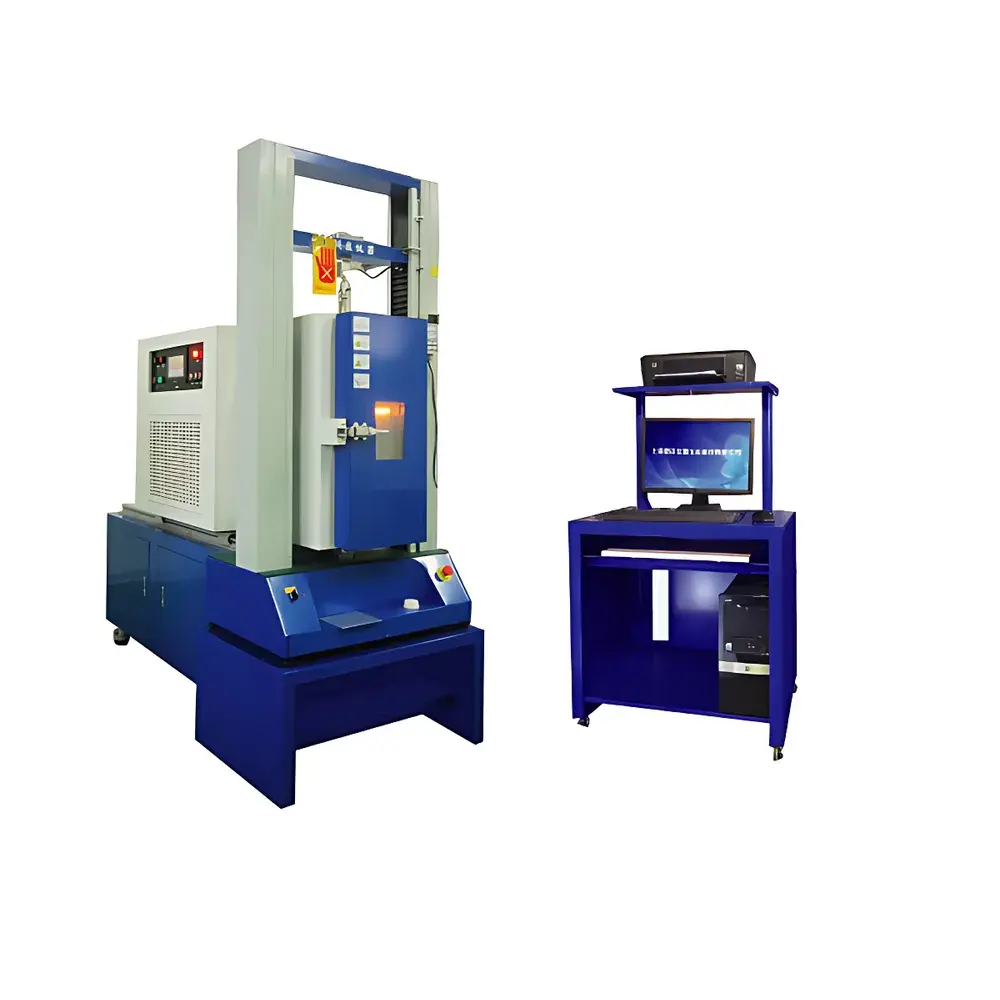
High-Temperature Flexural Strength Tester QJ211B
| Model | High-Low Temperature Series |
|---|---|
| Price | USD 9,400 |
| Max Test Load | 30 kN |
| Crosshead Speed Range | 0.01–500 mm/min |
| Load Cell Accuracy | ±0.01% FS |
| Force Measurement Uncertainty | < ±0.5% |
| Displacement & Strain Measurement Accuracy | ±0.5% |
| Temperature Range | –7 °C to +350 °C (Stable at 350 °C) |
| Heating Rate | ≥5 °C/min |
| Temperature Controller Resolution | 0.1 °C |
| Effective Test Width | 420 mm |
| Usable Test Height | ~800 mm (extendable) |
| Speed Accuracy | ±0.5% |
| Safety Features | Electronic Overtravel Limit Switches, Emergency Stop Button |
| Machine Weight | 265 kg) |
Overview
The QJ211B High-Temperature Flexural Strength Tester is an electromechanical universal testing system engineered for precise flexural, compressive, tensile, and bending characterization of structural and functional materials under controlled thermal environments. It integrates a servo-controlled loading frame with a high-stability environmental chamber capable of sustained operation up to 350 °C—enabling direct measurement of temperature-dependent mechanical behavior in accordance with fundamental principles of beam bending theory (e.g., three-point and four-point flexure per ASTM C1161, ISO 14704, and GB/T 6569). Unlike ambient-only testers, the QJ211B maintains thermal equilibrium during load application, eliminating thermally induced drift in displacement and force signals. Its modular chamber design allows rapid detachment for room-temperature testing—preserving test space integrity and facilitating multi-condition comparative studies without hardware reconfiguration.
Key Features
- Robust dual-column frame with 30 kN rated capacity and high rigidity to minimize deflection-induced error during high-load flexural tests at elevated temperatures
- Integrated high-temperature environmental chamber featuring PID-controlled heating elements, forced-air circulation, and real-time thermal mapping across specimen zone
- High-resolution load cell calibrated to ±0.01% full scale, traceable to national metrological standards (CNAS-accredited calibration available)
- Precision crosshead drive with closed-loop servo control delivering speed accuracy within ±0.5% across full range (0.01–500 mm/min)
- Optimized test geometry: 420 mm effective width and 800 mm standard test height—expandable to accommodate large ceramic tiles, refractory bricks, or composite laminates
- Dual-mode operation: fully computer-controlled via dedicated test software or manual digital panel interface for quick verification and setup validation
- Comprehensive safety architecture including dual-channel electronic limit switches, hardware-based emergency stop circuitry, and thermal runaway protection
Sample Compatibility & Compliance
The QJ211B supports standardized flexural test specimens per ASTM C1161 (advanced ceramics), ISO 14704 (fine ceramics), JIS R1601 (refractories), and GB/T 6569 (Chinese national standard for engineering ceramics). It accommodates rectangular bars (e.g., 3×4×45 mm, 6×6×50 mm), cylindrical rods, and thin-section composites. Specimen holders are fabricated from Inconel 600 to retain mechanical integrity above 300 °C. The system complies with ISO/IEC 17025 requirements for test equipment qualification and supports audit-ready documentation for GLP and GMP-regulated environments. All force, displacement, and temperature data streams meet FDA 21 CFR Part 11 criteria when paired with validated software configuration.
Software & Data Management
Bundled with PC-based test control and analysis software supporting real-time acquisition of load–displacement–temperature triple-parameter curves. Software modules include automated test sequence scripting, multi-curve overlay comparison, modulus calculation (initial tangent, secant), fracture strength extraction, and Weibull statistical analysis for brittle materials. Raw data export is provided in CSV, Excel, and XML formats compliant with LIMS integration protocols. Audit trail functionality records operator ID, timestamp, parameter changes, and calibration events—fully traceable for regulatory submissions. Optional upgrade includes networked remote monitoring and centralized fleet management for multi-instrument labs.
Applications
- High-temperature flexural strength evaluation of oxide and non-oxide ceramics (Al2O3, SiC, ZrO2) used in aerospace thermal protection systems
- Thermo-mechanical performance assessment of refractory linings in metallurgical furnaces and cement kilns
- Creep-flexure coupling analysis of glass-ceramic sealants in solid oxide fuel cells (SOFCs)
- Quality assurance testing of sintered metal matrix composites (MMCs) subjected to thermal cycling
- R&D of polymer-derived ceramics (PDCs) where degradation onset correlates with flexural modulus loss above 200 °C
- Validation of ASTM E2929–22 (Standard Guide for Mechanical Testing of Ceramic Matrix Composites at Elevated Temperatures)
FAQ
Does the QJ211B support four-point bending per ASTM C1211?
Yes—the base configuration includes interchangeable fixtures for both three-point and four-point flexure geometries, with alignment verification tools supplied.
Can the temperature chamber be upgraded for vacuum or inert gas purging?
Vacuum-compatible variants (up to 10−2 mbar) and argon/nitrogen purge ports are available as factory-installed options with modified sealing and feedthroughs.
Is third-party calibration certification included with delivery?
A NIST-traceable calibration certificate for load and displacement channels is provided; temperature calibration per ASTM E220 is optional and performed on-site by certified technicians.
What maintenance intervals are recommended for long-term stability at 350 °C?
Load cell and encoder recalibration every 12 months; chamber heater resistance check and thermocouple verification every 6 months; lubrication of lead screws per ISO 13849–1 guidelines.



