
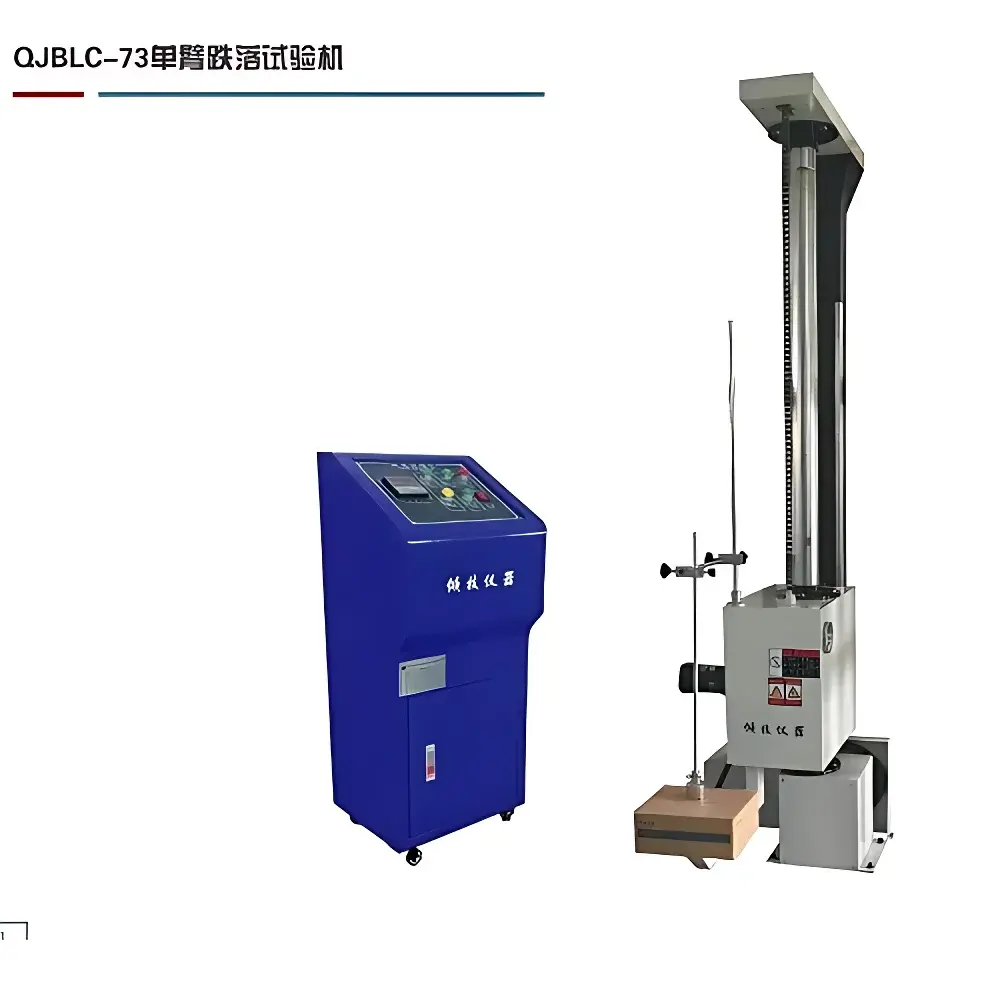
QJBLC-73 Plastic Packaging Drop Testing Machine
| Origin | Shanghai, China |
|---|---|
| Manufacturer Type | Authorized Distributor |
| Origin Category | Domestic (PRC) |
| Model | QJBLC-73 |
| Price | USD 4,200 (FOB Shanghai) |
| Drop Height Range | 300–2000 mm |
| Max. Specimen Weight | 60 kg |
| Max. Specimen Dimensions | 1000 × 800 × 800 mm |
| Drop Surface Dimensions | 1700 × 1200 × 3015 mm |
| Height Display Accuracy | ≤ ±2% of set value |
| Drop Angle Tolerance | ≤ ±5° |
| Drive Motor | 0.37 kW (1/2 HP), AC induction |
| Power Supply | AC 380 V, 50 Hz, 10 A |
| Machine Weight | 435 kg |
| Accuracy Class | Grade 1 or higher |
| Test Orientation | Face, Edge, and Corner Drop |
| Height Indication | LED digital display |
| Compliance Standards | ISO 2248, JIS Z 0202-1987, GB/T 4857.5–1992 |
Overview
The QJBLC-73 Plastic Packaging Drop Testing Machine is an electromechanically actuated, gravity-driven impact tester engineered for standardized evaluation of package integrity under free-fall conditions. It operates on the principle of controlled gravitational acceleration to simulate real-world handling shocks encountered during logistics, warehousing, and distribution—particularly relevant for flexible plastic packaging, pouches, stand-up bags, and laminated film containers. Unlike pneumatic or servo-hydraulic drop systems, the QJBLC-73 employs a robust electromagnetic release mechanism coupled with precision-guided vertical rails to ensure repeatable specimen release without pre-tension or kinetic interference. Its design conforms to the fundamental test geometry and energy equivalence requirements defined in ISO 2248 (Packaging — Complete, filled transport packages — Vertical impact test by dropping) and its national equivalents, including GB/T 4857.5–1992 and JIS Z 0202-1987. The machine supports three distinct drop orientations—flat face, edge, and corner—enabling comprehensive assessment of structural weak points in asymmetric or non-rigid packaging configurations.
Key Features
- Three-axis orientation capability: Programmable face, edge, and corner drop sequences via manual fixture repositioning and calibrated angular alignment jigs
- LED digital height indicator with real-time feedback and ≤ ±2% deviation from nominal setpoint across full 300–2000 mm range
- Guided vertical drop column system with hardened steel linear rails and low-friction polymer bushings for consistent descent trajectory
- Reinforced steel frame structure (435 kg total mass) providing inertial stability during high-energy impacts up to 1,176 J (60 kg × 2 m × 9.81 m/s²)
- Adjustable specimen retention platform accommodating irregular geometries within 1000 × 800 × 800 mm envelope
- Drop surface assembly: 1700 × 1200 mm rigid steel plate mounted on calibrated shock-absorbing elastomeric mounts to meet ISO-defined hardness and rebound specifications
- Electromagnetic release solenoid with fail-safe spring-return design, compliant with IEC 60204-1 safety standards for industrial machinery
Sample Compatibility & Compliance
The QJBLC-73 accommodates a broad spectrum of plastic-based consumer and industrial packaging formats—including heat-sealed polyethylene (PE), polypropylene (PP), metallized polyester (PET-Al), and multilayer coextruded barrier pouches—without requiring custom fixtures. Specimens up to 60 kg and 1000 × 800 × 800 mm are secured using adjustable clamping bars and non-marring rubber-faced grips to prevent slippage or deformation prior to release. All mechanical tolerances—including angular deviation (≤ ±5°), height repeatability, and release timing jitter—are verified per ISO/IEC 17025-accredited calibration protocols. The system meets essential requirements for GLP-compliant packaging validation workflows, supporting audit-ready documentation for ISO 9001:2015, IATF 16949, and FDA-regulated medical device packaging (21 CFR Part 820). Test reports generated include timestamped operator ID, specimen ID, drop sequence log, and environmental ambient conditions (optional hygrothermic monitoring integration available).
Software & Data Management
While the QJBLC-73 operates as a standalone electromechanical tester without embedded microprocessor control, it integrates seamlessly with external laboratory data acquisition systems via RS-232 serial interface (optional TTL-level output module). Height settings, drop count, orientation mode, and operator credentials can be logged externally using validated LIMS or MES platforms compliant with FDA 21 CFR Part 11 requirements. Optional USB-connected digital height verification sensors and high-speed impact force transducers (up to 10 kHz sampling) enable advanced kinetic energy profiling and coefficient-of-restitution analysis. Calibration certificates traceable to NIM (National Institute of Metrology, China) or NIST-equivalent reference standards are provided with each unit shipment.
Applications
- Validation of seal strength and delamination resistance in thermoformed blister packs and retort pouches
- Comparative durability screening of mono-material vs. multilayer recyclable packaging architectures
- Transport simulation for e-commerce fulfillment centers handling lightweight plastic mailers and padded envelopes
- Regulatory submission support for UN 4G certification testing of hazardous material packaging (when combined with certified drop surface hardness verification)
- Root cause analysis of field failure incidents involving puncture, burst, or zipper separation in flexible packaging
- Process capability studies for packaging line changeovers and new material qualification (e.g., bio-based PLA films)
FAQ
What standards does the QJBLC-73 comply with for international shipping validation?
It fully satisfies the mechanical test requirements of ISO 2248, JIS Z 0202-1987, and GB/T 4857.5–1992, all of which align with ISTA 1A and 2A drop test protocols when configured per specified drop heights and orientations.
Can the machine accommodate irregularly shaped or soft-packaged specimens?
Yes—the open-frame architecture and modular clamping system allow secure mounting of non-rigid, inflatable, or asymmetrical packages; optional vacuum-assisted hold-down plates are available for low-bulk-density items.
Is third-party calibration and certification available?
Yes—factory calibration is performed against NIM-traceable height gauges and load cells; optional on-site ISO/IEC 17025-certified recalibration services are offered annually.
What maintenance is required to sustain measurement accuracy over time?
Biannual inspection of rail lubrication, solenoid coil resistance, LED display calibration, and drop surface flatness (verified with grade-0 granite straightedge) is recommended per manufacturer’s technical bulletin TB-QJBLC-73-Rev.4.
Does the system support automated test sequencing or pass/fail logic?
Not natively—but with external PLC or PC-based control integration (via RS-232 or discrete I/O), users can implement programmable multi-drop sequences, auto-height adjustment, and pass/fail flagging based on post-test visual inspection logs.



