
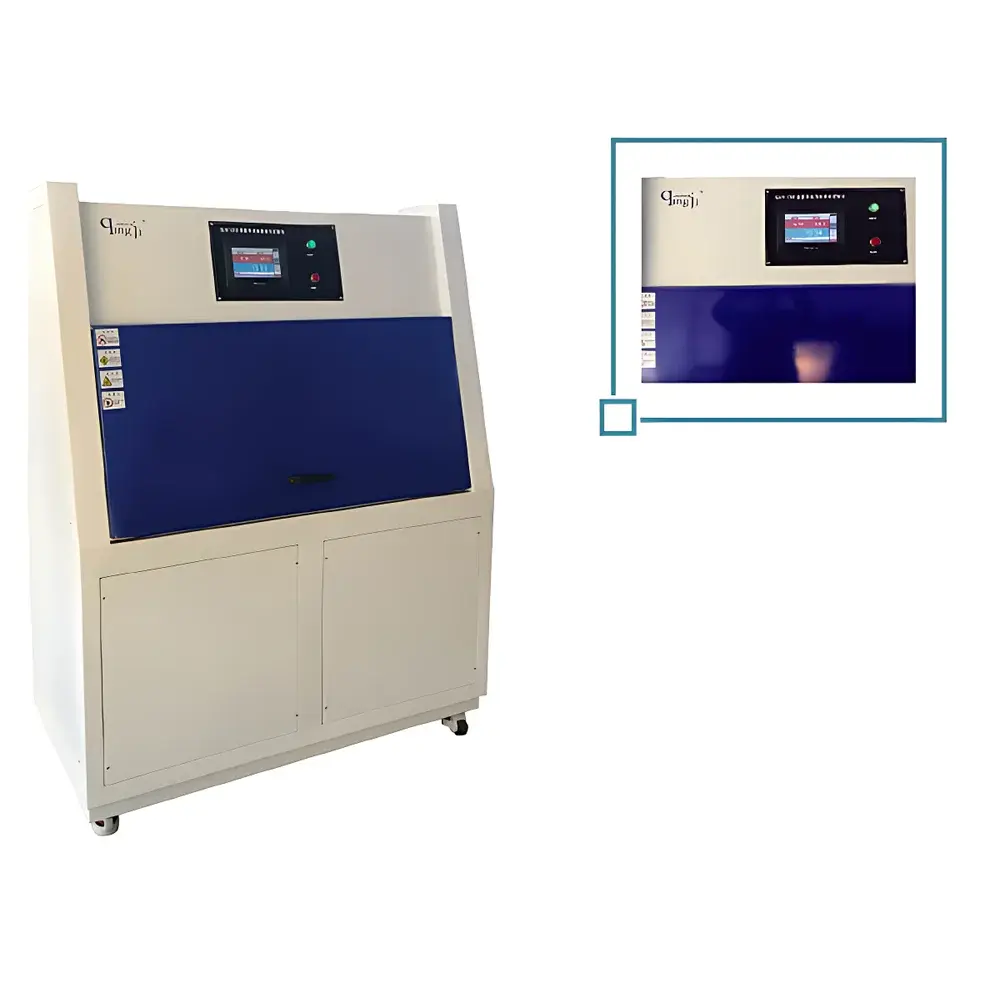
QUV1003 UV Weathering Test Chamber
| Origin | Shanghai, China |
|---|---|
| Manufacturer Type | Authorized Distributor |
| Origin Category | Domestic (PRC) |
| Model | QUV1003 (Spray-Type) |
| Price | USD 7,800 (FOB Shanghai) |
| Cycle Options | 4h UV irradiation + 4h condensation OR 8h UV irradiation + 4h condensation |
| Irradiance | 0.72 W/m² @ 313 nm |
| Lamp Power | 25 W per UV-B lamp |
| Humidity Range | ≥75% RH (condensation mode) |
| Irradiation Temperature Range | RT+10°C to 70°C |
| Black Panel Temperature Range | RT+10°C to 70°C |
| UV Spectrum | UV-B, 280–315 nm |
| Chamber Internal Dimensions (L×W×H) | 450 × 1165 × 500 mm |
Overview
The QUV1003 UV Weathering Test Chamber is an engineered environmental test system designed to accelerate material degradation under controlled ultraviolet radiation, thermal cycling, and moisture condensation—mimicking key outdoor weathering stressors including solar UV exposure, dew formation, and elevated temperature. Based on the fundamental principles of photochemical degradation kinetics, the chamber utilizes calibrated UV-B fluorescent lamps (280–315 nm) to induce polymer chain scission, chromophore breakdown, and oxidative crosslinking in organic materials. Unlike broad-spectrum xenon arc testers, the QUV1003 focuses specifically on the most damaging short-wavelength UV band, enabling high reproducibility in comparative aging studies for coatings, plastics, elastomers, and architectural finishes. Its design conforms to the core operational framework of ASTM G154 (Standard Practice for Operating Fluorescent Ultraviolet (UV) Lamp Apparatus for Exposure of Non-Metallic Materials) and ISO 4892-3 (Plastics — Methods of exposure to laboratory light sources — Part 3: Fluorescent UV lamps), supporting standardized evaluation of color shift, gloss loss, chalking, cracking, and tensile property deterioration.
Key Features
- UV-B fluorescent lamp array (25 W per lamp) with spectral output centered at 313 nm, compliant with ISO 4892-3 spectral classification for UV-B exposure
- Dual-cycle programmability: configurable sequences of 4 h UV irradiation + 4 h condensation or 8 h UV + 4 h condensation, enabling simulation of diurnal humidity cycles
- Precisely regulated black panel temperature control (RT+10°C to 70°C) with ±3°C uniformity, ensuring accurate surface temperature monitoring per ASTM D7869
- Condensation humidity generation via bottom-mounted water reservoir and heated chamber floor—maintaining ≥75% RH during dark/cool phases without external humidification systems
- Optimized lamp-to-specimen geometry: 55 mm specimen-to-lamp distance and 65–70 mm lamp center spacing for uniform irradiance distribution across standard 75 × 150 mm test panels
- Stainless steel 304 inner chamber construction with insulated double-wall housing for thermal stability and corrosion resistance
- Integrated spray function (optional per configuration) for cyclic wetting simulation, aligned with ASTM D5208 protocols for water-induced degradation assessment
Sample Compatibility & Compliance
The QUV1003 accommodates flat-panel specimens up to 75 × 150 mm and thickness ≤10 mm, compatible with standard test frames per ISO 11341 and GB/T 14522–1993. It supports multi-position sample racks for parallel testing of comparative formulations or batch validation. The chamber meets essential requirements for GLP-compliant aging studies when operated with documented calibration logs, lamp replacement tracking, and temperature/humidity verification records. While not inherently 21 CFR Part 11 compliant, its analog/digital control interface allows integration with external data acquisition systems configured for audit-trail-enabled operation in regulated QC environments (e.g., automotive OEM Tier-1 supplier labs, paint R&D centers). All operational parameters—including irradiance intensity, black panel temperature, and cycle timing—are traceable to NIST-traceable reference standards via third-party calibration services.
Software & Data Management
The QUV1003 operates via a microprocessor-based digital controller with real-time display of UV exposure time, black panel temperature, and condensation phase status. Though it does not include embedded PC software, its RS-485 communication port enables connection to external SCADA or LIMS platforms for automated data logging. Users may configure up to 99 programmable test cycles with independent setpoints for irradiation duration, temperature ramp rates, and condensation hold times. Calibration data (lamp irradiance decay, temperature sensor drift) must be manually recorded per ISO/IEC 17025 internal quality procedures. For full regulatory traceability, laboratories are advised to pair the unit with validated external software (e.g., LabVIEW-based custom modules or commercial test management suites) supporting electronic signatures, version-controlled protocols, and raw-data archiving.
Applications
- Accelerated weathering qualification of automotive exterior trim, clearcoats, and polymeric gaskets per SAE J2527 and GMW14124
- UV stability screening of architectural sealants, PVC window profiles, and roofing membranes per ASTM D4329 and EN 1297
- Comparative lifetime prediction of photovoltaic encapsulants and backsheet materials under UV-dominated field conditions
- QC release testing for industrial coatings used in marine, agricultural, and infrastructure applications
- Research into photostabilizer efficacy (HALS, UV absorbers) and synergistic degradation mechanisms in polymer blends
- Validation of accelerated test correlation models against natural exposure data from Florida or Arizona test sites
FAQ
What UV spectrum does the QUV1003 replicate, and why is UV-B emphasized?
The QUV1003 employs UV-B fluorescent lamps emitting between 280–315 nm, targeting the most photochemically active region of terrestrial solar UV. This band drives rapid degradation in polymers and pigments, offering higher acceleration factors than full-spectrum or UV-A-only exposures.
Is the irradiance level adjustable, and how is calibration maintained?
Irradiance is fixed at 0.72 W/m² @ 313 nm per lamp; output decays over time and requires periodic verification using a calibrated UV radiometer. Lamp replacement is recommended every 1,600–2,000 hours of operation to maintain test consistency.
Can the QUV1003 perform water spray cycles, and what water quality is required?
Yes—the QUV1003 (spray-type variant) includes a front-mounted spray nozzle system. Deionized or distilled water (≤5 µS/cm conductivity) is mandatory to prevent mineral deposits on lamps and specimens.
How is temperature uniformity verified across the test plane?
Uniformity is assessed per ASTM G151 Annex A3 using a minimum of nine black panel thermometers distributed across the specimen plane; deviation must remain within ±3°C at setpoint.
Does the chamber meet FDA or ISO 13485 requirements for medical device packaging validation?
While the QUV1003 itself is not certified for medical device use, its operational parameters align with ISO 11607-2 Annex B guidance for accelerated aging of sterile barrier systems—subject to full validation per ISO 11137 and internal protocol documentation.



