
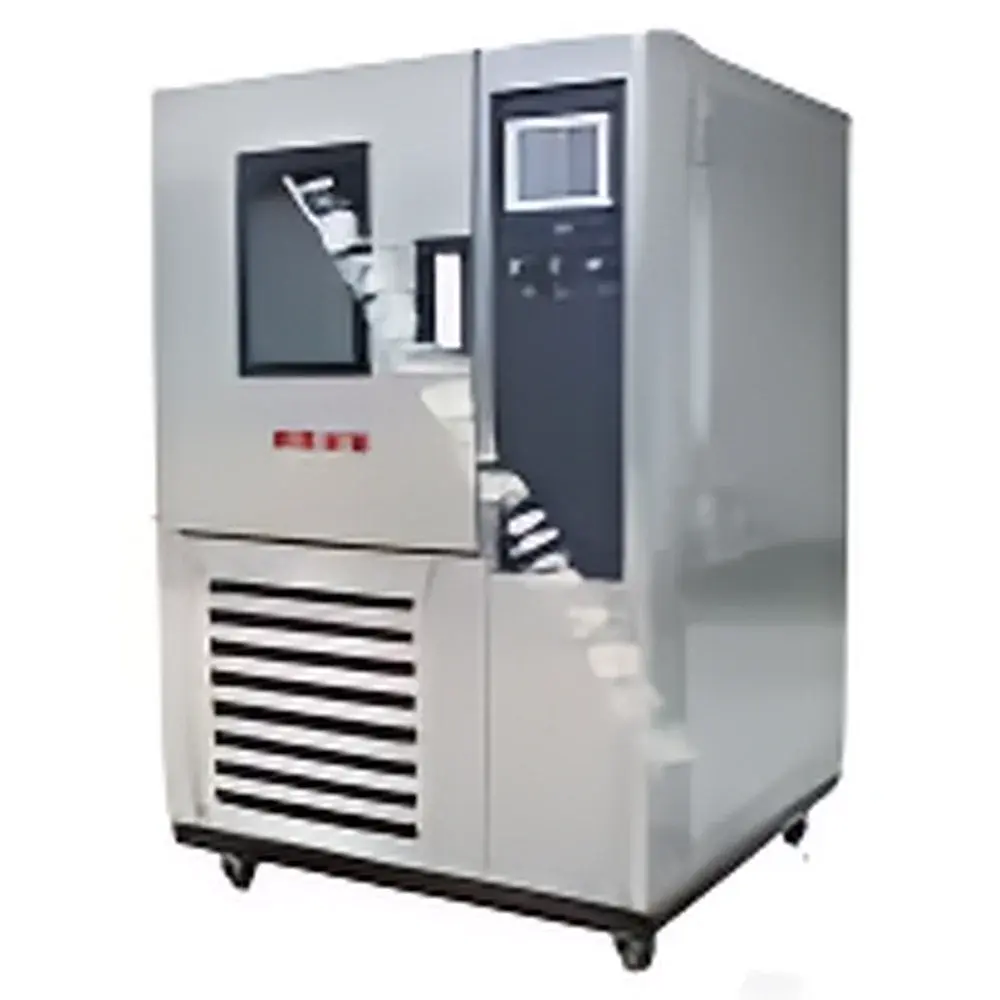
Qingji QJCK-350 Temperature and Humidity Controlled Environmental Test Chamber
| Brand | Qingji |
|---|---|
| Origin | Shanghai, China |
| Model | QJCK-350 |
| Temperature Range | −40 °C to +150 °C |
| Humidity Range | 10 %RH to 99.9 %RH |
| Temperature Resolution | 0.01 °C |
| Humidity Resolution | 0.01 %RH |
| Temperature Uniformity | ±2.0 °C |
| Humidity Uniformity | ±3.0 %RH |
| Temperature Accuracy | ±0.5 °C |
| Humidity Accuracy | ±2.5 %RH |
| Ramp Rates | 30 min (−20 °C → 100 °C), 35 min (20 °C → −40 °C) |
| Interior Dimensions (H×W×D) | 450×400×350 mm |
| Exterior Dimensions (H×W×D) | 1550×920×820 mm |
| Power Supply | 220 V AC |
| Rated Power | 2.0 kW |
| Net Weight | ~180 kg |
| Programmable Cycles | 120 programs / 1200 segments |
| Compliance | Designed for ISO 17025-aligned laboratory environments |
Overview
The Qingji QJCK-350 Temperature and Humidity Controlled Environmental Test Chamber is a precision-engineered climatic simulation system designed to replicate controlled thermal and hygroscopic conditions for accelerated environmental stress testing of materials and components. Operating on the principle of forced-air convection with dual independent PID-controlled refrigeration and humidification subsystems, the chamber delivers stable, repeatable exposure profiles across a wide operational envelope. Its architecture integrates a high-efficiency hermetic compressor, stainless-steel humidifier with ultrasonic mist generation, and a multi-point sensor array calibrated against NIST-traceable references. The system meets foundational requirements for compliance-driven test protocols—including those referenced in IEC 60068-2, MIL-STD-810H, and ASTM D4332—enabling standardized evaluation of product reliability under defined temperature-humidity stress sequences.
Key Features
- Wide operational range: −40 °C to +150 °C temperature control and 10 %RH to 99.9 %RH humidity regulation, supporting both low-temperature desiccation and high-humidity condensation testing
- High-resolution monitoring: 0.01 °C temperature resolution and 0.01 %RH humidity resolution, enabling fine-grained profile definition and deviation tracking
- Programmable test sequencing: Up to 120 distinct test programs, each containing up to 100 individual segments (1200 total segments), with ramp/hold/soak capability and automatic cycle repetition
- Uniformity-optimized airflow: Vertically oriented centrifugal blower system with adjustable baffle configuration ensures ±2.0 °C temperature uniformity and ±3.0 %RH humidity uniformity across the full working volume
- Dual-sensor redundancy: Independent platinum resistance thermometers (PT100) and capacitive RH sensors with real-time drift compensation algorithms
- Robust mechanical construction: Inner chamber fabricated from 304 stainless steel; outer enclosure with powder-coated cold-rolled steel; double-layer insulated door with magnetic seal and anti-condensation heater
- Integrated safety architecture: Over-temperature cutoff, compressor high-pressure protection, water-level monitoring, and door-open interlock with automatic system pause
Sample Compatibility & Compliance
The QJCK-350 accommodates a broad spectrum of sample types—including PCB assemblies, polymer housings, lithium-ion battery cells, optical lenses, pharmaceutical packaging, and aerospace-grade composites—within its 63 L internal volume (450×400×350 mm). Its chamber geometry and airflow design minimize localized thermal gradients, ensuring representative exposure for stacked or multi-tiered fixtures. While not certified to UL or CE as a standalone appliance, the chamber is engineered to support laboratories operating under ISO/IEC 17025 accreditation frameworks. Its programmable logic and data logging functionality align with Good Laboratory Practice (GLP) and Good Manufacturing Practice (GMP) expectations for audit-ready test records. When paired with validated external calibration services, the system supports traceable compliance with USP , ICH Q5C, and ISO 14644-3 environmental monitoring requirements.
Software & Data Management
The embedded controller features a 7-inch TFT-LCD touchscreen interface with multilingual support (English, German, Japanese, Chinese) and intuitive drag-and-drop program editing. All operational parameters—including setpoints, actual values, alarms, and event logs—are timestamped and stored internally for ≥30 days. Data export is supported via USB 2.0 (CSV format) or optional RS-485 Modbus RTU interface for integration into centralized LIMS or SCADA platforms. The system generates automated test reports compliant with 21 CFR Part 11–ready configurations when used with third-party electronic signature modules. Audit trail functionality records user login/logout events, parameter modifications, and program execution history with immutable timestamps—facilitating regulatory review and internal quality audits.
Applications
- Electronics reliability validation: Thermal cycling, damp heat (85 °C/85 %RH), and cold storage simulation per JEDEC JESD22-A104 and A110
- Automotive component qualification: Climate endurance testing of connectors, sensors, and infotainment modules per SAE J2412 and VW 80101
- Pharmaceutical stability studies: Long-term and accelerated storage condition assessment in accordance with ICH Q1A(R2)
- Polymer aging analysis: Hydrolytic degradation, dimensional stability, and tensile property drift under cyclic humidity exposure
- Aerospace material screening: Composite matrix compatibility with tropical and arctic environmental profiles defined in RTCA DO-160 Section 4
- Quality assurance for medical devices: Packaging integrity verification under worst-case transport and storage conditions per ISO 11607-1
FAQ
What is the standard calibration interval recommended for the QJCK-350?
Annual calibration against accredited reference standards is recommended; however, intervals may be adjusted based on usage frequency, criticality of application, and internal quality procedures aligned with ISO/IEC 17025 Clause 6.6.
Can the chamber operate continuously at −40 °C and 10 %RH simultaneously?
Yes—the refrigeration and dehumidification systems are decoupled and independently controllable, allowing simultaneous extreme low-temperature and low-humidity operation without condensation risk or compressor overload.
Is remote monitoring supported out-of-the-box?
The base configuration includes local HMI only; Ethernet or Wi-Fi connectivity requires optional hardware add-ons and compatible firmware revision, which must be specified at time of order.
Does the system include validation documentation (IQ/OQ/PQ)?
Factory-issued Installation Qualification (IQ) and Operational Qualification (OQ) templates are provided. Performance Qualification (PQ) must be executed by the end user or authorized service partner using site-specific load and sensor mapping.



