
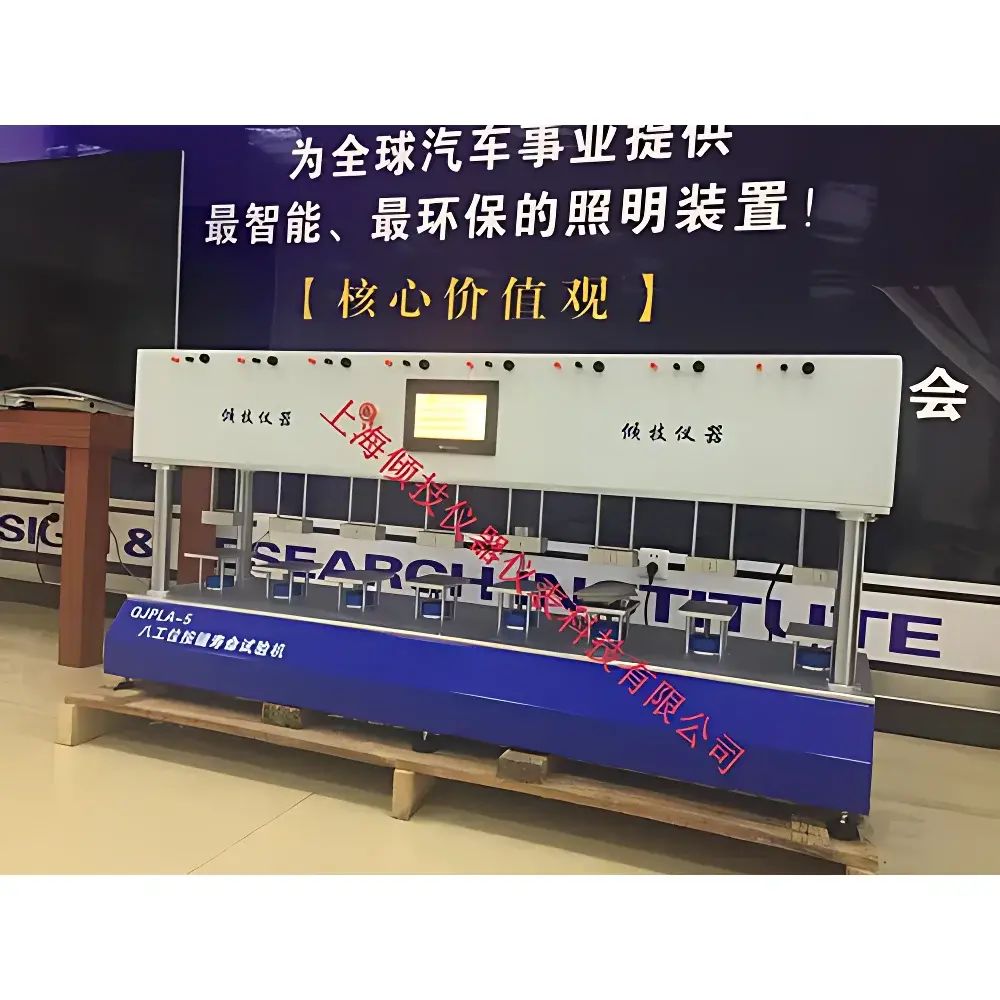
Qinji QJPLA-5 Eight-Station Keypad Fatigue Life Testing Machine
| Brand | Qinji |
|---|---|
| Origin | Shanghai, China |
| Model | QJPLA-5 |
| Test Stations | 8 |
| Force Range | 50 g, 100 g, 200 g, 300 g (standard calibrated weights) |
| Frequency Range | 1–360 cycles/min |
| Vertical Stroke | 10 mm (adjustable up to 50 mm) |
| Test Platform Dimensions | 80 mm × 80 mm |
| Stroke Adjustment Range | 0–150 mm (test probe mounting height) |
| Electrical Continuity Monitoring | integrated real-time conductivity detection with automatic halt on open-circuit failure |
| Actuation Mechanism | linear bearing-guided vertical compression system |
| Cycle Counter | 8-digit presettable counter (max 99,999,999 cycles) |
| Power Supply | 220 V AC, 50 Hz |
| Warranty | 12 months comprehensive |
Overview
The Qinji QJPLA-5 Eight-Station Keypad Fatigue Life Testing Machine is a precision-engineered electromechanical test system designed for accelerated durability evaluation of tactile input components—primarily membrane switches, rubber dome keypads, mechanical pushbuttons, and capacitive touch overlays used in consumer electronics, industrial control panels, medical devices, and automotive human-machine interfaces (HMIs). It operates on the principle of controlled repetitive compression loading, where discrete mechanical actuation events simulate end-user interaction under defined force, frequency, and displacement parameters. Unlike generalized servo-hydraulic fatigue testers, the QJPLA-5 employs a dedicated linear bearing–guided vertical actuator architecture optimized for low-force, high-cycle-count testing (up to 107 cycles), ensuring minimal hysteresis, repeatable stroke fidelity, and long-term kinematic stability across all eight independent test stations.
Key Features
- Eight parallel test stations enable concurrent evaluation of identical or heterogeneous keypad samples—significantly reducing total qualification time while maintaining inter-channel synchronization.
- Adjustable actuation frequency from 1 to 360 cycles per minute, programmable in 1-cycle increments, supports both slow-cycle validation (e.g., 5–20 cpm for medical device compliance) and accelerated life testing (e.g., 300+ cpm for production line screening).
- Standardized force application via traceable stainless-steel calibration weights (50 g, 100 g, 200 g, 300 g), eliminating reliance on pneumatic or motor-torque-based load control—ensuring metrological consistency and eliminating drift over extended test durations.
- Real-time electrical continuity monitoring across all channels: integrated circuitry detects loss of conductivity (e.g., contact separation, dome collapse, or silver ink fracture) and triggers immediate test termination with timestamped event logging.
- Precision linear bearing motion system ensures sub-micron repeatability in vertical stroke (10 mm nominal, adjustable up to 50 mm), minimizing lateral deviation and preventing skewed actuation that could compromise failure mode fidelity.
- Eight-digit programmable cycle counter (00000001–99999999) with non-volatile memory retention, supporting multi-phase test protocols and intermediate pause/resume functionality without data loss.
Sample Compatibility & Compliance
The QJPLA-5 accommodates standard keypad formats with mounting footprints up to 80 mm × 80 mm and accommodates variable button heights via its 0–150 mm vertical probe adjustment range. Its modular fixture interface allows adaptation to custom jigs for curved surfaces, recessed keys, or backlit assemblies. While not certified to ISO 17025 as a standalone measurement instrument, the system supports adherence to industry-relevant durability standards including IEC 60659 (switches for household appliances), UL 61058-1 (electromechanical control equipment), and internal OEM specifications aligned with AEC-Q200 stress test profiles. Data output is structured for traceability in GLP/GMP environments, with cycle count, stop reason (e.g., “open circuit at 428,193 cycles”), and timestamp logged per station.
Software & Data Management
The QJPLA-5 operates via embedded microcontroller firmware with no external PC dependency. All configuration—including target cycle count, force selection, frequency setpoint, and pass/fail logic—is performed through an intuitive front-panel keypad and LCD interface. Cycle logs are stored internally and exportable via USB flash drive in CSV format, containing columns: Station ID, Start Time, End Time, Total Cycles, Termination Code (0 = manual stop, 1 = limit reached, 2 = continuity failure), and Duration (hh:mm:ss). Audit trail integrity is maintained through write-once firmware logging; no user-editable fields exist in raw output files—supporting basic FDA 21 CFR Part 11 alignment for electronic records in regulated manufacturing settings.
Applications
- Qualification of membrane switch stacks prior to automotive dashboard integration (ISO 16750-3 vibration correlation).
- Production-line 100% functional endurance screening of medical device control panels (IEC 62304 Class B software-controlled systems).
- Comparative analysis of dome material fatigue resistance (stainless steel vs. polyester vs. polyimide).
- Validation of adhesive bond integrity between overlay films and PCB-mounted contacts under thermal cycling preconditioning.
- Root cause analysis of intermittent failures in consumer IoT device keypads using synchronized video capture (via optional external camera trigger output).
FAQ
Does the QJPLA-5 support variable force profiles (e.g., ramped or pulsed loading)?
No. Force is applied statically via calibrated deadweights; dynamic force modulation is outside its design scope.
Can test data be integrated into LabVIEW or Python-based QA systems?
Yes—CSV exports are natively compatible with Pandas, MATLAB, and LabVIEW file I/O functions; no proprietary drivers required.
Is calibration certification included with shipment?
A factory-issued calibration report referencing NIST-traceable mass standards is provided; annual recalibration is recommended per ISO/IEC 17025 guidelines.
What maintenance intervals are advised for sustained operation?
Linear bearings require light lubrication every 500,000 cycles; weight sets should be verified annually using Class M2 reference masses.
Are custom fixtures available for non-standard keypad geometries?
Yes—Qinji offers engineering consultation and CNC-machined fixture design services under NDA, with lead time typically 3–4 weeks.



