
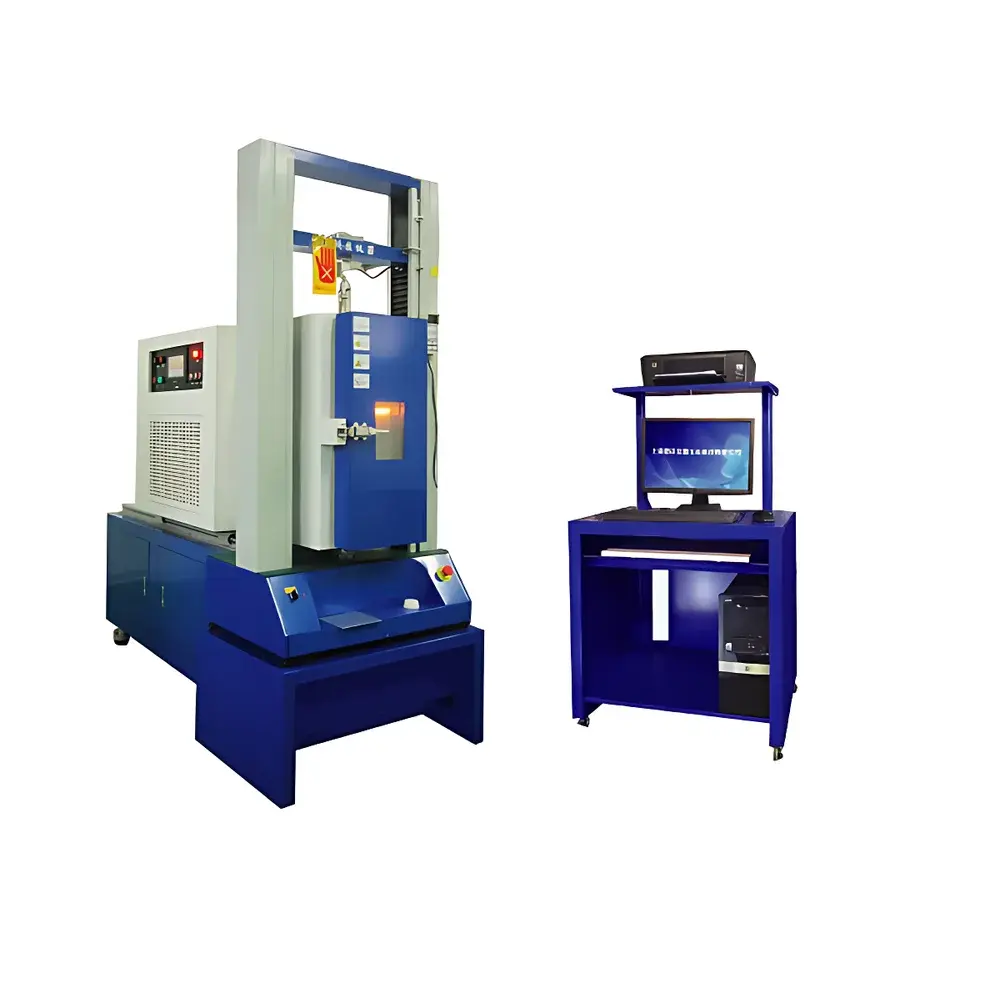
QJ211B Universal Tensile Testing Machine with Integrated Environmental Chamber
| Origin | Shanghai, China |
|---|---|
| Manufacturer Type | Authorized Distributor |
| Origin Category | Domestic (China) |
| Model | QJ211B |
| Price | USD 7,700 (FOB Shanghai) |
| Instrument Type | Electromechanical Universal Testing Machine |
| Max Test Load | 30 kN |
| Load Range | 0–30 kN (full-scale, selectable) |
| Load Accuracy | ±1.0% or ±0.5% FS |
| Crosshead Travel | 420 mm |
| Displacement Resolution | ±0.5% of reading |
| Temperature Range | −70 °C to +350 °C (isothermal capability at 350 °C) |
| Heating/Cooling Rate | ≥5 °C/min |
| Temperature Controller Resolution | 0.1 °C |
| Test Speed Range | 0.001–500 mm/min (optional extension to 1000 mm/min) |
| Speed Accuracy | ±0.5% |
| Extensometer Compatibility | Yes (optional) |
| Safety Features | Dual electronic limit switches, emergency stop circuit |
| Machine Weight | 135 kg |
| Effective Test Width | 420 mm |
| Usable Test Height | ~800 mm (extendable) |
Overview
The QJ211B Universal Tensile Testing Machine with Integrated Environmental Chamber is an electromechanical materials testing system engineered for high-fidelity mechanical characterization of adhesives, elastomers, composites, polymers, and thin films under controlled thermal conditions. It operates on the principle of servo-controlled axial force application via a precision ball-screw-driven crosshead, coupled with real-time load cell feedback and synchronized environmental conditioning. Unlike ambient-only tensile testers, the QJ211B integrates a vertically mounted, independently controlled temperature chamber—capable of stable operation from −70 °C to +350 °C—enabling standardized evaluation of viscoelastic transitions, cold-brittle points, heat-activated bonding strength, and thermal degradation kinetics. Its modular architecture allows rapid detachment of the environmental chamber for high-throughput room-temperature testing (e.g., peel, shear, and tensile strength per ASTM D1002, ISO 4587, or GB/T 7124), thereby optimizing lab space utilization and workflow flexibility.
Key Features
- High-stability dual-zone thermal chamber with independent PID control, achieving ±1.0 °C uniformity across specimen zone at 350 °C and ≤±0.5 °C stability at sub-zero setpoints
- 30 kN load frame with overload protection, calibrated against NIST-traceable standards; optional high-resolution load cells (0.01% FS linearity) available for low-force adhesive peel and tack measurements
- Real-time displacement measurement via high-resolution encoder (±0.5% of reading), compatible with clip-on extensometers for strain-controlled protocols (e.g., ISO 527-2, ASTM D638)
- Full PC-based control interface supporting programmable multi-step test profiles—including ramp-hold-relax, cyclic loading, and creep compliance—with synchronized thermal ramping
- Modular chamber design enables tool-free removal in <90 seconds, converting the system into a dedicated ambient universal tester without recalibration
- Dual safety architecture: hardware-based emergency stop with redundant contactors and software-enforced travel limits compliant with ISO 12100 mechanical safety principles
Sample Compatibility & Compliance
The QJ211B accommodates standard adhesive test geometries including lap-shear (ASTM D1002), T-peel (ASTM D1876), 180° peel (ASTM D903), and compression-shear specimens per ISO 4587 and GB/T 7124. Specimen clamping supports pneumatic, wedge, and hydraulic grips (optional) with adjustable pressure up to 2 MPa. The system meets essential requirements of ISO/IEC 17025 for calibration traceability, supports audit-ready data export in CSV and XML formats, and complies with GLP documentation workflows. All firmware and software modules are validated per ICH Q9 risk management principles and support 21 CFR Part 11-compliant user access controls when configured with electronic signatures and audit trails.
Software & Data Management
The embedded Windows-based testing software provides ISO 17025-aligned data acquisition at up to 100 Hz sampling rate, with automatic calculation of modulus, elongation at break, yield point, and energy-to-break. Raw data files include metadata tags for operator ID, environmental chamber status, calibration certificate IDs, and timestamped thermal profiles. Export functions generate PDF reports with embedded graphs, statistical summaries (n ≥ 5), and pass/fail flags based on user-defined acceptance criteria. Data integrity is ensured through write-once-read-many (WORM) archive mode, SHA-256 hash verification, and optional integration with LIMS platforms via OPC UA or RESTful API.
Applications
- Quantifying temperature-dependent cohesive strength and interfacial fracture energy of structural adhesives in aerospace bonding (e.g., epoxy-aluminum joints at −55 °C and +120 °C)
- Evaluating hot-melt adhesive performance during automotive interior assembly—measuring melt viscosity transition onset and bond strength recovery post-cooling
- Validating medical-grade silicone adhesive biocompatibility per ISO 10993-10 through controlled peel testing at body temperature (37 °C) and sterilization-cycle stress (121 °C steam exposure)
- Characterizing thermoplastic polyurethane (TPU) film delamination resistance under thermal cycling (−40 °C ↔ +85 °C) per IPC-9701A
- Supporting formulation R&D for UV-curable acrylates by correlating glass transition (Tg) shifts—measured via dynamic mechanical analysis (DMA)-mode testing—with crosslink density
FAQ
Does the QJ211B meet ASTM D1002 and ISO 4587 requirements for adhesive shear testing?
Yes—the system’s rigid frame stiffness (>1.2 × 10⁶ N/mm), axial alignment tolerance (<0.02 mm/m), and load cell resolution satisfy the mechanical prerequisites of both standards. Chamber-integrated fixtures maintain specimen parallelism within ±0.1° across the full temperature range.
Can the environmental chamber be replaced with a custom-designed humidity-controlled unit?
Yes—chamber mounting interfaces conform to ISO 2041:2018 mechanical coupling specifications. Third-party humidity chambers (e.g., 10–95% RH, ±2% RH accuracy) may be integrated upon validation of thermal-electrical isolation and data synchronization latency (<50 ms).
Is remote diagnostics and firmware updates supported?
Yes—via secure TLS 1.3 encrypted connection. Firmware updates require dual-operator authentication and generate immutable update logs compliant with FDA 21 CFR Part 11 Annex 11.
What calibration documentation is provided at shipment?
A full calibration certificate issued by an ILAC-MRA accredited laboratory, covering load (0.5–30 kN), displacement (0–420 mm), and temperature (−70 °C to +350 °C), with uncertainty budgets traceable to NIM (China) and NIST (USA).
How is thermal gradient management handled during rapid temperature transitions?
The chamber employs asymmetric heating/cooling manifolds with adaptive power modulation, limiting axial thermal gradients across the gauge length to ≤0.8 °C/mm during 5 °C/min ramps—verified per ASTM E220.



