
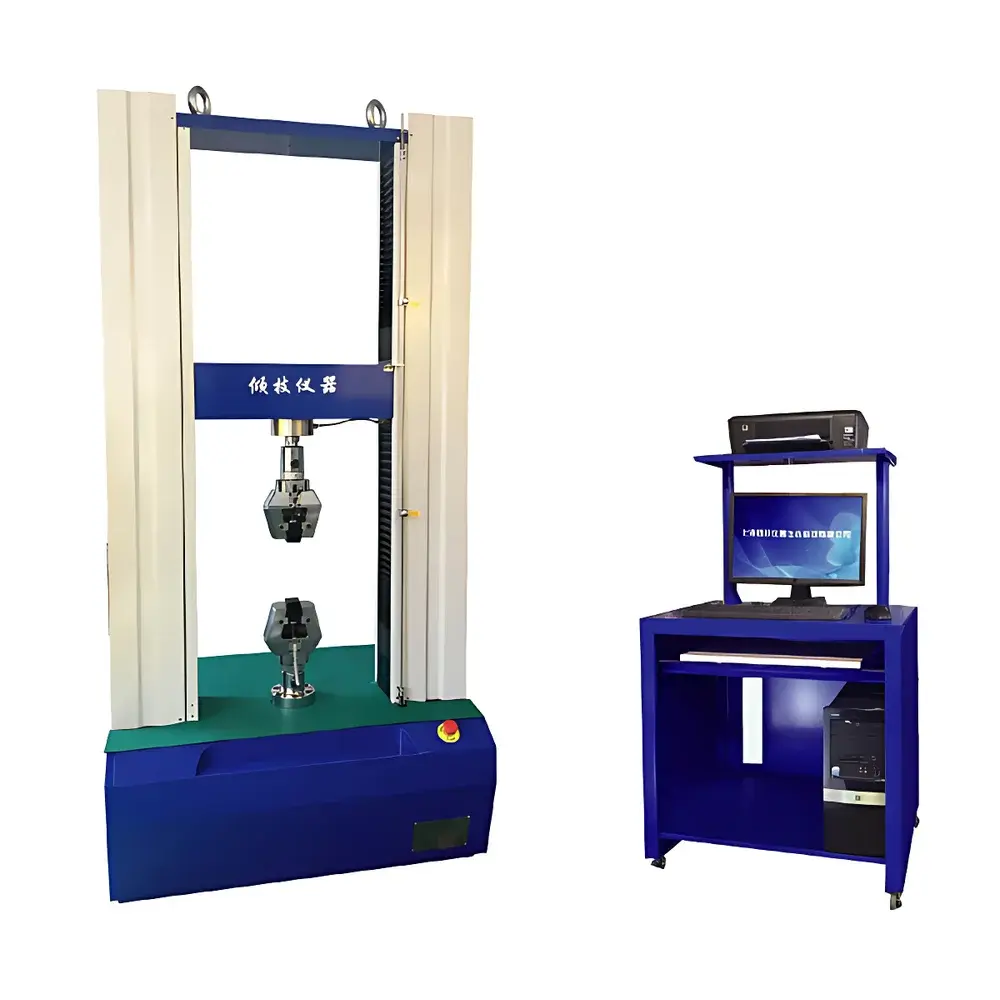
QJ212C Universal Tensile Testing Machine for Wire Harnesses and Welded Components
| Origin | Shanghai, China |
|---|---|
| Manufacturer Type | Authorized Distributor |
| Country of Origin | China |
| Model | QJ212C |
| Price | USD 9,400 (FOB Shanghai) |
| Instrument Type | Electromechanical Universal Testing Machine |
| Max Test Load | 50 kN |
| Load Range | 0–50 kN (full-scale, selectable sub-ranges) |
| Load Accuracy | ±0.5% of reading |
| Crosshead Travel | 500 mm |
| Displacement Resolution | ±0.5% of indicated value |
| Load Cell Options | 10 kN / 20 kN / 30 kN / 50 kN |
| Force Resolution | 1 part in 250,000 (fixed, no range switching) |
| Effective Test Width | 500 mm |
| Effective Tensile Stroke | 600 mm or 800 mm (configurable) |
| Test Speed | 5–300 mm/min (continuously adjustable) |
| Speed Accuracy | ±1% of set value |
| Displacement Measurement Accuracy | ±1% of reading |
| Strain/Deformation Measurement Accuracy | ±1% of reading |
| Crosshead Vertical Adjustment | Dual-speed (fast/slow), jog-enabled |
| Safety Protection | Electronic travel limit switches, overload protection (110% FS), emergency stop |
| Return Mode | Manual rapid return or automatic post-test return |
| Motor Power | 4 kW |
| Dimensions (W×D×H) | 960 × 650 × 2000 mm |
| Net Weight | ~85 kg |
| Compliance | ISO 7500-1, ASTM E4, ASTM D638, ASTM D3039, ISO 527, ISO 6892-1, JIS Z2241, GB/T 228.1 |
Overview
The QJ212C Universal Tensile Testing Machine is an electromechanical testing system engineered for high-reproducibility mechanical characterization of wire harness assemblies, spot-welded joints, crimped terminals, soldered interconnects, and other electrically integrated structural components. It operates on the principle of controlled uniaxial force application via a precision servo-motor-driven crosshead, with real-time measurement of load (via calibrated S-type or cantilever load cells), displacement (via high-resolution encoder), and optional strain (via extensometer or video-based DIC). Designed to meet international metrological standards—including ISO 7500-1 (class 0.5 accuracy), ASTM E4 (verification of force-measuring systems), and ISO 6892-1 (tensile testing of metallic materials)—the system delivers traceable, audit-ready data suitable for quality assurance, supplier qualification, and regulatory documentation under ISO 9001, IATF 16949, and APQP Phase 3 validation protocols.
Key Features
- Full-range force resolution of 1:250,000 without auto-ranging—ensuring consistent sensitivity across 0.5% to 100% of full scale (e.g., 50 kN)
- Dual-mode crosshead control: precise jog operation for specimen alignment + programmable speed ramping (5–300 mm/min) for quasi-static and creep-sensitive tests
- Integrated electronic safety architecture: dual-channel position limit detection, hardware-based overload cutoff (110% FS), and emergency stop circuit compliant with EN ISO 13850
- Modular load cell support: interchangeable 10/20/30/50 kN transducers calibrated per ISO 376, each with individual NIST-traceable certificate
- Thermally stable aluminum test frame (960 × 650 × 2000 mm) with reinforced column geometry to minimize deflection under peak load
- Windows-based control software with real-time multi-curve overlay, dynamic scaling, and synchronized event tagging (e.g., yield point, necking onset, fracture)
Sample Compatibility & Compliance
The QJ212C accommodates standardized and custom specimens per ISO 527-2 (plastics), ASTM D638 (tensile properties of plastics), ASTM D3039 (composite laminates), and automotive-specific standards including USCAR-21 (wire harness pull tests) and VW 60330 (weld joint strength evaluation). Grip configurations include pneumatic wedge grips (for flat cables), serrated vise jaws (for busbars), and custom fixture interfaces for multi-pin connectors and PCB-mounted welds. All test methods are pre-configured to comply with GLP/GMP data integrity requirements: audit trails record user ID, timestamp, parameter changes, and raw channel data—fully compatible with FDA 21 CFR Part 11 when deployed with validated software version and electronic signature module.
Software & Data Management
The embedded Windows 10 Pro platform runs proprietary test control software compliant with ASTM E1318 (standard practice for computerized systems in mechanical testing). Data acquisition occurs at ≥1 kHz sampling rate, with lossless storage of raw analog channels (load, displacement, extensometer) in HDF5 format. Reporting supports customizable templates aligned with ISO/IEC 17025 clause 7.8, exporting PDF reports with embedded metadata (calibration due date, operator ID, environmental conditions). Curve manipulation tools include derivative analysis (dF/dx for stiffness), hysteresis loop integration (for cyclic loading), and statistical batch comparison (ANOVA-ready CSV export). All data files are digitally signed and checksum-verified upon save.
Applications
- Quantification of tensile strength, elongation at break, and yield offset (0.2%) for automotive wire harness bundles subjected to vibration-induced stress
- Shear strength evaluation of resistance spot welds in battery pack interconnects (per ISO 14272)
- Peel adhesion testing of insulated jacket materials per UL 758 and CSA C22.2 No. 210
- Creep rupture analysis of crimped terminal interfaces under sustained 85°C thermal load (IEC 60512-5-1)
- Mechanical validation of laser-welded copper-aluminum dissimilar joints in EV power electronics
- Interlaminar shear strength (ILSS) assessment of flexible printed circuit (FPC) substrates used in ADAS sensor modules
FAQ
Does the QJ212C support ASTM D638 Type I and Type IV specimen geometries?
Yes—the adjustable test width (500 mm) and stroke (600/800 mm) accommodate both standard and extended gauge length specimens, with optional hydraulic wedge grips for high-force polymer testing.
Is third-party calibration certification included with shipment?
Each unit ships with a factory-issued ISO/IEC 17025-accredited calibration certificate covering load (0.5%–100% FS), displacement (0–500 mm), and speed (5–300 mm/min), valid for 12 months.
Can test sequences be automated for high-volume incoming inspection?
Yes—batch test scripting supports sequential execution of up to 99 test profiles with pass/fail logic, automatic report generation, and SQL database logging for MES integration.
What is the recommended maintenance interval for the servo drive and load cell?
Preventive maintenance is scheduled every 1,000 operational hours or annually—whichever occurs first—with documented torque verification of grip assemblies and encoder zero-point recalibration.
Is remote diagnostics supported for troubleshooting outside warranty periods?
Yes—optional Ethernet/IP connectivity enables secure remote access via TLS-encrypted VNC session; all diagnostic logs comply with ISO/IEC 27001 information security controls.



