
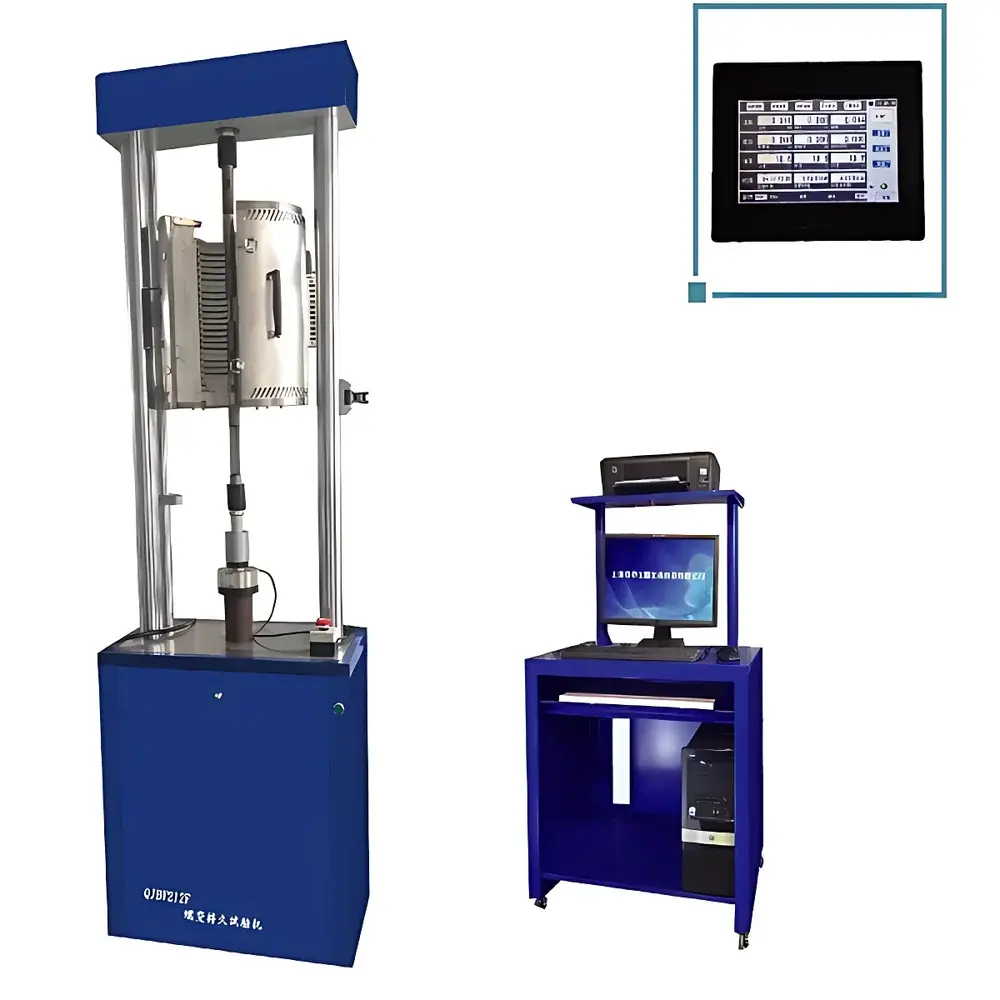
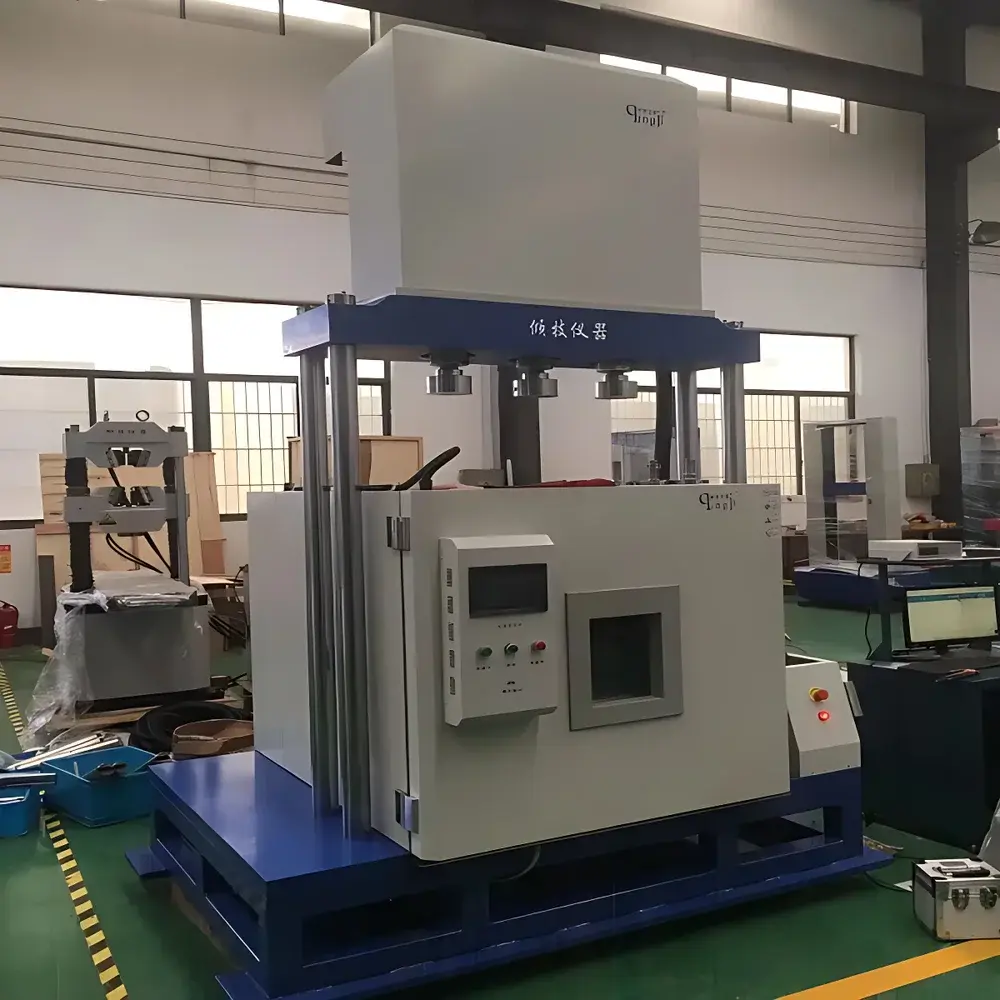
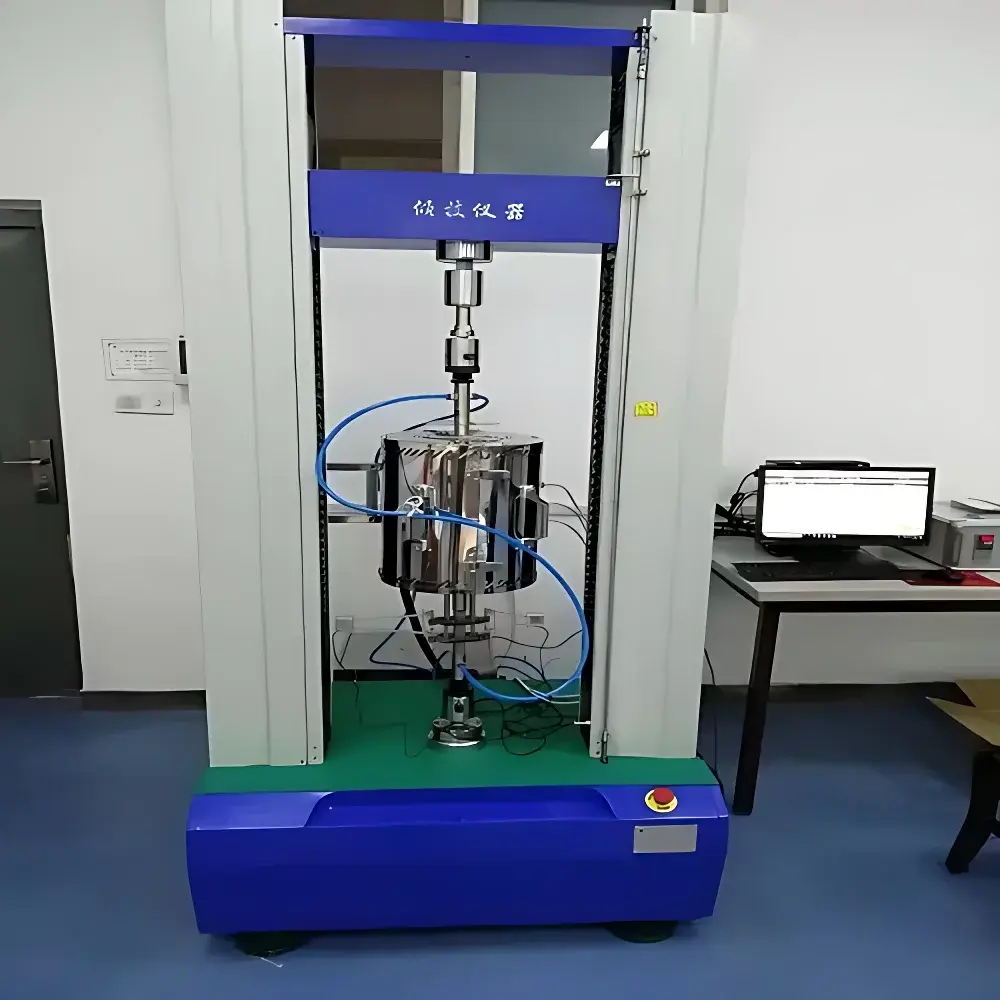
Qinji QJ-BV212F High-Temperature Creep and Fatigue Testing Machine
| Brand | Qinji |
|---|---|
| Origin | Shanghai, China |
| Model | QJ-BV212F |
| Maximum Test Load | 300 kN |
| Host Weight | 850 kg |
| Temperature Range | Ambient to 1200 °C |
| Furnace Bore Diameter | φ50 mm |
| Furnace Length | 450 mm |
| Constant-Temperature Zone Length | >150 mm |
| Temperature Control Accuracy | ±0.5 °C |
| Temperature Resolution | 0.1 °C |
| Load Measurement Accuracy | ±0.5% of reading (from 1% FS) |
| Load Control Stability | ±1% of reading |
| Load Adjustment Range | 0–100 kN (continuous, multi-range) |
| Load Resolution | 0.1 N |
| Crosshead Speed | 0.01–180 mm/min |
| Stroke | 200 mm |
| Strain Measurement | Imported rod-type encoder |
| Strain Range | 25 mm (multiple ranges available) |
| Strain Accuracy | ±0.5% |
| Power Supply | 3 kW |
| Compliance | JJG 276–1988, GB/T 2039–1997, HB 5150–1996, HB 5151–1996 |
Overview
The Qinji QJ-BV212F High-Temperature Creep and Fatigue Testing Machine is a precision-engineered electromechanical system designed for long-term mechanical property evaluation of metallic and alloy materials under sustained load and elevated temperature conditions. It operates on the principle of uniaxial tensile loading combined with controlled thermal exposure, enabling quantitative measurement of time-dependent deformation (creep strain), rupture life (stress-rupture), and fatigue behavior in accordance with internationally recognized metallurgical testing standards. The system integrates a high-rigidity load frame, servo-controlled actuation, a programmable high-temperature furnace with axial uniformity optimization, and synchronized data acquisition for load, displacement, strain, and temperature. Its architecture supports both constant-load (creep/persistence) and cyclic-load (low-cycle fatigue) test protocols, making it suitable for qualification testing in mission-critical sectors including aerospace engine component development, power generation turbine materials certification, and nuclear structural alloy validation.
Key Features
- Robust dual-column load frame rated for up to 300 kN static capacity, constructed from high-strength alloy steel with precision-machined guide surfaces and preloaded linear motion systems to minimize parasitic bending moments during high-temperature testing.
- High-fidelity load control via industrial-grade servo motor and planetary gearbox assembly, delivering stable force application across the full 0–100 kN range with ±1% control accuracy and 0.1 N resolution — calibrated traceable to national metrological standards.
- Modular high-temperature furnace with triple-zone heating elements, optimized for radial and axial thermal uniformity; achieves ±0.5 °C stability over a >150 mm isothermal zone at temperatures up to 1200 °C, with rapid ramp rates and programmable soak profiles.
- Non-contact or direct-contact extensometry options: standard configuration includes imported rod-type optical encoders for axial displacement measurement (25 mm range, ±0.5% error), compatible with optional high-temperature clip-on extensometers for true strain monitoring.
- Integrated crosshead drive with continuously variable speed (0.01–180 mm/min), supporting quasi-static tensile, creep rate profiling, and step-load hold sequences without mechanical reconfiguration.
- Comprehensive safety architecture including over-temperature cutoff, load cell overload protection, emergency stop interlocks, and furnace door position sensing — compliant with IEC 61000-6-2/6-4 electromagnetic compatibility requirements.
Sample Compatibility & Compliance
The QJ-BV212F accommodates standard ASTM E139, ISO 204, and GB/T 2039-compliant cylindrical or flat dog-bone specimens (typically 2–10 mm gauge diameter, 25–50 mm gauge length), with custom fixtures available for threaded-end, shoulder-type, or notched geometries. It supports testing of ferrous alloys (e.g., stainless steels, Ni-based superalloys), non-ferrous metals (Ti-6Al-4V, Inconel 718), and advanced intermetallics under inert gas or vacuum environments when interfaced with auxiliary chamber modules. Regulatory alignment includes full traceability to JJG 276–1988 (verification procedures for high-temperature creep machines), HB 5150–1996 and HB 5151–1996 (aerospace-specific creep and rupture test methods), and GB/T 2039–1997 (general metallic creep testing). Data logs meet GLP audit requirements with timestamped metadata, user authentication, and electronic signature support for FDA 21 CFR Part 11 readiness.
Software & Data Management
Control and analysis are executed via Qinji’s proprietary WinTest-Creep software platform, running on Windows 10 IoT Enterprise. The interface provides real-time visualization of load–time, strain–time, and temperature–time curves with overlay capability for multi-run comparison. Test sequences are defined using hierarchical script logic (hold, ramp, cycle, conditional branching), supporting automated transitions between creep stages and fatigue blocks. Raw data export is available in CSV, Excel (.xlsx), and universal HDF5 formats; all datasets include embedded calibration coefficients, environmental timestamps, and instrument configuration snapshots. Audit trails record operator ID, parameter changes, start/stop events, and calibration history — retained for ≥10 years with optional network-attached storage integration. Optional API access enables bidirectional communication with LIMS and MES platforms.
Applications
- Determination of minimum creep rate, time to tertiary creep onset, and rupture life per ASTM E139 for turbine disk and blade alloys operating above 0.4 Tm.
- Stress-rupture curve generation for pressure vessel steels used in fossil fuel and next-generation nuclear reactors (ASME Section II, Part D).
- Low-cycle fatigue (LCF) characterization of welded joints and additively manufactured components under thermomechanical loading (TMF) protocols.
- Validation of constitutive models (e.g., Norton-Bailey, Garofalo) for finite element simulation of component lifetime under transient thermal-mechanical loads.
- Quality assurance testing of supplier-sourced superalloy billets and forgings against OEM material specifications (e.g., Rolls-Royce RRP90, GE Aircraft Engines GEG-1000).
- Academic research into dislocation climb mechanisms, grain boundary sliding, and oxidation-assisted crack initiation in aggressive high-temperature environments.
FAQ
What standards does the QJ-BV212F comply with for high-temperature creep testing?
It meets JJG 276–1988 (Chinese national verification regulation), GB/T 2039–1997 (national standard for metallic creep testing), HB 5150–1996 and HB 5151–1996 (aviation industry standards for persistent strength and creep), and aligns with the technical scope of ASTM E139 and ISO 204.
Can the system perform both creep and fatigue tests in a single setup?
Yes — the machine supports sequential or hybrid protocols: users may execute a creep hold phase followed by a low-cycle fatigue block within one test sequence, with automatic transition based on elapsed time or accumulated strain.
Is third-party calibration documentation provided upon delivery?
Each unit ships with factory calibration certificates for load cell, displacement sensor, and thermocouple inputs, traceable to CNAS-accredited laboratories; on-site verification and ISO/IEC 17025-compliant recalibration services are available.
What furnace atmosphere options are supported?
Standard operation is in ambient air; optional configurations include argon-purged enclosures, vacuum chambers (10−3 mbar base pressure), and custom gas mixing manifolds for controlled oxidizing or reducing environments.
Does the software support automated reporting for regulatory submissions?
Yes — WinTest-Creep includes configurable report templates aligned with ASTM, ISO, and internal QA formats; PDF exports embed digital signatures, revision history, and raw data hyperlinks for full 21 CFR Part 11 compliance.



