
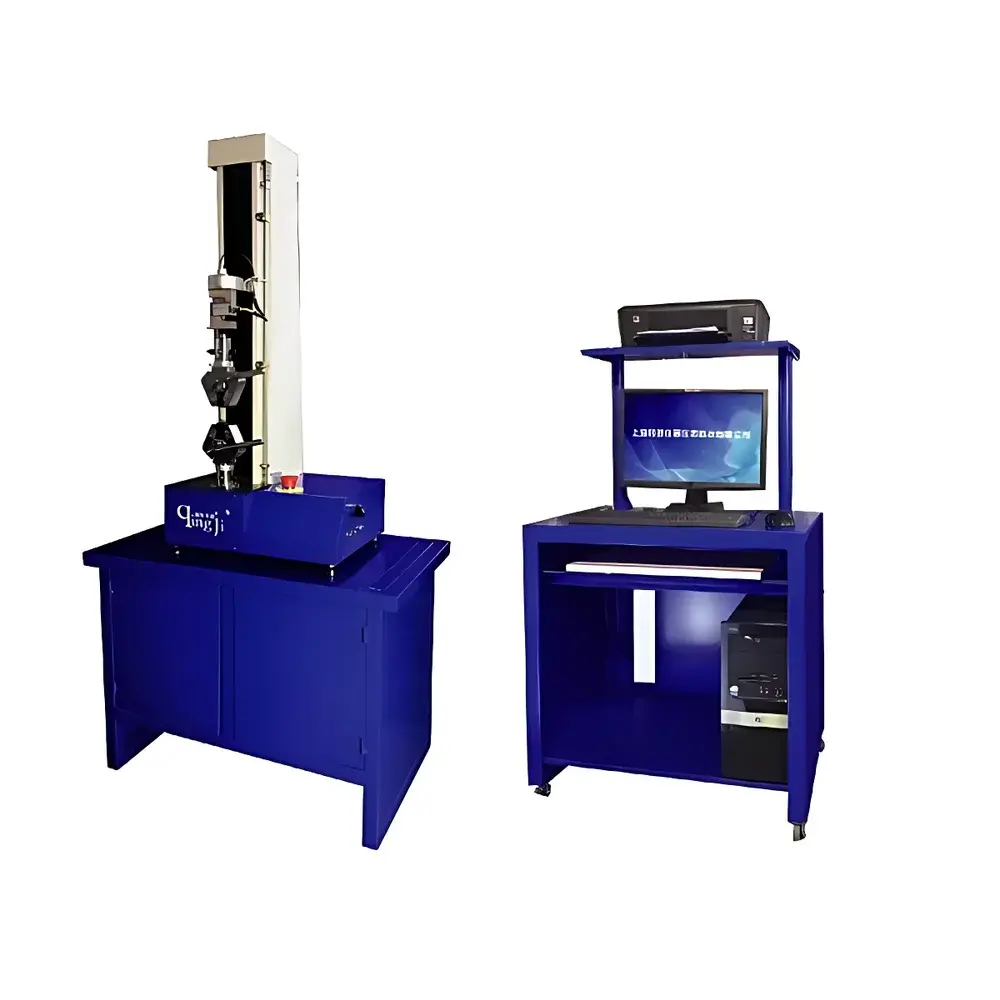
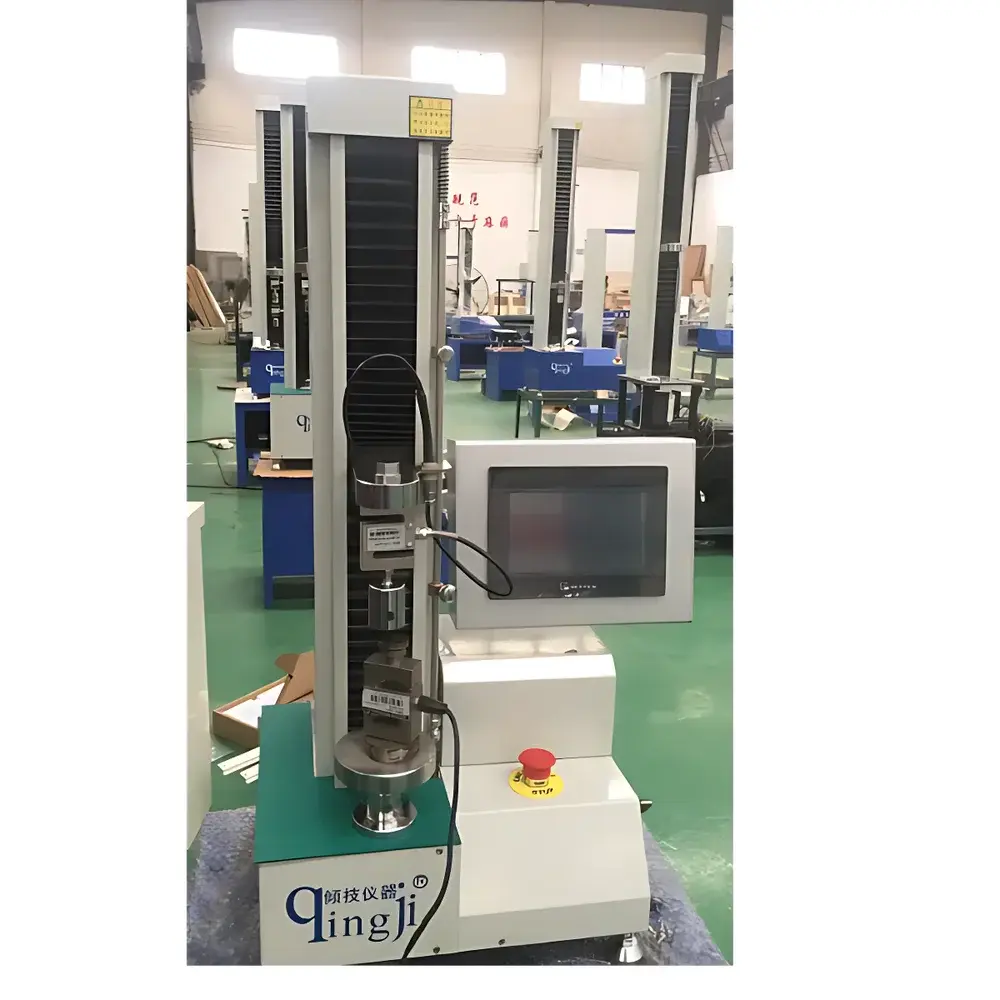
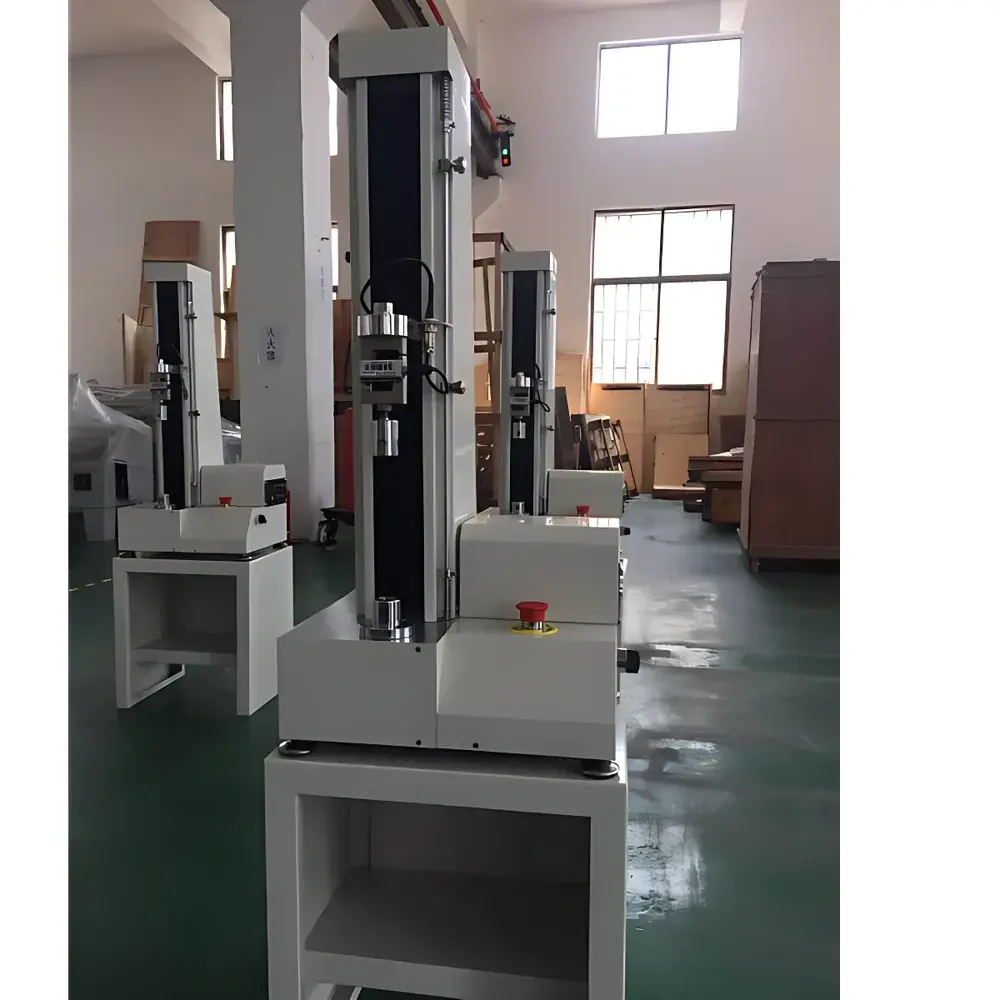
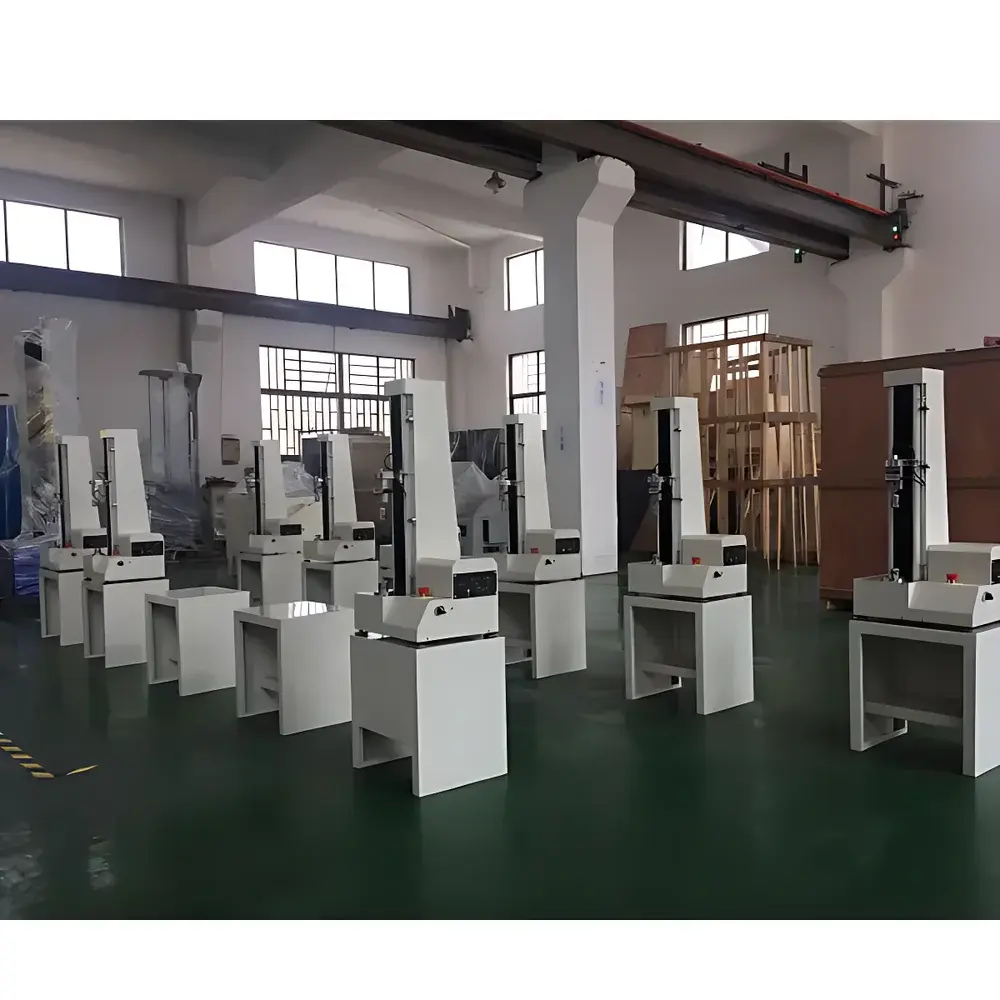
Qinsun QJ210 Single-Filament Tensile Tester for Plastics
| Brand | Qinsun |
|---|---|
| Origin | Shanghai, China |
| Model | QJ210 |
| Instrument Type | Electromechanical Universal Testing Machine |
| Load Capacity | 2500 N |
| Load Accuracy | ±0.5% of reading |
| Effective Test Width | 150 mm |
| Effective Stroke | 300 mm |
| Test Speed Range | 0.01–300 mm/min |
| Speed Accuracy | ±0.5% of set value |
| Displacement Measurement Accuracy | ±0.5% of reading |
| Strain Measurement Accuracy | ±0.5% of reading |
| Force Resolution | 500,000 counts (full-scale, no range switching) |
| Control System | Panasonic Full-Digital AC Servo Controller |
| Load Cell | High-precision U.S.-sourced strain-gauge sensor |
| Software | Full-digital closed-loop control system supporting constant stress, constant strain, and constant displacement modes |
| Safety Protection | Electronic limit switches, software-based overload diagnosis (10% over capacity), automatic return post-test |
| Power | 200 W |
| Dimensions (L×W×H) | 430 × 315 × 855 mm |
| Net Weight | 45 kg |
Overview
The Qinsun QJ210 Single-Filament Tensile Tester for Plastics is an electromechanical universal testing machine engineered for high-reproducibility mechanical characterization of polymer monofilaments, including PET, nylon, polypropylene, and fluoropolymer-based single strands. It operates on the fundamental principle of controlled uniaxial force application via a precision ball-screw-driven crosshead, actuated by a 200 W Panasonic AC servo motor and synchronized timing belt reduction system. The instrument delivers traceable, ISO/IEC 17025-aligned mechanical data—tensile strength, elongation at break, modulus of elasticity, yield point, and load–displacement hysteresis—under standardized quasi-static loading conditions. Designed for compliance with international mechanical testing protocols, it supports full-force-range linearity (0.2%–100% of 2500 N) without range switching, ensuring consistent resolution across low-force filament testing (e.g., <10 N) and higher-load validation (up to 2500 N). Its rigid frame architecture, low-vibration drive train, and real-time digital feedback loop minimize thermal drift and mechanical hysteresis—critical for repeatable measurement of fine-diameter plastic filaments (typically 0.1–2.0 mm diameter) used in medical sutures, fishing lines, textile reinforcement, and 3D printing feedstock.
Key Features
- Full-scale force resolution of 500,000 counts—maintained uniformly from 0.2% to 100% of maximum load (2500 N), eliminating range-switching artifacts during low-force filament testing.
- High-fidelity displacement and strain measurement with ±0.5% accuracy per ASTM E8/E8M and ISO 527-3, validated using traceable reference standards.
- Dual-speed crosshead control (fast/slow mode) enables rapid positioning and precise strain-rate regulation—essential for capturing brittle fracture or viscoelastic creep behavior in thermoplastic filaments.
- Integrated electronic limit switches and software-based overload protection (triggered at 110% of selected load cell capacity) ensure hardware integrity and operator safety during routine and failure-mode testing.
- Modular fixture interface compatible with custom-designed grips—including pneumatic, wedge-action, and self-tightening configurations—for secure clamping of smooth, low-friction plastic monofilaments without slippage or premature necking.
- Real-time dynamic display of force, displacement, strain, and time on a high-contrast LCD panel; all parameters simultaneously logged at user-defined sampling rates (up to 100 Hz).
Sample Compatibility & Compliance
The QJ210 is optimized for single-filament specimens with diameters ranging from 0.1 mm to 2.0 mm and lengths ≥150 mm (gauge length configurable per standard). It accommodates both virgin and recycled polymer filaments, as well as surface-treated or coated variants (e.g., silicone-lubricated, plasma-etched). The system meets the mechanical verification requirements of ISO 7500-1 (static calibration), ISO 5893 (tensile testing machines), and ASTM E4 (load verification). Test methods executed include ISO 527-3 (plastics—determination of tensile properties—Part 3: Test conditions for films and sheets), ASTM D2343 (standard test method for tensile properties of glass filament yarns), and GB/T 14344 (Chinese national standard for synthetic fiber filament tensile testing). All firmware and software modules are structured to support audit-ready documentation under GLP and GMP environments, with optional 21 CFR Part 11-compliant electronic signatures and audit trails when paired with validated PC-based control software.
Software & Data Management
The QJ210 employs a full-digital closed-loop control architecture, enabling programmable test profiles—including ramp-to-load, hold-at-strain, cyclic loading, and stress-relaxation sequences—with real-time PID parameter tuning. Raw data (force, displacement, time, calculated strain) are acquired at up to 100 Hz and stored in ASCII-compatible .csv format for downstream analysis in MATLAB, Python (NumPy/Pandas), or industry-standard packages such as Blue Hill or MTS TestSuite. The embedded controller supports multi-step test sequencing, automatic zeroing, pre-load compensation, and modulus calculation via linear regression over user-defined strain intervals (e.g., 0.05–0.25 ε). When connected to a host PC (optional Lenovo desktop included), the system generates compliant test reports conforming to ISO/IEC 17025 reporting clauses—including uncertainty statements, equipment ID, calibration dates, environmental conditions, and operator signature fields.
Applications
- Tensile property validation of monofilament suture materials per USP and ISO 10993-12 biocompatibility requirements.
- Quality control of extruded fishing line filaments against JIS K 6759 and ASTM D2256 specifications.
- Comparative evaluation of UV-stabilized vs. non-stabilized PP filaments for agricultural netting applications.
- Mechanical screening of recycled PET monofilaments for circular economy material certification programs.
- R&D-level strain-rate dependency studies on shape-memory polymer filaments under controlled temperature-humidity environments (when integrated with optional environmental chamber).
FAQ
What filament diameters can the QJ210 reliably test?
The system is validated for filaments between 0.1 mm and 2.0 mm in diameter; optimal grip performance is achieved with specimens ≥150 mm in total length and ≥25 mm gauge length.
Does the QJ210 comply with ISO 527-3 for plastic filament testing?
Yes—the machine satisfies the metrological and procedural requirements of ISO 527-3:2019, including crosshead speed tolerance (±0.5%), extensometer accuracy class (Class 1), and data acquisition resolution thresholds.
Can test data be exported for statistical process control (SPC)?
Yes—raw time-series data export in .csv format supports direct import into SPC platforms (e.g., Minitab, JMP) for capability analysis (Cp/Cpk), trend monitoring, and out-of-specification alerting.
Is third-party calibration certification available?
Calibration certificates traceable to NIM (National Institute of Metrology, China) or UKAS-accredited laboratories are available upon request, including as-found/as-left reports and measurement uncertainty budgets.
What maintenance is required to sustain 0.5% load accuracy over time?
Annual verification of load cell linearity, crosshead alignment, and encoder resolution is recommended; routine cleaning of ball screw and timing belt assemblies every 6 months ensures long-term positional fidelity.



