
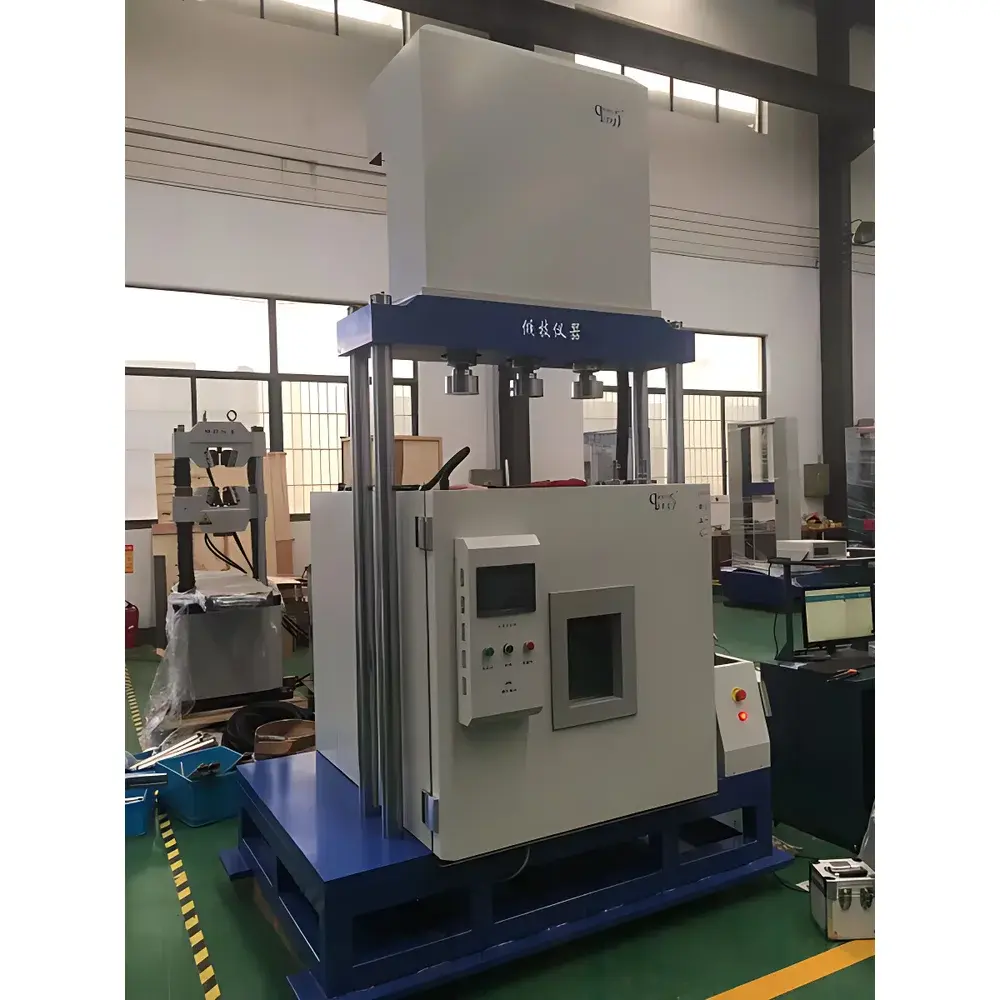
Qinji QJBV212F High-Temperature and Low-Temperature Creep Testing Machine
| Origin | Shanghai, China |
|---|---|
| Manufacturer Type | Authorized Distributor |
| Origin Category | Domestic (PRC) |
| Model | QJBV212F |
| Price | USD 16,800 (FOB Shanghai) |
| Max Test Load | 10–100 kN (configurable) |
| Load Accuracy | ±0.5% of reading (≥1% FS) |
| Load Stability | ≤1% of reading |
| Crosshead Speed | 0.01–180 mm/min |
| Stroke | 200 mm |
| Strain Measurement | Imported linear encoder |
| Strain Range | Up to 25 mm (multiple ranges available) |
| Strain Accuracy | ±0.5% of reading |
| Furnace ID | φ50 mm |
| Furnace Length | 450 mm |
| Temp Range | Ambient to 1200 °C |
| Temp Control Accuracy | ±0.5 °C |
| Temp Resolution | 0.1 °C |
| Uniform Temperature Zone | >150 mm |
| Loading System | Imported servo-driven creep actuation |
| Load Resolution | 0.1 N |
| Power Supply | 3 kW |
| Unit Weight | 850 kg |
Overview
The Qinji QJBV212F High-Temperature and Low-Temperature Creep Testing Machine is a precision-engineered mechanical testing system designed for time-dependent deformation characterization of metallic and alloy materials under sustained mechanical load across extreme thermal conditions. It operates on the fundamental principle of uniaxial tensile creep testing, where specimens are subjected to constant or stepwise axial force while being held at controlled elevated or sub-ambient temperatures for durations ranging from hours to thousands of hours. The system integrates a high-stability electromechanical loading frame with a programmable high-temperature furnace and closed-loop displacement/strain feedback, enabling compliance with internationally recognized standards including ASTM E139, ISO 204, GB/T 2039–2012 (revised), JJG 276–2015 (Calibration Specification for High-Temperature Creep Testing Machines), HB 5150–2018, and HB 5151–2018. Its architecture supports both creep rupture (time-to-failure) and creep strain rate analysis—critical for life prediction modeling in structural integrity assessments.
Key Features
- Modular load frame with configurable capacity options: 10 kN, 20 kN, 30 kN, 50 kN, and 100 kN — selected per application-specific stress-level requirements
- High-precision servo-controlled loading system delivering ±1% control accuracy and 0.1 N resolution for stable long-term force application
- Integrated high-temperature furnace with φ50 mm hot zone diameter and 450 mm total length, ensuring ≥150 mm uniform temperature zone (±0.5 °C) over full operating range (ambient to 1200 °C)
- Dual-mode deformation measurement: high-resolution linear encoder (±0.5% accuracy, up to 25 mm range) with optional extensometer compatibility for direct gauge-length strain monitoring
- Adjustable crosshead speed from 0.01 to 180 mm/min, supporting both rapid setup and ultra-slow creep displacement tracking
- Robust mechanical design with 850 kg structural mass to minimize vibration-induced noise during extended-duration tests
- Thermal shielding and insulation optimized for energy efficiency and operator safety, compliant with IEC 61000-6-2 EMC immunity requirements
Sample Compatibility & Compliance
The QJBV212F accommodates standard cylindrical and flat-bar tensile specimens conforming to ASTM E8/E8M, ISO 6892-1, and GB/T 228.1 geometries. Specimen gripping systems support threaded, shoulder, and wedge-type configurations for metals including carbon steels, stainless alloys, nickel-based superalloys (e.g., Inconel 718, Hastelloy X), titanium alloys, and aluminum composites. All test procedures and calibration protocols align with GLP (Good Laboratory Practice) documentation frameworks. Data acquisition and reporting meet traceability requirements per ISO/IEC 17025, and system validation supports audit readiness for GMP-regulated environments where creep data informs ASME BPVC Section II Part D or NRC regulatory submissions.
Software & Data Management
Control and analysis are performed via Qinji’s proprietary WinTest-Creep software, a Windows-based platform featuring real-time multi-channel plotting (load, displacement, temperature, time), automated hold-step sequencing, and customizable test templates. Raw data is saved in ASCII-delimited format (.csv) with metadata headers (operator ID, calibration date, furnace serial, load cell ID) for LIMS integration. The software implements built-in calculation modules for minimum creep rate (ε̇min), time to specific strain thresholds (tε), and Larson-Miller parameter derivation. Audit trail functionality records all user actions, parameter changes, and calibration events in accordance with FDA 21 CFR Part 11 requirements when configured with electronic signature modules.
Applications
- Predictive modeling of component lifetime in gas turbine blades, steam piping, and nuclear reactor internals operating above 0.4 Tm (melting temperature)
- Qualification testing of weldments and heat-affected zones (HAZ) per AWS D17.1 and EN 15614-2
- Development and validation of constitutive equations (e.g., Norton-Bailey, Garofalo) for finite element thermomechanical simulations
- Interlaboratory round-robin studies coordinated under ASTM Committee E28 on Mechanical Testing
- Failure analysis of service-exposed components exhibiting intergranular cracking or cavitation damage mechanisms
- Material certification for aerospace OEMs requiring AS9100-compliant creep datasets
FAQ
What standards does the QJBV212F comply with for high-temperature creep testing?
It meets JJG 276–2015, GB/T 2039–2012, HB 5150–2018, HB 5151–2018, ASTM E139, and ISO 204 for test method execution, as well as ISO/IEC 17025 for laboratory competence.
Can the system perform low-temperature creep tests below ambient?
The base configuration supports ambient-to-1200 °C operation; cryogenic capability requires integration with an external liquid nitrogen or mechanical cooling shroud (available as custom option).
Is third-party calibration certification included with delivery?
Yes—each unit ships with NIST-traceable calibration certificates for load cell, encoder, and thermocouple inputs, valid for 12 months from shipment date.
What maintenance intervals are recommended for long-term reliability?
Furnace insulation inspection every 500 operational hours; load cell recalibration annually; encoder alignment verification quarterly under continuous use.
Does the system support automated data export to MATLAB or Python for post-processing?
Yes—WinTest-Creep exports timestamped .csv files compatible with Pandas, NumPy, and MATLAB’s readmatrix() function; API access for direct script control is available under enterprise licensing.
Related Products



