
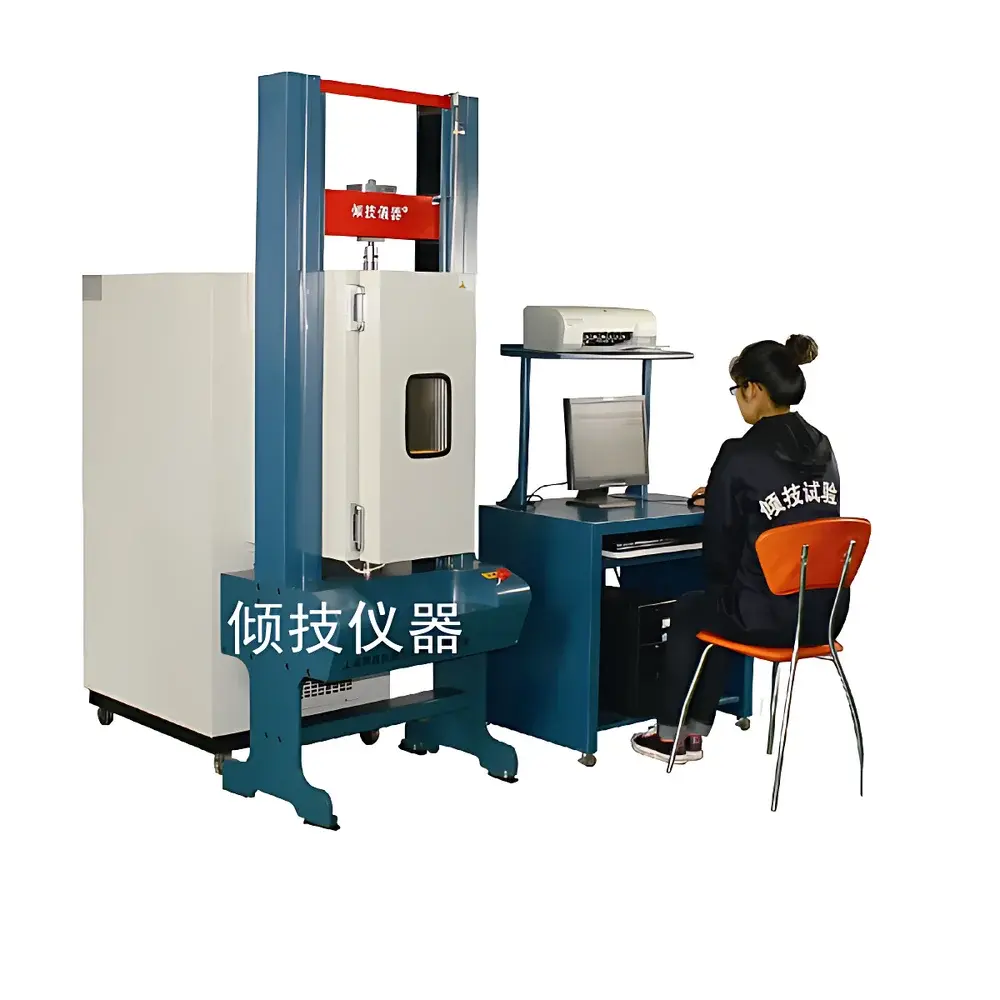
Qinsun QJ211B Universal High-Low Temperature Tensile Testing Machine
| Brand | Qinsun |
|---|---|
| Origin | Shanghai, China |
| Model | QJ211B |
| Maximum Load Capacity | 30 kN |
| Temperature Range | −70 °C to +350 °C (isothermal at 350 °C) |
| Temperature Ramp Rate | ≥5 °C/min |
| Temperature Controller Resolution | 0.1 °C |
| Load Cell Accuracy | ±0.01% of full scale |
| Force Measurement Accuracy | ±0.5% or ±1% (per ASTM E4 & ISO 7500-1) |
| Crosshead Speed Range | 0.001–500 mm/min (extendable to 1000 mm/min for short-stroke configurations) |
| Speed Accuracy | ±0.5% |
| Displacement Measurement Accuracy | ±0.5% |
| Strain/Extension Measurement Accuracy | ±0.5% |
| Effective Test Width | 420 mm |
| Usable Stroke | ~800 mm (customizable extension available) |
| Safety Features | Electronic end-limit switches, emergency stop button |
| Net Weight | 135 kg |
| Control Mode | Dual-mode — PC-based software control with integrated digital panel interface |
| Compliance Standards | ASTM D638, D790, D882, ISO 527, ISO 178, GB/T 1040, GB/T 9341, JIS K7113, DIN 53455 |
Overview
The Qinsun QJ211B Universal High-Low Temperature Tensile Testing Machine is an electromechanical materials testing system engineered for precision mechanical property evaluation under controlled thermal environments. It integrates a high-performance servo-controlled actuator with a thermally isolated environmental chamber capable of stable operation from −70 °C to +350 °C, enabling quasi-static and low-cycle fatigue characterization across extreme temperature gradients. The system operates on the principle of uniaxial force application via a calibrated load cell and displacement transducer, conforming to fundamental metrological traceability requirements outlined in ISO/IEC 17025-accredited calibration practices. Designed for laboratories requiring compliance with international test standards—including ASTM, ISO, GB/T, JIS, and DIN—the QJ211B supports tensile, compression, flexural, peel, tear, shear, puncture, and cyclic loading protocols while maintaining strict adherence to force and displacement linearity, repeatability, and resolution specifications.
Key Features
- Modular thermal chamber design: Removable high-low temperature enclosure allows rapid reconfiguration for ambient-temperature testing, maximizing bench space utilization and operational flexibility.
- High-fidelity load measurement: Dual-range 30 kN load cell with ±0.01% full-scale accuracy, certified per ISO 7500-1 Class 0.5 and ASTM E4 Annex A2.
- Precise thermal control: PID-regulated chamber with 0.1 °C resolution and ≥5 °C/min ramp rate; isothermal stability maintained at ±1 °C over 350 °C for extended durations.
- Wide dynamic range actuation: Servo-motor-driven crosshead delivering speeds from 0.001 to 500 mm/min (optionally up to 1000 mm/min), with speed accuracy within ±0.5% of setpoint.
- Robust mechanical architecture: Rigid dual-column frame with 420 mm effective test width and 800 mm standard stroke (extendable); total mass 135 kg ensures vibration damping and long-term alignment stability.
- Dual-control interface: Simultaneous operation via Windows-based software and embedded digital panel—enabling both automated test sequencing and manual jog control with real-time parameter feedback.
- Comprehensive safety integration: Redundant electronic limit switches, hardware-triggered emergency stop circuitry, and automatic overload cut-off protect both operator and specimen integrity.
Sample Compatibility & Compliance
The QJ211B accommodates specimens ranging from thin polymer films (<0.01 mm) to metallic rods (up to Ø12 mm), elastomeric sheets, composites, adhesives, textiles, and biomedical polymers. Gripping solutions include pneumatic, wedge, hydraulic, and custom fixture sets compatible with ASTM D3330 (peel), D624 (tear), and D790 (flexure) geometries. All mechanical and thermal subsystems are validated against ISO 17025-relevant uncertainty budgets. The system meets essential requirements for GLP-compliant environments, including audit-ready test logs, user-access controls, and electronic signature support. While not inherently 21 CFR Part 11 compliant out-of-the-box, the software architecture permits configuration for FDA-regulated validation workflows upon customer request and IQ/OQ documentation support.
Software & Data Management
The proprietary QinsunTest™ software provides ISO/IEC 17025-aligned data acquisition, real-time curve visualization (stress–strain, load–displacement, time–temperature), and automated report generation in PDF/Excel formats. Raw data files (.qdt) retain full metadata—including environmental chamber status, calibration certificates, operator ID, and timestamped event markers. Batch testing, multi-step ramp-hold sequences, and conditional branching (e.g., terminate on yield detection) are supported. Export modules comply with ASTM E1434 and ISO 10360-6 for interoperability with LIMS platforms. Audit trails record all parameter modifications, test starts/stops, and calibration events with immutable timestamps—critical for regulatory submissions and internal quality audits.
Applications
- Thermo-mechanical characterization of thermoplastics (e.g., PP, PA6, PEEK) across glass transition and melt regions.
- Evaluation of adhesive bond strength degradation at elevated service temperatures (e.g., automotive under-hood components).
- Low-temperature embrittlement assessment of elastomers and rubber compounds per ASTM D1415.
- Mechanical aging studies of aerospace composites under thermal cycling per ASTM D3410.
- Quality control of medical device polymers (e.g., tubing, catheters) per ISO 10993-12 and USP .
- Research into shape-memory alloys and phase-change materials under constrained thermal–mechanical loading.
FAQ
What temperature uniformity can be expected inside the chamber during isothermal testing at 350 °C?
At 350 °C, axial and radial uniformity is maintained within ±1.5 °C across a 100 mm × 100 mm test zone, verified using NIST-traceable thermocouples per ASTM E220.
Is the system compatible with extensometers for strain measurement?
Yes—both contact-type (clip-on, video, and laser extensometers) and non-contact digital image correlation (DIC) systems can be integrated via standardized mounting interfaces and synchronized data acquisition channels.
Does the software support automated pass/fail criteria based on material specifications?
Yes—user-defined acceptance thresholds (e.g., yield strength > X MPa, elongation at break ≥ Y%) trigger real-time alerts and auto-classify results during batch runs.
What maintenance intervals are recommended for long-term accuracy retention?
Load cell recalibration every 12 months or after 10,000 cycles; thermal chamber sensor verification every 6 months; mechanical alignment check annually or following relocation.
Can the system be upgraded to meet future ISO 17025 accreditation requirements?
Yes—Qinsun provides documented IQ/OQ protocols, uncertainty analysis templates, and third-party calibration coordination services to support formal laboratory accreditation processes.



