
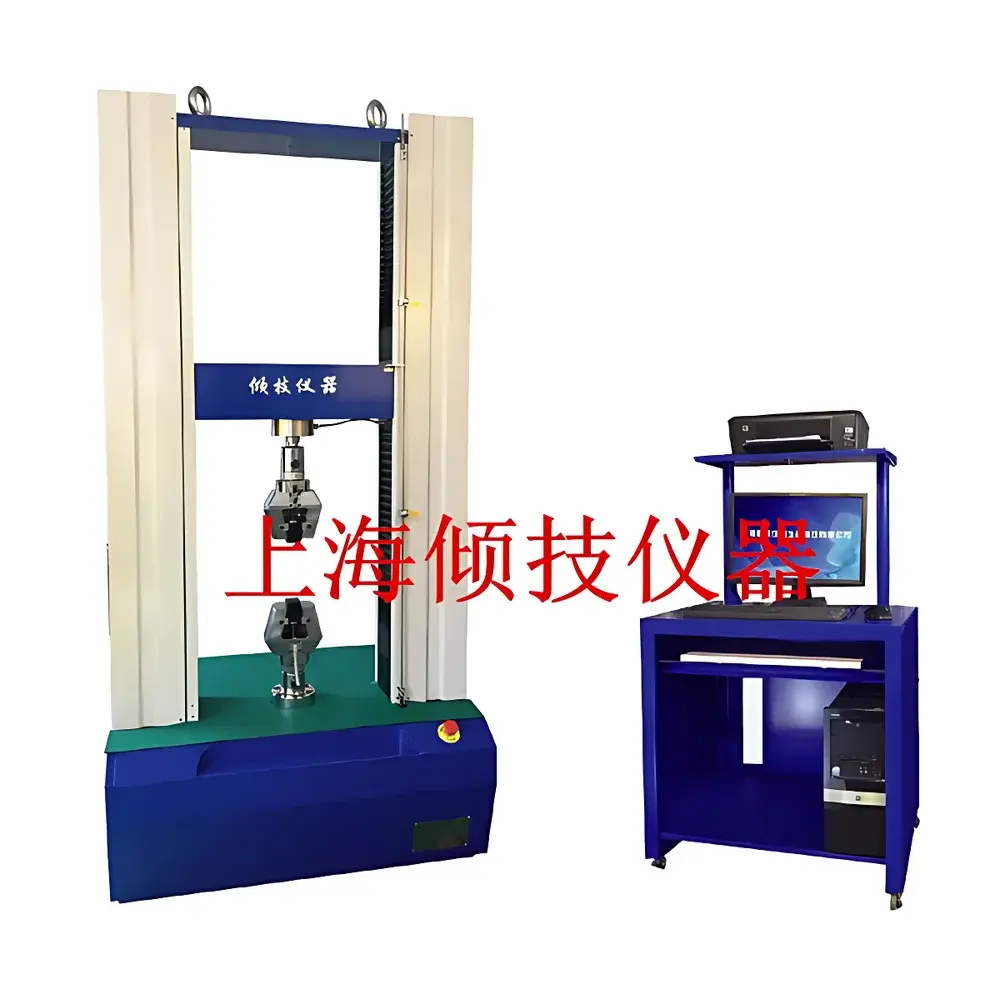
QJ212C Universal Testing Machine (UTM) by Qingji
| Brand | Qingji |
|---|---|
| Origin | Shanghai, China |
| Model | QJ212C |
| Load Capacity | 0–500 kN (selectable) |
| Load Accuracy | ±0.5% of full scale |
| Force Resolution | ±1/250,000 FS (constant across full range) |
| Effective Test Width | 500 mm |
| Max. Tensile Travel | 600 mm or 800 mm (configurable) |
| Test Speed Range | 0.001–1000 mm/min |
| Speed Accuracy | ±1% of indicated value |
| Displacement Measurement Accuracy | ±0.5% of indicated value |
| Strain/Deformation Measurement Accuracy | ±0.5% of indicated value |
| Motor Power | 1.5 kW |
| Dimensions (W×D×H) | 960 × 650 × 2000 mm |
| Weight | 1200 kg |
| Safety Features | Electronic travel limit protection, overload protection at 110% FS, manual/auto return, dual-speed crosshead control |
| Compliance Standards | ISO 6892-1, ASTM E8/E21, JIS Z2241, DIN 50125 |
Overview
The QJ212C Universal Testing Machine (UTM) by Qingji is an electromechanical static testing system engineered for high-reproducibility mechanical characterization of metallic materials—particularly structural steels—under uniaxial tensile, compressive, flexural, shear, and low-cycle fatigue loading conditions. Based on closed-loop servo-controlled hydraulic or electromechanical actuation (model-dependent configuration), the system applies precisely regulated axial force while synchronously measuring displacement, strain, and load in real time. Its architecture adheres to fundamental principles of materials mechanics: stress (σ = F/A₀), strain (ε = ΔL/L₀), and modulus derivation via linear elastic region slope analysis. Designed for laboratory and quality control environments, the QJ212C supports standardized test execution per internationally recognized protocols—including ISO 6892-1 (metallic materials — tensile testing), ASTM E8/E21 (tension tests of metallic materials), JIS Z2241, and DIN 50125—ensuring data traceability, inter-laboratory comparability, and regulatory alignment in manufacturing and certification workflows.
Key Features
- Modular load frame with rigid four-column construction and precision-ground guide rails, optimized for minimal deflection under peak 500 kN loads.
- High-resolution force measurement system with ±0.5% full-scale accuracy and constant resolution of ±1/250,000 FS across the entire range—no recalibration required when switching between 10 kN and 500 kN configurations.
- Adjustable crosshead travel (600 mm or 800 mm standard) with dual-speed motorized control (fast positioning + fine-tuning mode) and programmable return functionality.
- Electronically enforced stroke limits and hardware-based overload cutoff (110% FS threshold) to prevent mechanical damage during operator error or specimen failure.
- Integrated displacement transducer with ±0.5% indication accuracy, synchronized with load cell output for true stress–strain curve generation.
- Real-time dynamic curve visualization under Windows-based control software, supporting multi-curve overlay, zoom, pan, and export in CSV, XML, and PDF formats.
Sample Compatibility & Compliance
The QJ212C accommodates standardized steel specimens per ISO 6892-1 (e.g., Type 1A flat tensile coupons, round bars up to Ø25 mm), as well as non-standard geometries via custom grips (e.g., wedge-action, pneumatic, or hydraulic clamping systems). It supports both extensometer-based strain measurement (for Young’s modulus and yield point determination) and crosshead-displacement-derived strain (for routine QC). All test sequences are configurable to meet ISO/IEC 17025 documentation requirements, including audit-ready test logs with timestamps, operator ID, environmental notes (optional ambient sensor integration), and digital signature fields. The system complies with essential safety directives (CE Machinery Directive 2006/42/EC) and electromagnetic compatibility (EMC) standards (EN 61326-1).
Software & Data Management
The embedded Windows-based control interface enables fully automated test sequencing—from preload application and rate ramping to fracture detection and post-failure unloading. Raw data streams (load, displacement, time, optional strain) are logged at ≥1 kHz sampling rate and stored with metadata (test standard, specimen ID, calibration certificate IDs, environmental conditions). Software supports GLP/GMP-aligned features: user role-based access control (admin/operator/auditor), electronic signatures compliant with FDA 21 CFR Part 11 (when deployed with validated software version and network authentication), and immutable audit trails for all parameter changes and result modifications. Exported datasets include calculated outputs: ultimate tensile strength (Rₘ), yield strength (Rₑₗ/Rₚ₀.₂), elongation at break (A₅), reduction in area (Z), and modulus of elasticity (E).
Applications
- Verification of mechanical property compliance for ASTM A615, A706, and EN 10080 reinforcing steels in civil infrastructure projects.
- Quality assurance of hot-rolled structural sections (I-beams, channels, angles) per ASTM A6/A6M and EN 10025.
- Material qualification for pressure vessel fabrication (ASME Section II, Part D) and offshore platform components (DNV-OS-F101).
- Research-grade tensile–fatigue interaction studies using programmable low-cycle fatigue (LCF) waveforms with hold-time control.
- Failure analysis laboratories performing root-cause evaluation of brittle/ductile transitions, necking behavior, and fracture surface correlation with microstructure.
FAQ
What international standards does the QJ212C support out-of-the-box?
Preconfigured test methods include ISO 6892-1:2019, ASTM E8/E21-23, JIS Z2241:2021, and DIN 50125:2018—with editable parameters to accommodate lab-specific deviations.
Is the system suitable for accredited testing laboratories?
Yes—when operated with documented calibration certificates (traceable to NIM or equivalent NMIs), validated software, and defined SOPs, it meets ISO/IEC 17025:2017 requirements for mechanical testing competence.
Can third-party extensometers be integrated?
The system provides analog and digital input ports compatible with LVDT, clip-on, and video extensometers meeting ASTM E83 Class B-1 or ISO 9513 Class 1 specifications.
What maintenance is required during the first year of operation?
Routine tasks include quarterly lubrication of lead screws, biannual verification of load cell linearity, and annual full-system calibration—supported by Qingji’s global service network and certified field engineers.
Does the software support multi-user environments with permission tiers?
Yes—administrator-defined roles govern access to method editing, calibration functions, report generation, and raw data export, ensuring separation of duties in regulated settings.



