
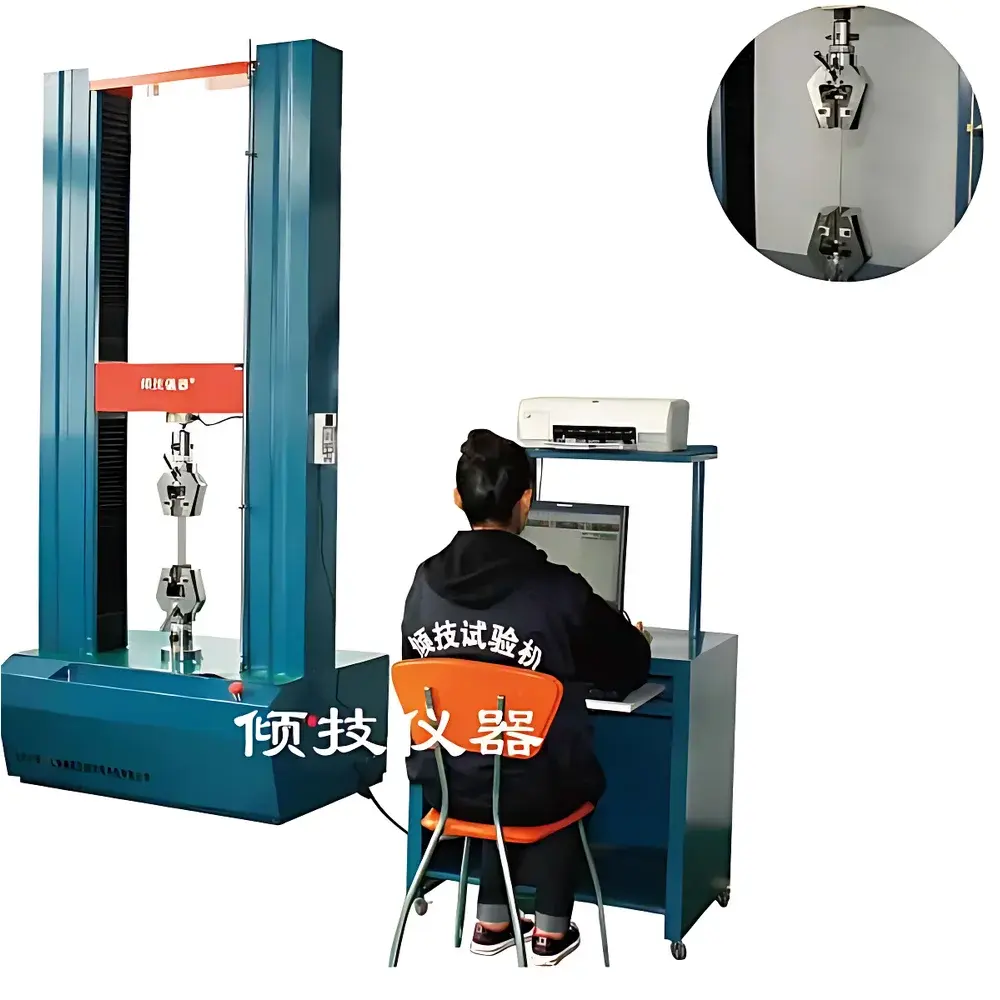
Qinsun QJ212 Ring Stiffness Tester for Pipes
| Brand | Qinsun |
|---|---|
| Origin | Shanghai, China |
| Model | QJ212 |
| Max Load Capacity | 10–300 kN |
| Max Test Diameter | ≤Φ5000 mm |
| Accuracy Class | Class 1 / Class 0.5 |
| Crosshead Speed Range | 0.01–500 mm/min |
| Load Accuracy | ±1% (±0.5%) of reading |
| Speed Accuracy | ±0.5% (±0.15%) of reading |
| Displacement Resolution | 0.01 mm |
| Control Interface | Full Chinese GUI with PC-integrated real-time curve display, data auto-storage, and report printing |
| Compliance | Designed to meet ISO 9969, ASTM D2412, EN 13476-2, GB/T 9647, and ISO 13968 test requirements for ring stiffness evaluation |
Overview
The Qinsun QJ212 Ring Stiffness Tester is a high-precision, dual-mode electromechanical testing system engineered specifically for the structural characterization of rigid and semi-rigid tubular products. It operates on the principle of controlled diametral compression—applying uniform radial force to a pipe segment supported on two parallel knife-edge supports—thereby quantifying resistance to deformation under compressive loading. This method directly yields the ring stiffness value (SN), expressed in kN/m², as defined by international standards including ISO 9969 (thermoplastics), ASTM D2412 (polyethylene and PVC pipes), EN 13476-2 (structured-wall pipes), and GB/T 9647 (Chinese national standard). Unlike general-purpose universal testers, the QJ212 integrates purpose-built fixtures—including adjustable three-point support frames, internal diameter deformation sensors, and axial alignment guides—to ensure geometric fidelity during ring compression tests. Its modular architecture also permits seamless transition into tensile, compressive, and flexural testing modes via interchangeable grips and platens, enabling full mechanical property profiling per ASTM E8, ISO 6892-1, and ISO 178.
Key Features
- Dual-column or six-column load frame configurations available, optimized for stability during high-load ring compression tests up to 300 kN.
- Integrated internal deformation measurement system with high-resolution LVDT or digital caliper interface, enabling direct capture of pipe ovalization at specified gauge lengths—critical for accurate SN calculation per ISO 13968 Annex A.
- Real-time displacement-controlled actuation with closed-loop servo feedback, ensuring compliance with speed tolerance requirements across the full range (0.01–500 mm/min) as mandated by ASTM D2412 Section 7.3.
- Class 1 or optional Class 0.5 load cell calibration traceable to national metrological institutes, supporting GLP-compliant validation protocols.
- Full Chinese-language HMI with intuitive navigation, contextual help prompts, and on-screen parameter configuration—designed for routine operation by QC technicians without advanced programming training.
- PC-based control software with synchronized multi-channel acquisition (load, displacement, internal deformation), automatic peak detection, and configurable pass/fail thresholds aligned with project-specific specification limits.
Sample Compatibility & Compliance
The QJ212 accommodates pipe specimens with outer diameters up to Φ5000 mm and wall thicknesses ranging from 2 mm to 200 mm, covering thermoplastic (PE, PP, PVC-U), thermoset (GRP/FRP), metallic (ductile iron, steel), and composite (sandwich, filament-wound) materials. Its support span and loading geometry are fully adjustable to satisfy the L/D ratio requirements of ISO 9969 (span = 0.03 × OD, min. 100 mm) and ASTM D2412 (span = 0.025 × OD, min. 100 mm). All hardware components—including hardened steel knife edges, low-friction roller supports, and anti-rotation clamps—meet surface finish and hardness specifications outlined in EN 13476-2 Annex B. The system supports audit-ready documentation generation compliant with ISO/IEC 17025 clause 7.8.2 and FDA 21 CFR Part 11 when configured with electronic signature and audit trail modules.
Software & Data Management
The embedded control software provides synchronized acquisition of load, crosshead displacement, and internal deformation signals at ≥1 kHz sampling rate. Test sequences are programmable using step-based logic (e.g., pre-load → dwell → ramp → hold → unload), with automatic derivation of ring stiffness (SN = (F × L³) / (0.083 × Δy × D), where F = applied load, L = support span, Δy = deflection, D = mean diameter). Raw data files (.csv, .xlsx) include timestamped metadata (operator ID, sample ID, environmental conditions), while PDF reports embed annotated stress–strain curves, statistical summaries (mean, SD, CV%), and conformance statements against user-defined acceptance criteria. Data integrity is preserved via write-once storage, immutable file hashing, and optional network backup to NAS or LIMS servers.
Applications
- Quality assurance of sewer, drainage, and conduit pipes prior to field installation per municipal procurement specifications.
- R&D validation of novel pipe formulations—e.g., PE-RT compounds with enhanced creep resistance—against long-term stiffness degradation models.
- Third-party certification testing for CE marking under EN 13476 series and CCC certification per GB/T 9647–2015.
- Comparative analysis of recycled-content HDPE pipes versus virgin-material benchmarks under identical test conditions.
- Mechanical screening of geothermal heat exchanger tubing subjected to soil-induced lateral loads.
FAQ
What standards does the QJ212 comply with for ring stiffness testing?
It supports ISO 9969, ASTM D2412, EN 13476-2, GB/T 9647, and ISO 13968, with hardware and software parameters pre-configured for each standard’s dimensional and procedural requirements.
Can the system measure both ring stiffness and tensile properties on the same specimen?
No—ring stiffness requires diametral compression of a cut pipe segment; tensile testing demands dog-bone or strip specimens. However, the same QJ212 frame can be reconfigured with appropriate grips and software modules to perform both test types on separate samples.
Is internal deformation measurement mandatory for ring stiffness calculations?
Yes—per ISO 13968 and ASTM D2412, SN derivation requires precise measurement of pipe deflection (Δy) at the mid-span under defined load increments. The QJ212’s integrated LVDT-based sensor satisfies this requirement without operator intervention.
How is traceability maintained for calibration records?
Load cells and displacement transducers are supplied with UKAS-accredited calibration certificates, and the software logs all calibration events—including date, technician ID, reference standard used, and as-found/as-left deviations—in an encrypted database.
Does the system support remote diagnostics or firmware updates?
Yes—via secure HTTPS-enabled web interface, authorized service engineers can initiate diagnostic routines, review system health logs, and deploy validated firmware patches without physical access to the instrument.



