
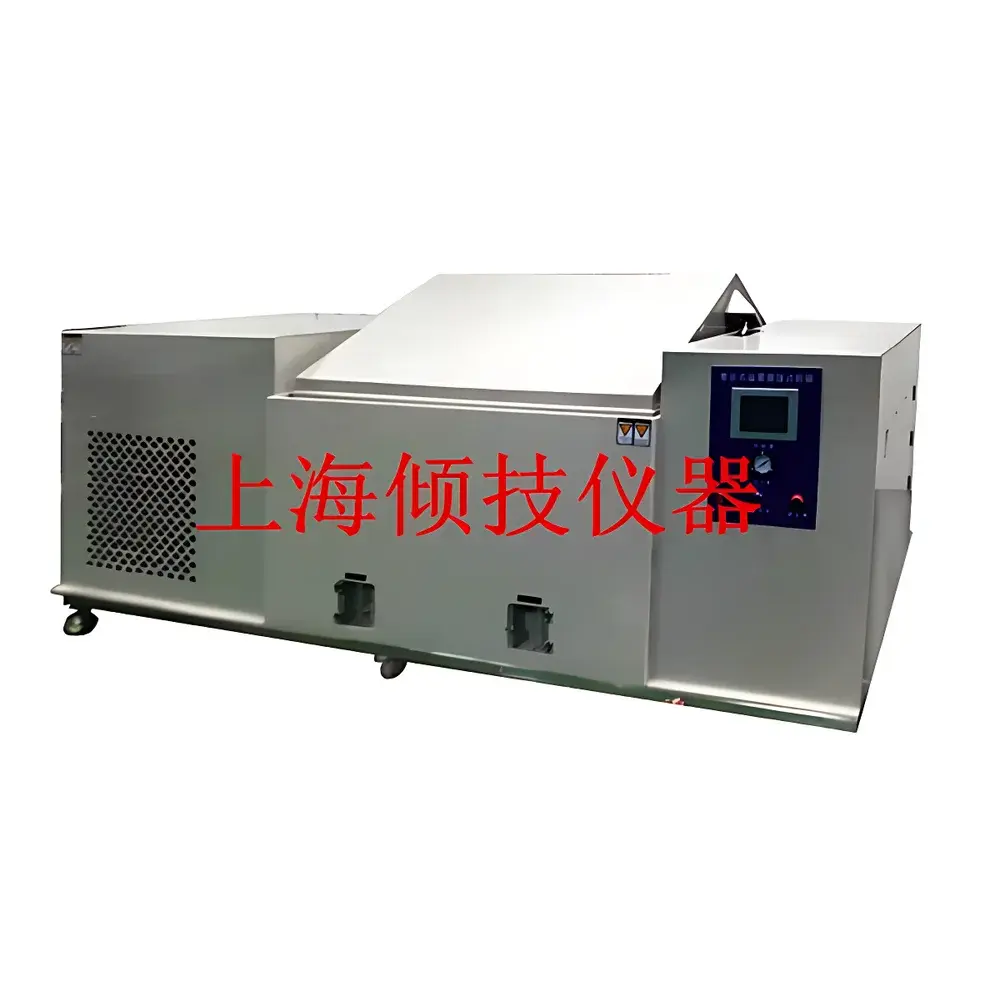
Qinji QJYS-70 Precision Salt Spray Test Chamber
| Brand | Qinji |
|---|---|
| Origin | Shanghai, China |
| Manufacturer Type | Authorized Distributor |
| Country of Origin | China |
| Model | QJYS-70 |
| Price | USD 2,800 (FOB Shanghai) |
| Internal Chamber Dimensions (Min–Max) | 600 × 450 × 400 mm – 1600 × 1000 × 500 mm |
| External Dimensions (Min–Max) | 1075 × 630 × 1185 mm – 2300 × 1200 × 1485 mm |
| Chamber Volume (Min–Max) | 108 L – 800 L |
| Salt Solution Reservoir Capacity (Min–Max) | 15 L – 40 L |
| Test Temperature Range | Ambient to 65 °C |
| Compliance Standards | GB/T 2423.17 (Neutral Salt Spray), ASTM B117, ISO 9227, JIS Z2241 |
| Test Types Supported | Neutral Salt Spray (NSS), Acetic Acid Salt Spray (AASS), Copper-Accelerated Acetic Acid Salt Spray (CASS) |
Overview
The Qinji QJYS-70 Precision Salt Spray Test Chamber is a rigorously engineered environmental simulation system designed for accelerated corrosion testing of metallic materials, protective coatings, electroplated surfaces, and finished industrial components. It operates on the principle of continuous or cyclic salt fog generation—atomizing a precisely formulated sodium chloride (NaCl) solution under controlled temperature and humidity conditions—to replicate aggressive coastal or industrial atmospheric exposure. As a core instrument in reliability engineering and quality assurance workflows, the QJYS-70 supports standardized evaluation of corrosion resistance per internationally recognized test protocols, including ASTM B117 (Neutral Salt Spray), ISO 9227 (NSS, AASS, CASS), JIS Z2241, and GB/T 2423.17. Its robust chamber architecture, thermally insulated double-wall construction, and digitally regulated saturation air heater ensure stable chamber temperature (up to 65 °C), uniform fog distribution, and high reproducibility across repeated test cycles—critical for comparative analysis in R&D labs, QC departments, and third-party certification facilities.
Key Features
- Seven scalable chamber configurations—from compact 108 L benchtop units to large-capacity 800 L walk-in systems—enabling flexibility for small specimens or full-size automotive subassemblies.
- Precision-machined PVC-coated internal chamber with acid-resistant sealing gaskets and corrosion-inhibiting hardware to ensure long-term structural integrity under continuous saline exposure.
- Automated salt solution delivery system with adjustable spray nozzle pressure (1–2 bar), calibrated collection rate (1.0–2.0 mL/80 cm²/h), and integrated level-sensing reservoir (15–40 L capacity) to maintain consistent test conditions over extended durations.
- Digital PID temperature controller with ±0.5 °C accuracy across ambient to 65 °C operating range; independent heating of saturation chamber and test chamber prevents thermal stratification.
- Compliance-ready design: pre-configured for ASTM B117 calibration requirements, including calibrated temperature sensors, fog collection funnels, and pH-stabilized salt solution preparation guidelines.
- Front-access service panel with quick-release fasteners facilitates routine maintenance, nozzle cleaning, and sensor verification without disassembly.
Sample Compatibility & Compliance
The QJYS-70 accommodates diverse sample geometries—including fasteners, stamped sheet metal, printed circuit boards (PCBs), coated steel panels, anodized aluminum housings, and polymer-coated automotive trim—via adjustable specimen racks and non-metallic support fixtures. All internal contact surfaces are inert (PVC, PP, or quartz-coated stainless steel) to prevent galvanic interference. The system meets essential regulatory and industry-standard compliance frameworks: it supports audit-ready documentation per ISO/IEC 17025 laboratory accreditation requirements; enables traceable test execution aligned with IATF 16949 automotive quality management; and provides configurable data logging compatible with FDA 21 CFR Part 11 electronic record controls when paired with optional compliant software modules. Test reports generated from this chamber are routinely accepted by CNAS-accredited testing laboratories and OEM validation teams across Tier-1 automotive, aerospace, and electronics supply chains.
Software & Data Management
While the base QJYS-70 operates via intuitive front-panel HMI with real-time display of chamber temperature, elapsed test time, and spray status, optional PC-based control software (Qinji TestSuite v3.2) extends functionality with automated test sequencing, multi-stage profile programming (e.g., NSS → dry → humid cycles), and timestamped CSV/Excel export of all operational parameters. The software includes built-in calibration certificate templates, user role-based access control (administrator/operator), and audit trail logging for GLP/GMP environments. All firmware and software updates are distributed via secure download portal with SHA-256 signature verification—no cloud dependency or remote telemetry.
Applications
- Corrosion performance benchmarking of zinc-nickel, chromate, and trivalent chromium passivation layers on automotive brake calipers and chassis components.
- Validation of conformal coating adhesion and pinhole resistance on military-grade PCBs per MIL-STD-202G Method 215.
- Accelerated life assessment of marine-grade stainless steels (e.g., 316L, duplex 2205) used in offshore instrumentation enclosures.
- Comparative evaluation of organic coatings (epoxy, polyurethane, PVDF) on architectural aluminum extrusions per AAMA 2605.
- Supplier qualification testing for electroplated connectors in consumer electronics, per IPC-J-STD-002D and JEDEC JESD22-B101.
FAQ
Does the QJYS-70 comply with ASTM B117 calibration requirements?
Yes—the chamber is factory-calibrated to meet ASTM B117’s temperature uniformity (±2 °C across working volume), fog collection rate (1.0–2.0 mL/80 cm²/h), and pH specification (6.5–7.2 for NSS). Calibration certificates and verification procedures are provided with each unit.
Can the system perform cyclic corrosion testing (CCT)?
The standard QJYS-70 supports static NSS, AASS, and CASS modes. For programmable multi-phase CCT (e.g., salt spray → drying → humidity), the optional QJYS-70-CCT upgrade kit adds dual-zone humidity control and integrated PLC-based cycle sequencing.
What maintenance intervals are recommended for long-term reliability?
Daily: rinse nozzles and inspect collection funnels. Weekly: verify salt solution concentration and clean saturation tower. Annually: recalibrate temperature sensors and replace PVC gaskets per manufacturer’s service bulletin QJYS-70-MNT-2024.
Is technical support available outside mainland China?
Yes—Qinji maintains authorized service partners in Germany, South Korea, and Mexico, and provides remote diagnostics, English-language documentation, and video-assisted commissioning for international installations.



