
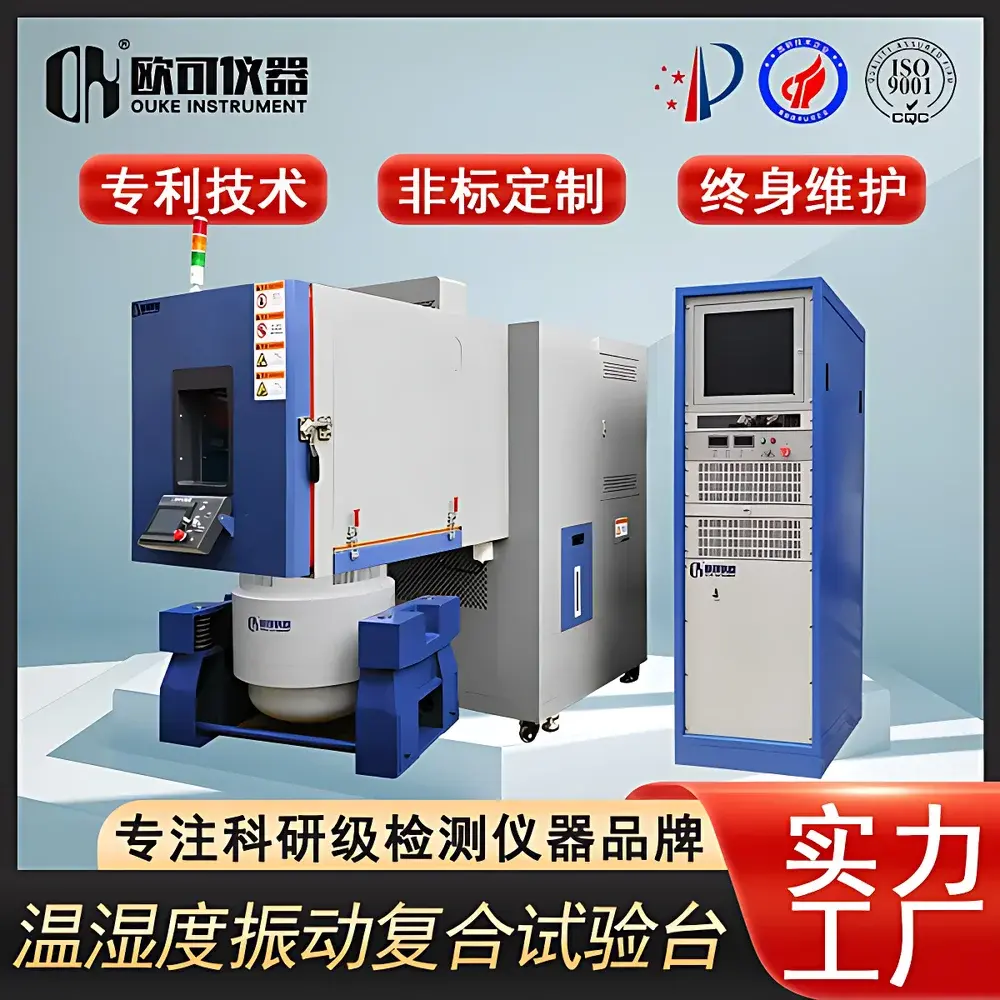
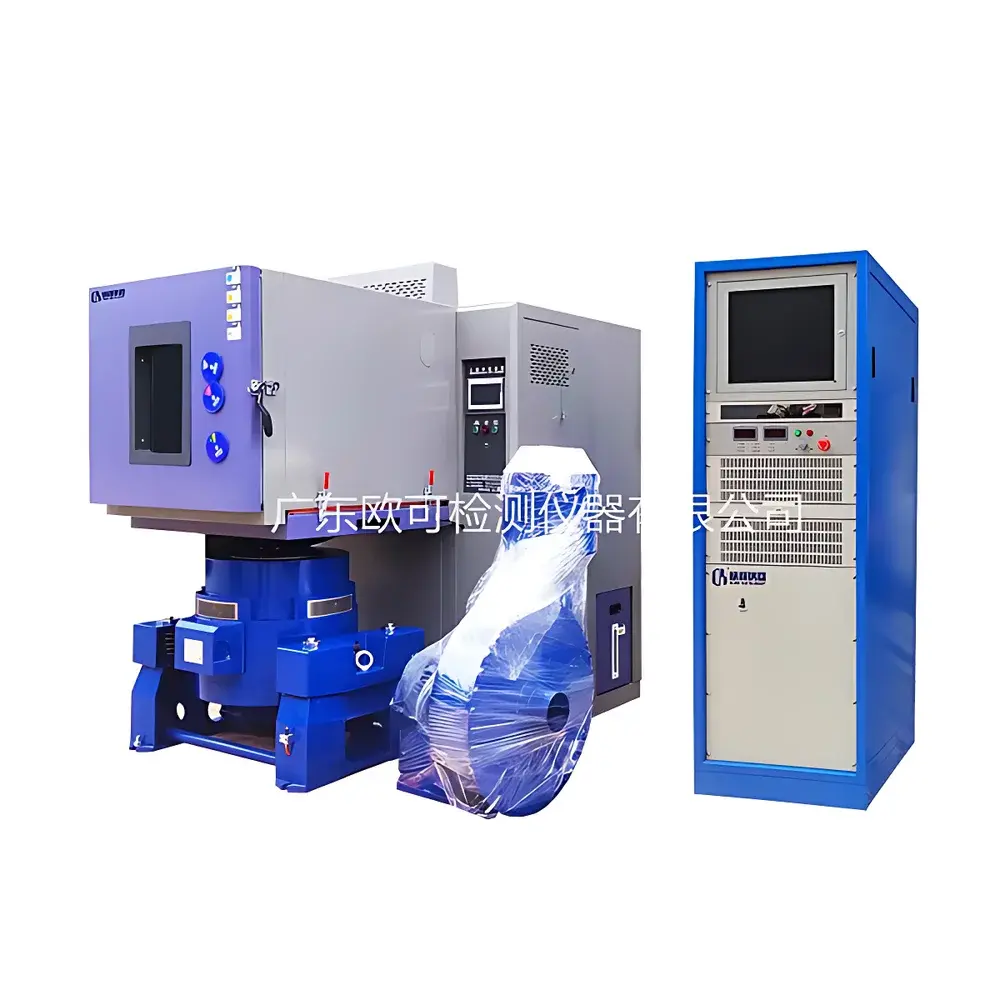
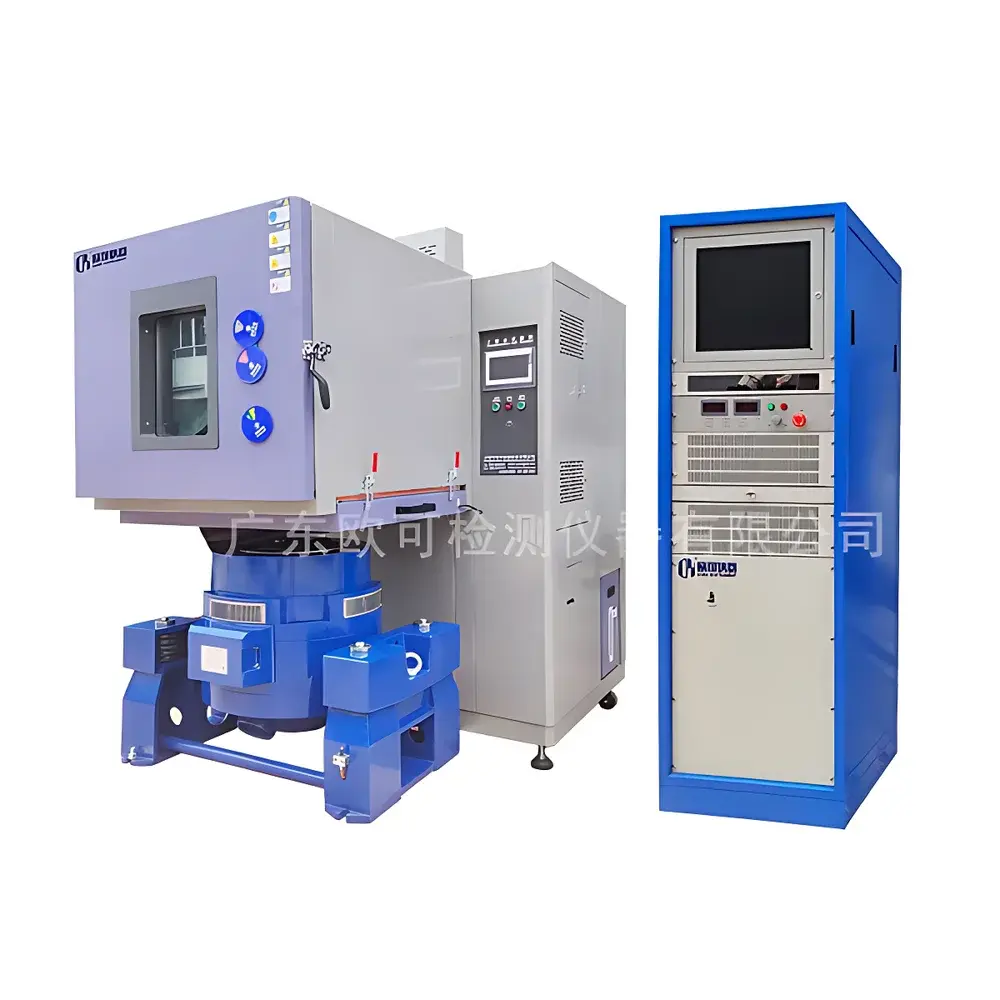
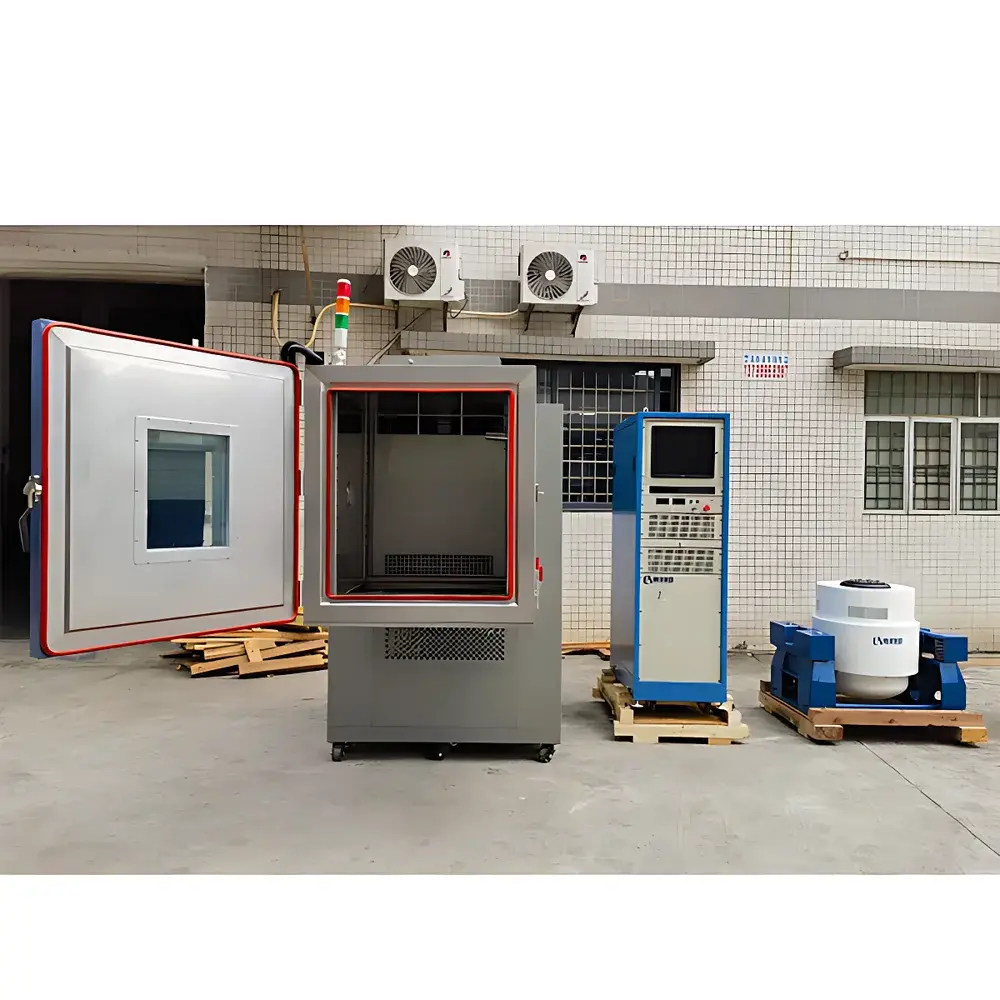
OK Instruments OK-ZTH-1440.2 Combined Temperature-Humidity-Vibration Environmental Test Chamber
| Brand | OK Instruments |
|---|---|
| Origin | Guangdong, China |
| Manufacturer Type | Direct Manufacturer |
| Product Origin | Domestic (China) |
| Model | OK-ZTH-1440.2 |
| Temperature Range | −70 °C to +150 °C |
| Humidity Range | 20–98 %RH at 20–85 °C |
| Temperature Ramp Rate | 5 / 10 / 15 °C/min |
| Temperature Uniformity | ≤ ±0.5 °C |
| Standard Load Capacity | 15 kg aluminum mass, 350 W internal heat dissipation |
Overview
The OK Instruments OK-ZTH-1440.2 Combined Temperature-Humidity-Vibration Environmental Test Chamber is an integrated reliability testing system engineered for high-fidelity simulation of real-world operational and transportation environments. It simultaneously applies three independent environmental stress domains—thermal, hygric, and mechanical vibration—within a single controlled chamber volume. This multi-stress concurrency enables accelerated life testing methodologies such as Highly Accelerated Life Testing (HALT) and Highly Accelerated Stress Screening (HASS), where synergistic stress interactions amplify latent design or process weaknesses that would remain undetected under sequential single-stress exposure. The system operates on a coupled control architecture: a double-stage refrigeration system achieves stable sub-zero operation down to −70 °C; resistive heating elements provide precise thermal control up to +150 °C; steam-based humidification and refrigerative dehumidification ensure repeatable RH regulation across the full 20–98 %RH range at temperatures between 20 °C and 85 °C; and a high-dynamic electric shaker serves as the structural baseplate, delivering calibrated vibratory input directly beneath the test specimen. Unlike legacy sequential chambers, this platform maintains strict phase synchronization between thermal transients, humidity profiles, and vibration spectra—enabling reproduction of complex mission profiles defined per IEC 60068-2-68, MIL-STD-810H Method 520.5, and RTCA DO-160G Section 16.
Key Features
- Integrated triple-stress architecture with synchronized real-time control of temperature, relative humidity, and vibration acceleration
- Double-stage cascade refrigeration system supporting −70 °C minimum operating temperature and programmable ramp rates of 5, 10, or 15 °C/min
- Steam-generation humidification system with closed-loop PID control ensuring ≤ ±2 %RH accuracy across 20–98 %RH range
- Electrodynamic vibration table mounted as integral floor plate, rated for 15 kg payload and 350 W continuous thermal load
- Thermally insulated chamber constructed from polyurethane-filled steel-clad panels (≥100 mm thickness), equipped with double-glazed observation window and multiple feedthrough ports
- Comprehensive safety interlock suite including overtemperature cutoff, vibration overload detection, refrigerant high/low pressure monitoring, and ground fault circuit interruption
- Modular control hardware compliant with IEC 61000-4 electromagnetic compatibility standards for co-located instrumentation
Sample Compatibility & Compliance
The OK-ZTH-1440.2 accommodates test specimens up to 1440 L internal volume (W×D×H: 1200 × 1000 × 1200 mm) with unrestricted access to all three stress domains. Its mechanical interface supports standard mounting configurations per ISO 5344 and ASTM D999 for vibration fixture integration. All environmental profiles are fully traceable and audit-ready: time-stamped sensor data—including Pt100 temperature sensors (Class A tolerance), capacitive RH transducers (±1.5 %RH), and piezoelectric accelerometers (±2 % amplitude linearity)—are logged at ≥10 Hz sampling rate. The system conforms to GLP/GMP-aligned data integrity requirements, supporting 21 CFR Part 11-compliant electronic signatures, user-access tiering, and immutable audit trails for qualification reports. Calibration certificates are provided per ISO/IEC 17025-accredited procedures, and validation documentation aligns with IQ/OQ/PQ protocols required for aerospace (AS9100), automotive (IATF 16949), and medical device (ISO 13485) quality systems.
Software & Data Management
Control and data acquisition are managed via OK-TestSuite™ v4.2—a deterministic real-time application built on a Linux RT kernel. The software features a dual-mode interface: a graphical profile editor for constructing multi-segment thermal-hygric-vibrational test sequences (e.g., sinusoidal sweep overlaid on linear temperature ramp), and a script-based automation engine supporting Python 3.9 APIs for custom test logic and integration with MES/PLM platforms. All raw sensor streams, setpoint trajectories, and alarm events are stored in HDF5 format with embedded metadata (unit definitions, calibration dates, operator IDs). Export options include CSV, MATLAB .mat, and ASAM MDF4 for post-processing in third-party analysis tools such as MATLAB, JMP, or ReliaSoft Weibull++. Built-in statistical functions compute failure onset thresholds, acceleration factors (AF), and confidence intervals per Nelson-Aalen estimators—supporting quantitative HALT boundary identification per ANSI/GEIA-STD-0009.
Applications
- Aerospace electronics: Qualification of avionics modules per RTCA DO-160G Sections 16 (vibration), 22 (temperature), and 23 (humidity)
- Automotive ECUs and ADAS sensors: Validation against ISO 16750-4 (mechanical loads) and ISO 16750-3 (climatic loads) combined stress conditions
- Military-grade communications equipment: Compliance testing per MIL-STD-810H Methods 502.7 (low temperature), 507.6 (humidity), and 520.5 (combined environments)
- Consumer electronics: Transport simulation per ISTA 3A and packaging-level reliability screening
- Power semiconductor modules: Thermal cycling fatigue assessment under simultaneous power dissipation and mechanical resonance
- Medical imaging subsystems: Verification of long-term dimensional stability and signal integrity in MRI/CT gantry-mounted components
FAQ
What distinguishes combined environmental testing from sequential testing?
Combined testing induces synergistic failure mechanisms—such as condensation-enhanced corrosion under cyclic vibration or thermally activated solder joint cracking amplified by mechanical strain—that cannot be replicated when stresses are applied separately.
Can the OK-ZTH-1440.2 perform HALT without modification?
Yes—the system includes HALT-specific firmware modules for step-stress profiling, rapid extremum searching, and margin verification, fully compatible with industry-standard HALT test plans.
Is remote monitoring and control supported?
The chamber integrates native OPC UA server functionality, enabling secure TLS-encrypted access via enterprise SCADA systems or cloud-based dashboards (AWS IoT Core, Azure IoT Hub).
How is vibration isolation maintained during thermal cycling?
The shaker baseplate employs active thermal compensation algorithms and low-CTE titanium alloy isolators to minimize drift-induced misalignment; mechanical coupling stiffness is validated per ISO 10816-3 vibration severity thresholds.
Does the system support custom test standard import?
Yes—XML-based standard templates (e.g., MIL-STD-810H, IEC 60068-2) can be imported, parsed, and auto-converted into executable test profiles with parameter mapping and constraint validation.



