
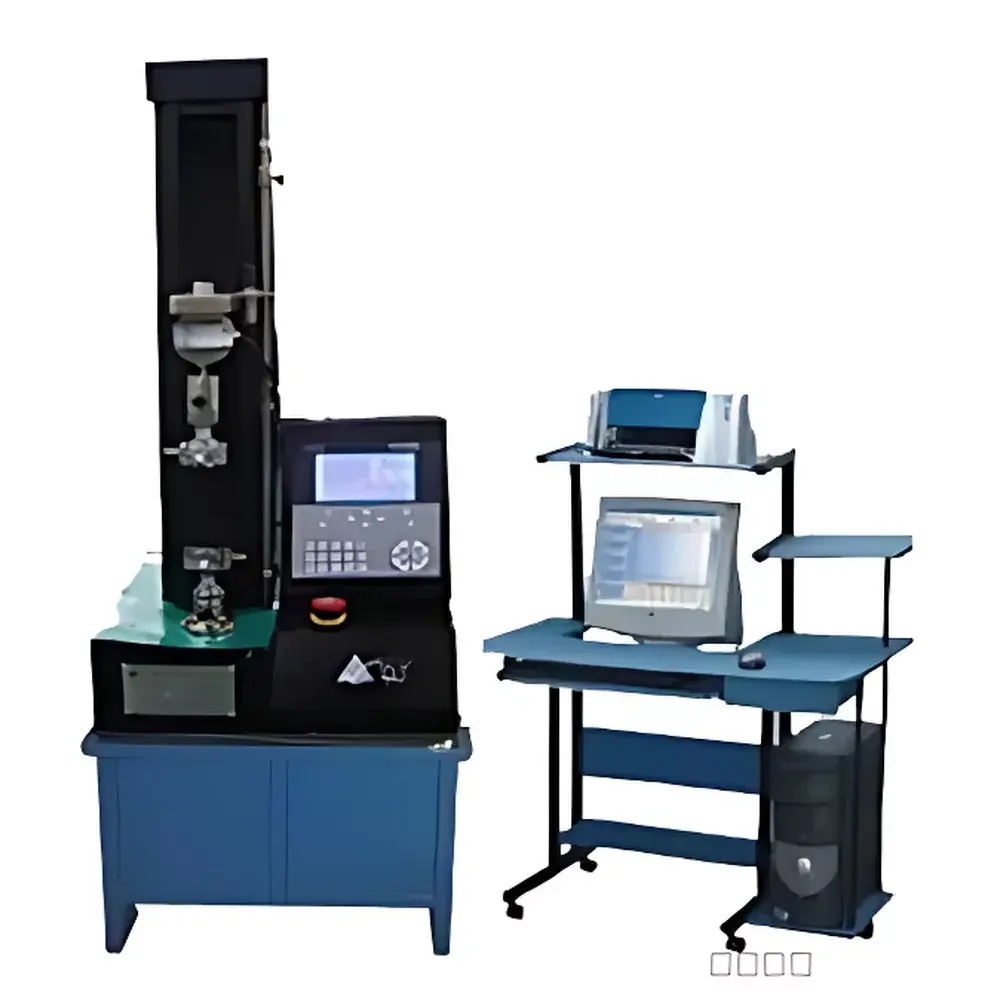
QJ210 Universal Tensile Testing Machine for Woven Straps
| Origin | Shanghai, China |
|---|---|
| Manufacturer Type | Authorized Distributor |
| Origin Category | Domestic (China) |
| Model | QJ210 |
| Price | USD 1,400 (approx.) |
| Instrument Type | Electromechanical Universal Testing Machine |
| Max Load Capacity | 5000 N |
| Load Cell Accuracy | 0.01% FS |
| Measurement Accuracy | ±0.5% |
| Control Mode | PC-based closed-loop control with real-time data acquisition |
| Valid Test Width | 150 mm |
| Effective Stroke | 800 mm (extendable) |
| Test Speed Range | 0.001–500 mm/min |
| Speed Accuracy | ±0.5% |
| Displacement Accuracy | ±0.5% |
| Safety Features | Electronic stroke limit protection, emergency stop button |
| Unit Weight | ~85 kg |
Overview
The QJ210 Universal Tensile Testing Machine is an electromechanical static testing system engineered for high-reproducibility mechanical characterization of flexible web materials—particularly woven straps, textile slings, safety harness webbing, and polymer-based load-bearing tapes. It operates on the principle of controlled uniaxial force application via a precision ball-screw-driven crosshead, coupled with a calibrated load cell and high-resolution encoder-based displacement feedback. The system complies with core mechanical testing standards including ISO 13934-1 (tensile properties of textiles), ASTM D5035 (breaking force and elongation of textile fabrics), and GB/T 3923.1 (Chinese national standard for textile tensile testing). Designed for QC laboratories, R&D departments, and third-party certification bodies, the QJ210 delivers traceable, repeatable force-displacement data under both constant-rate-of-extension (CRE) and constant-rate-of-traverse (CRT) test modes.
Key Features
- High-fidelity 5000 N load capacity with 0.01% full-scale load cell resolution, enabling precise quantification of yield strength, ultimate tensile strength, and elongation at break for narrow-width woven structures.
- Real-time synchronized acquisition of force (N), displacement (mm), and strain rate (mm/min), visualized dynamically on integrated LCD interface and simultaneously streamed to PC software.
- Adjustable test width (150 mm effective clamping zone) accommodates standard strap widths from 10 mm to 120 mm without reconfiguration.
- Extended stroke capability (800 mm base; modular extension kits available) supports high-elongation materials such as polypropylene or nylon webbing requiring >300% extension before rupture.
- Ultra-broad speed range (0.001–500 mm/min) meets diverse protocol requirements—from slow creep evaluation per ISO 291 to rapid impact simulation per EN 12195-2.
- Rugged aluminum extrusion frame with electrostatic powder-coated finish ensures dimensional stability and long-term alignment integrity during repeated high-cycle testing.
- Dual-layer safety architecture: hardware-based electronic stroke limit switches + software-enforced upper/lower bounds prevent overtravel and specimen ejection hazards.
Sample Compatibility & Compliance
The QJ210 is optimized for planar, anisotropic textile specimens with defined edge geometry and uniform thickness (0.5–5 mm typical). Compatible sample types include flat-woven polyester/nylon straps, braided lifting slings, seatbelt webbing, medical restraint tapes, and geotextile reinforcement strips. Clamping is achieved via pneumatic or manual wedge-action grips with serrated faces to minimize slippage and stress concentration. All test methods align with internationally recognized regulatory frameworks: data audit trails support GLP-compliant reporting; exported CSV/Excel files meet FDA 21 CFR Part 11 electronic record requirements when used with validated software configurations; test reports conform to ISO/IEC 17025 documentation structure for accredited labs.
Software & Data Management
The machine integrates with Windows-based proprietary testing software supporting multi-language UI (English, Chinese, Spanish), customizable test templates, and automated pass/fail evaluation against user-defined limits. Raw data streams at ≥100 Hz sampling rate, enabling accurate peak detection and post-yield curve analysis. Software modules include modulus calculation (secant/tangent), Poisson’s ratio estimation (with optional extensometer input), and statistical batch reporting (mean, SD, CV%, min/max). Export formats include PDF (print-ready ASTM/ISO-formatted reports), XML (for LIMS integration), and ASCII-delimited text. All test sessions are timestamped and logged with operator ID, environmental metadata (optional external hygrothermograph input), and instrument calibration status.
Applications
- Quality assurance of automotive seatbelt webbing per FMVSS 209 and ECE R16.
- Validation of lifting sling compliance with EN 1492-1 and ASME B30.9.
- Research into moisture-temperature effects on tensile retention of flame-retardant aramid straps.
- Accelerated aging studies correlating UV exposure duration with breaking strength degradation (ASTM G154).
- Comparative analysis of splice/join efficiency in woven vs. heat-sealed strap terminations.
- Supplier qualification testing for military-spec MIL-W-4088K webbing used in parachute rigging.
FAQ
What is the recommended calibration interval for the QJ210 load cell?
Annual calibration against NIST-traceable deadweight standards is advised; interim verification using certified reference load cells every 3 months is recommended for GLP environments.
Can the QJ210 perform cyclic fatigue testing?
No—the QJ210 is a static-dynamic CRE/CRT machine; it does not support programmable load cycling or hysteresis loops. For fatigue applications, consider the QJ212 series with servo-hydraulic actuation.
Is ASTM D5035 pre-programmed in the software?
Yes—standard test templates for ASTM D5035, ISO 13934-1, and GB/T 3923.1 are pre-installed with automatic parameter loading (gauge length = 200 mm, speed = 100 mm/min, etc.).
Does the system support external extensometers?
Yes—via RS-422 interface; compatible with non-contact video extensometers (e.g., DIC systems) and clip-on mechanical extensometers meeting ASTM E83 Class B-2 accuracy.
What power supply and environmental conditions are required?
Single-phase 220 V ±10%, 50 Hz, 2 kW; operating ambient: 10–35 °C, RH ≤80% non-condensing; vibration-isolated bench mounting strongly recommended.



