
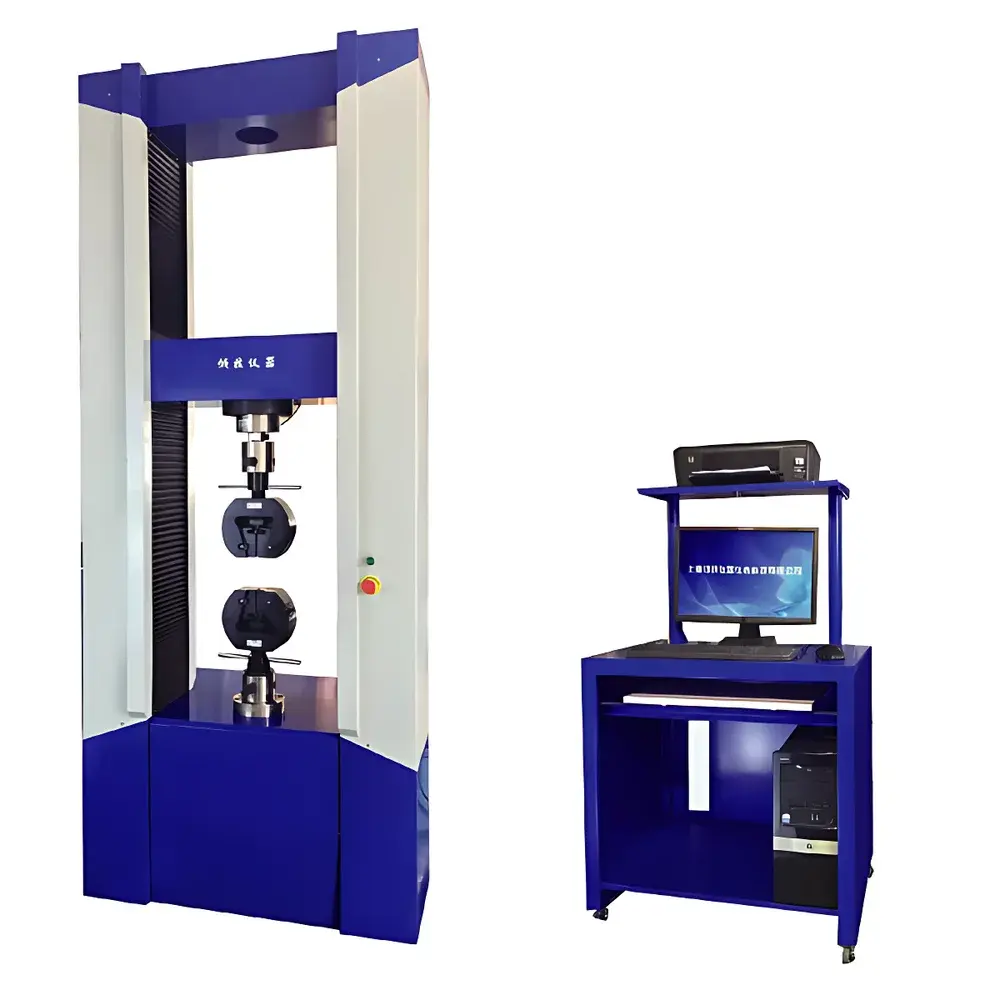
QJ212C Universal Testing Machine
| Origin | Shanghai, China |
|---|---|
| Manufacturer Type | Authorized Distributor |
| Origin Category | Domestic (China-made) |
| Model | QJ212C |
| Price | USD 7,700 (approx.) |
| Instrument Type | Electromechanical Universal Testing Machine |
| Load Capacity Options | 50 kN, 100 kN, 200 kN, 300 kN, 500 kN |
| Accuracy Class | 0.5 |
| Effective Test Width | 520 mm |
| Max Tensile Stroke | 800 mm |
| Speed Range | 0.01–1000 mm/min (standard: 300 mm/min) |
| Speed Accuracy | ±0.5% of indicated value |
| Load Resolution | 500,000 counts (full-scale, no range switching) |
| Force Measurement Range | 0.02–100% of selected capacity |
| Displacement & Strain Measurement Accuracy | ±0.5% of indicated value |
| Load Cell | High-precision strain-gauge sensor (USA-sourced) |
| Controller | Panasonic full-digital AC servo controller |
| Control System | Full-digital closed-loop control supporting constant load, constant strain, and constant displacement modes |
| Safety Protection | Software diagnostics, electronic limit switches, overload protection at 110% capacity |
| Crosshead Adjustment | Dual-speed (fast/slow) motorized lift |
| Return Mode | Manual or automatic post-test return to initial position |
| Fixture Customization | User-specific fixtures available upon request |
| Optional Accessories | Brand-name LCD PC, color inkjet printer |
| Motor Power | 2–5 kW |
| Dimensions (W×D×H) | 1000 × 680 × 2450 mm |
| Weight | ~1450 kg |
Overview
The QJ212C Universal Testing Machine is an electromechanical static testing system engineered for high-reproducibility mechanical characterization of metallic, polymeric, composite, ceramic, and textile materials under tension, compression, bending, peel, shear, tear, puncture, and low-cycle fatigue conditions. Built upon a rigid dual-column frame architecture with precision-ground ball screws and preloaded linear guides, the system implements closed-loop servo control to maintain strict adherence to ASTM E4, ISO 7500-1, GB/T 228.1, and JIS Z 2241 standards during force, displacement, and strain regulation. Its modular load cell design—calibrated to 0.5 accuracy class per ISO 7500-1—enables seamless capacity interchangeability across 50 kN to 500 kN ranges without recalibration, supporting both R&D validation and routine QC workflows in accredited laboratories and manufacturing QA departments.
Key Features
- Rigid structural frame with reinforced base and crosshead assembly, minimizing deflection under maximum rated load
- Full-digital closed-loop control system integrating Panasonic AC servo drive and real-time PID algorithm for precise stress/strain/displacement trajectory tracking
- High-resolution load measurement: 500,000 internal counts, no auto-ranging required, uniform resolution across entire force span
- Dynamic test speed range from 0.01 to 1000 mm/min (standard configuration: 300 mm/min), compliant with ASTM D638 and ISO 527 tensile protocols
- Dual-mode crosshead positioning: programmable fast/slow adjustment with manual override capability
- Integrated safety architecture including electronic travel limits, software-based overload cutoff (110% of set capacity), and automatic emergency stop on fault detection
- Modular fixture interface compatible with standardized wedge-action, pneumatic, hydraulic, and custom-designed grips
- Real-time Windows-based graphical user interface with live curve plotting, multi-curve overlay, zoom, trace, and export functions (CSV, PDF, image)
Sample Compatibility & Compliance
The QJ212C accommodates specimens up to 520 mm wide and 800 mm in active gauge length, supporting standardized test bars, dog-bone coupons, sheet metal strips, wire strands, adhesive lap joints, and biomedical sutures. It meets metrological requirements of ISO/IEC 17025-accredited testing labs and supports audit-ready documentation per GLP and GMP frameworks. Test methods executed include but are not limited to ASTM D638 (tensile), D790 (flexural), D1876 (peel), D732 (shear), D624 (tear), and ISO 6892-1, 178, 1133, 228.1. All calibration certificates comply with ISO/IEC 17025 traceability to NIST or CNAS reference standards.
Software & Data Management
The embedded Windows-native test software provides full compliance with FDA 21 CFR Part 11 requirements when deployed with optional electronic signature modules and audit trail logging. Users may define multi-step test profiles—including ramp-hold-relax sequences—and assign unique sample IDs, operator credentials, and environmental metadata. Raw data is stored in encrypted binary format with timestamped backups; export options include ASCII CSV for LIMS integration, vector-based PDF reports, and PNG/JPEG snapshots. Version-controlled firmware updates and backward-compatible data file formats ensure long-term archival integrity.
Applications
- Mechanical property validation of aerospace alloys (e.g., Ti-6Al-4V, 7075-T6) per AMS and MIL-STD specifications
- Tensile strength and elongation-at-break assessment of thermoplastics (PP, PET, PC) and elastomers (EPDM, silicone)
- Compression testing of concrete cores, foam cushions, and battery electrode stacks
- Bending modulus determination of fiber-reinforced composites per ASTM D7264
- Adhesion strength evaluation of pressure-sensitive tapes, laminates, and medical device coatings
- Low-frequency cyclic loading for fatigue life estimation of orthopedic implant components
- Quality conformance verification in automotive component production (brackets, bushings, gaskets)
FAQ
What international standards does the QJ212C support out-of-the-box?
The system includes preconfigured test templates for ASTM, ISO, GB/T, JIS, DIN, and EN standards, with customizable parameter sets for method-specific compliance.
Can the machine be integrated into an existing LIMS or MES environment?
Yes—via TCP/IP or RS232 communication protocols, with configurable data field mapping and automated report push to designated network folders or database endpoints.
Is remote diagnostics and software update supported?
Remote desktop-assisted troubleshooting is available; firmware and software updates are delivered via secure HTTPS download with SHA-256 checksum verification.
What maintenance intervals are recommended for optimal performance?
Preventive maintenance is advised every 12 months or after 2,000 test cycles, including load cell verification, screw lubrication, and encoder calibration using certified reference weights.
Does the system meet ISO 17025 traceability requirements for accredited labs?
Yes—factory calibration certificates include uncertainty budgets and direct traceability to national metrology institutes (NIM, NIST, PTB); on-site recalibration services are available globally.
Related Products



