
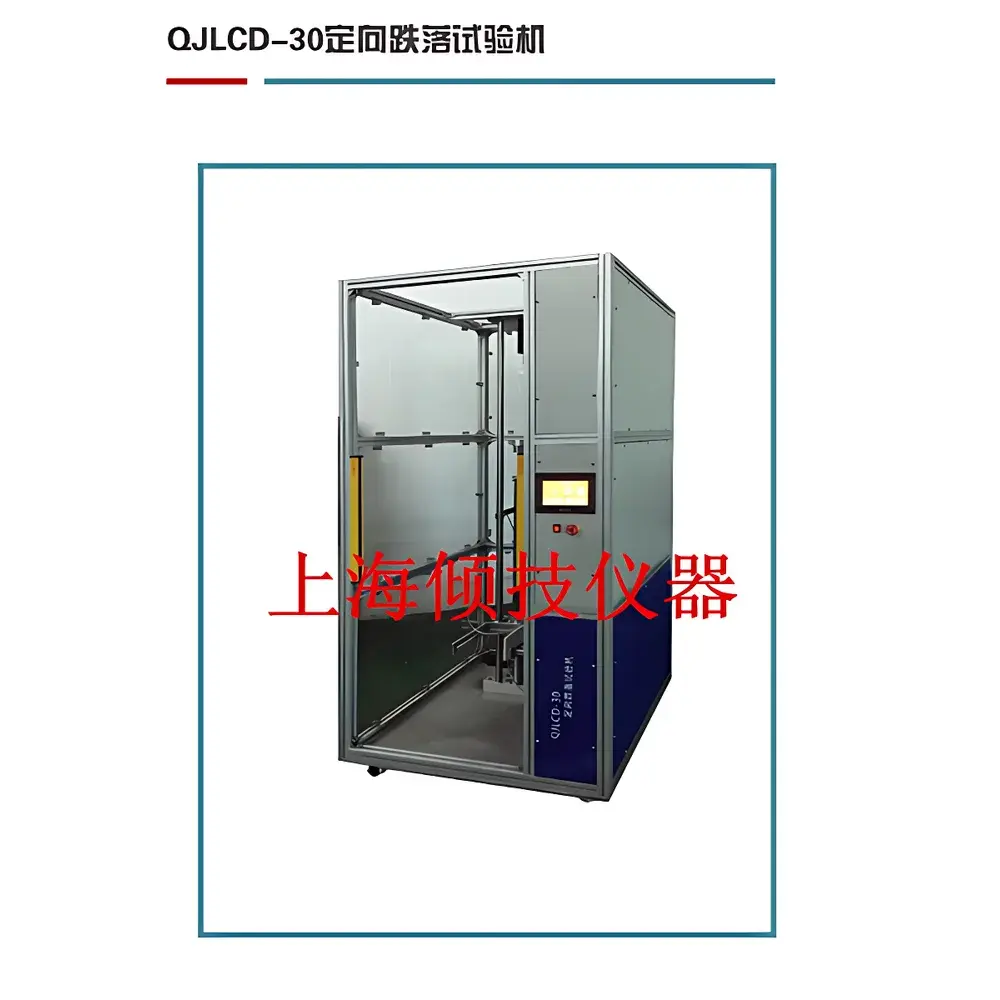
Qinji QJLCD Smartphone Cover Drop Tester
| Brand | Qinji |
|---|---|
| Origin | Shanghai, China |
| Manufacturer Type | Authorized Distributor |
| Country of Origin | China |
| Model | QJLCD |
| Price | USD 8,500 (FOB Shanghai) |
| Drop Height Range | 400–1800 mm (±0.5 mm positioning accuracy) |
| Drop Angles | 0°, 45°, 90° |
| Compliant Standards | IEC 60068-2-32 |
| Suction Cups | Six Ø16 mm vacuum cups |
| Sample Weight Capacity | ≤700 g |
| Test Surface Dimensions | 350 × 350 × 50 mm |
| Test Surface Material | Granite or Portland cement board (customizable) |
| Surface Roughness | Ra 0.59 µm (granite), Ra 1.29 µm (cement board) |
| Drive System | Servo motor + timing belt |
| Control System | HMI touchscreen + PLC |
| Air Supply | Clean compressed air ≥0.6 MPa |
| Power Supply | AC 220 V ±10%, 50 Hz |
| Rated Power | 400 W |
| Overall Dimensions | 800 × 900 × 2400 mm |
| Net Weight | 270 kg |
Overview
The Qinji QJLCD Smartphone Cover Drop Tester is an electromechanical impact testing system engineered for standardized mechanical durability evaluation of rigid flat-panel components—primarily smartphone front cover glasses (e.g., chemically strengthened aluminosilicate glass), display modules, and encapsulated touch sensor assemblies. It operates on the principle of controlled free-fall under gravity, where a vacuum-held specimen is released from a precisely defined height onto a rigid, calibrated impact surface. The system implements the drop test methodology specified in IEC 60068-2-32 (Environmental testing – Part 2-32: Tests – Test Ed: Free fall), ensuring reproducible boundary conditions for shock loading assessment. Unlike generalized drop towers, the QJLCD integrates multi-axis orientation capability via three independently actuated vacuum cup arrays, enabling systematic evaluation of edge, corner, and face impacts—critical failure modes in handheld device reliability qualification.
Key Features
- Precision servo-driven vertical lift mechanism with ±0.5 mm positional repeatability across the full 400–1800 mm drop height range
- Triple-axis vacuum cup configuration (six Ø16 mm cups) supporting 0° (face-down), 45° (edge-on), and 90° (corner-first) impact orientations per test sequence
- Modular impact surface assembly accommodating interchangeable granite (Ra 0.59 µm) and cement board (Ra 1.29 µm) plates, both dimensioned to 350 × 350 × 50 mm for ASTM E433-compliant surface flatness
- Integrated HMI touchscreen interface with PLC-based logic control, enabling parameter logging, test sequencing, and real-time status monitoring without external PCs
- Compressed-air vacuum system (≥0.6 MPa supply pressure) ensuring consistent suction force across all cups during acceleration and release phases
- Structural frame fabricated from reinforced steel with vibration-damped base mounting, minimizing energy dissipation outside the intended impact path
Sample Compatibility & Compliance
The QJLCD accommodates planar samples up to 700 g mass and typical smartphone cover dimensions (≤160 mm diagonal). Its orientation flexibility enables full IEC 60068-2-32 compliance testing—including all eight corners, four edges, and two major faces of rectangular specimens. The granite and cement impact surfaces are selected to replicate common real-world impact substrates while meeting surface roughness tolerances referenced in ISO 4287 and ASTM E1155. Device operation adheres to electrical safety requirements per IEC 61000-6-2 (immunity) and IEC 61000-6-4 (emissions), with CE marking documentation available upon request. While not certified for medical device validation, the system supports GLP-aligned test record generation when paired with external audit-trail-capable data acquisition software.
Software & Data Management
The embedded PLC controller logs each test cycle with timestamped metadata: nominal drop height, actual release height (encoder-verified), impact angle, total cycle count, elapsed test time, and cumulative operational hours. All parameters are stored in non-volatile memory and exportable via USB to CSV format for traceability. Optional RS-485 or Ethernet communication ports enable integration into centralized lab management systems (LIMS) for automated report generation. For regulated environments, third-party software add-ons can be configured to meet FDA 21 CFR Part 11 requirements—including electronic signatures, audit trails, and role-based access control—though native firmware does not include cryptographic signing or biometric authentication.
Applications
- Pre-production validation of cover glass fracture resistance against mechanical shock during consumer handling and accidental drops
- Comparative analysis of anti-shatter film performance under identical impact vectors
- Quality control screening of incoming cover glass batches prior to module assembly
- Root cause investigation of field-return failures involving edge chipping or corner cracking
- Supporting R&D efforts in glass composition optimization (e.g., ion-exchange depth vs. drop survivability)
- Supplemental testing for ISO 13485-certified medical device housings requiring impact resilience verification
FAQ
Does the QJLCD support automated pass/fail judgment based on post-test visual inspection?
No—the system records quantitative test parameters but does not incorporate machine vision or AI-based defect classification. Pass/fail determination remains a manual process conducted by qualified personnel per internal acceptance criteria.
Can the impact surface be replaced with aluminum or steel plate?
Yes—custom impact surfaces (e.g., 6061-T6 aluminum, AISI 1045 steel) can be supplied upon request; however, surface roughness, hardness, and flatness must be validated against IEC 60068-2-32 Annex A requirements to maintain test equivalence.
Is calibration certification included with shipment?
A factory calibration report verifying height encoder linearity and vacuum cup holding force is provided. Third-party accredited calibration (e.g., ISO/IEC 17025) is available as an optional service.
What maintenance intervals are recommended for long-term reliability?
Vacuum filters should be inspected monthly; timing belts and linear guide rails require lubrication every 500 operating hours; suction cup elastomers should be replaced after 10,000 drop cycles or visible wear.
Does the system comply with RoHS or REACH directives?
Yes—all structural materials and electronic components conform to EU Directive 2011/65/EU (RoHS2) and Regulation (EC) No 1907/2006 (REACH), with full material declarations available under NDA.



