
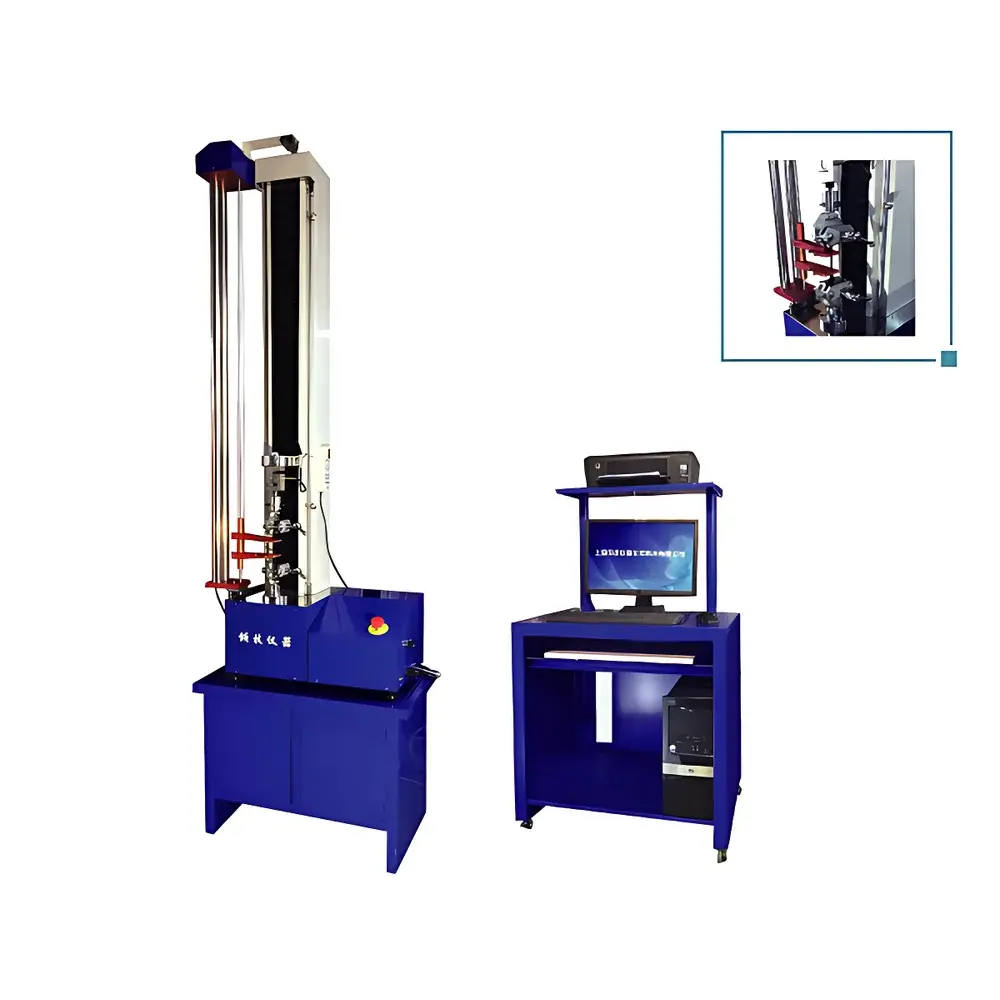
QJ210A Universal Testing Machine for Latex Glove Tensile Strength Testing
| Origin | Shanghai, China |
|---|---|
| Manufacturer Type | Authorized Distributor |
| Origin Category | Domestic (China) |
| Model | QJ210A |
| Price | USD 4,200 (FOB Shanghai) |
| Instrument Type | Electromechanical Universal Testing Machine |
| Load Capacity | Up to 5 kN |
| Accuracy Class | 0.5 |
| Effective Test Width | 150 mm |
| Max Travel Distance | 800 mm |
| Speed Range | 0.01–500 mm/min |
| Force Resolution | 500,000 counts (full-scale, no range switching) |
| Displacement Accuracy | ±0.5% of reading |
| Force Measurement Sensor | U.S.-sourced high-precision load cell |
| Control System | Panasonic full-digital AC servo controller |
| Power Supply | 200 V AC, 400 W |
| Dimensions (L×W×H) | 590 × 355 × 1640 mm |
| Weight | ~85 kg |
Overview
The QJ210A Universal Testing Machine is an electromechanical tensile testing system engineered for precise mechanical characterization of thin elastomeric medical products—particularly natural rubber latex gloves—within a 5 kN load capacity. It operates on the principle of controlled uniaxial force application via a servo-driven crosshead, measuring real-time load, displacement, and strain response in accordance with standardized tensile protocols defined in ISO 37, ASTM D412, and YY/T 0613–2014 (Chinese standard for medical gloves). Unlike legacy hydraulic or manual testers, the QJ210A integrates closed-loop digital servo control, enabling consistent strain-rate compliance and high reproducibility across repeated test cycles. Its modular frame architecture supports rapid fixture reconfiguration for multi-mode mechanical evaluation—including tensile strength, elongation at break, tear resistance (ASTM D624), puncture resistance (ISO 22313), peel adhesion (ASTM D903), and shear deformation—making it suitable for both QC laboratories and R&D environments in medical device manufacturing, PPE certification bodies, and regulatory testing labs.
Key Features
- High-accuracy force measurement with 0.5-class calibration traceable to national metrology institutes; full-scale resolution of 500,000 counts ensures stable sensitivity across the entire 5 N–5,000 N range without auto-ranging artifacts.
- Dual-speed crosshead actuation (fast jog + fine-tune mode) with programmable speed profiles from 0.01 to 500 mm/min, meeting ISO 527–1 and ASTM D882 requirements for low-strain-rate elastomer testing.
- Integrated digital display panel showing real-time force (N/kN), displacement (mm), and stress–strain curve visualization—enabling immediate operator verification prior to data export.
- Robust structural design featuring extruded aluminum enclosure with industrial-grade powder coating, minimizing thermal drift and mechanical resonance during dynamic loading.
- Comprehensive safety architecture: electronic limit switches, software-based overload cutoff (110% FS), automatic return-to-start function post-test, and dual-mode emergency stop (hardware + firmware).
- Modular fixture interface compatible with ISO-standard pneumatic, wedge, and pin-type grips—customizable for flat glove strips, finger-tip specimens, or rolled cuff sections per EN 455–2.
Sample Compatibility & Compliance
The QJ210A accommodates specimens conforming to standard glove test geometries defined in ISO 4074 (natural rubber latex surgical gloves) and ASTM D3577 (general-purpose rubber gloves). Specimen widths up to 150 mm and gauge lengths up to 800 mm allow full-thickness tensile evaluation of cut strips (typically 6 mm wide × 25 mm gauge length) as well as whole-finger burst tests. All mechanical outputs comply with GLP documentation requirements: raw force/displacement time-series data are timestamped, digitally signed, and stored with audit trail metadata. The system supports validation against ISO/IEC 17025 clause 6.4.10 (equipment verification), and its force transducer is certified per ISO 376:2011 Class 0.5. Test reports generated meet FDA 21 CFR Part 11 electronic record integrity criteria when paired with compliant PC software and user access controls.
Software & Data Management
The QJ210A interfaces with Windows-based testing software (v3.2+) supporting ASTM E4, ISO 179-1, and GB/T 228.1–2021 test method templates. Software features include automated parameter sequencing (pre-set ramp-hold-break cycles), real-time curve overlay comparison, statistical batch reporting (mean, SD, CV%, min/max), and export to CSV, PDF, or XML formats. Data encryption, user-level permissions (admin/operator/viewer), and electronic signature capture satisfy GMP Annex 11 and EU GMP Chapter 4 requirements. Optional integration with LIMS platforms via OPC UA or TCP/IP enables direct result ingestion into enterprise quality databases without manual transcription.
Applications
- Tensile strength and ultimate elongation testing of medical-grade latex, nitrile, and vinyl gloves per ISO 4074 and YY/T 0613.
- Puncture resistance assessment using conical or needle-type probes per ISO 22313 and ASTM F1342.
- Peel strength measurement of laminated glove cuffs or coated surfaces per ASTM D903.
- Quality conformance screening for incoming raw material (latex concentrate viscosity, film casting consistency) and finished goods release.
- Stability studies evaluating aging effects (thermal/UV/ozone exposure) on mechanical integrity over shelf life.
- Regulatory submission support for FDA 510(k), CE Marking (MDR Annex II), and NMPA registration dossiers.
FAQ
What standards does the QJ210A support out-of-the-box?
Preloaded test methods include ISO 37, ASTM D412, ISO 4074, YY/T 0613–2014, GB/T 528–2009, and EN 455–2. Custom method creation is enabled via script-based configuration.
Can the system be validated for ISO/IEC 17025 accreditation?
Yes—the machine includes factory calibration certificates (traceable to NIM, China), uncertainty budgets per ISO/IEC 17025:2017 Annex A.3, and IQ/OQ documentation templates.
Is third-party software required for FDA 21 CFR Part 11 compliance?
No. The native software provides role-based login, electronic signatures, audit trails, and data immutability—fully compliant when deployed on validated IT infrastructure.
What maintenance is recommended for long-term accuracy?
Annual recalibration of the load cell and displacement encoder is advised; routine verification using certified reference weights (Class M1) and gauge blocks (ISO 3651) should occur before each shift.
Does the system support automated specimen loading?
Not natively—but the open RS-232/USB/Ethernet API allows integration with robotic sample handlers or conveyor-fed indexing stages via custom PLC interfacing.



