
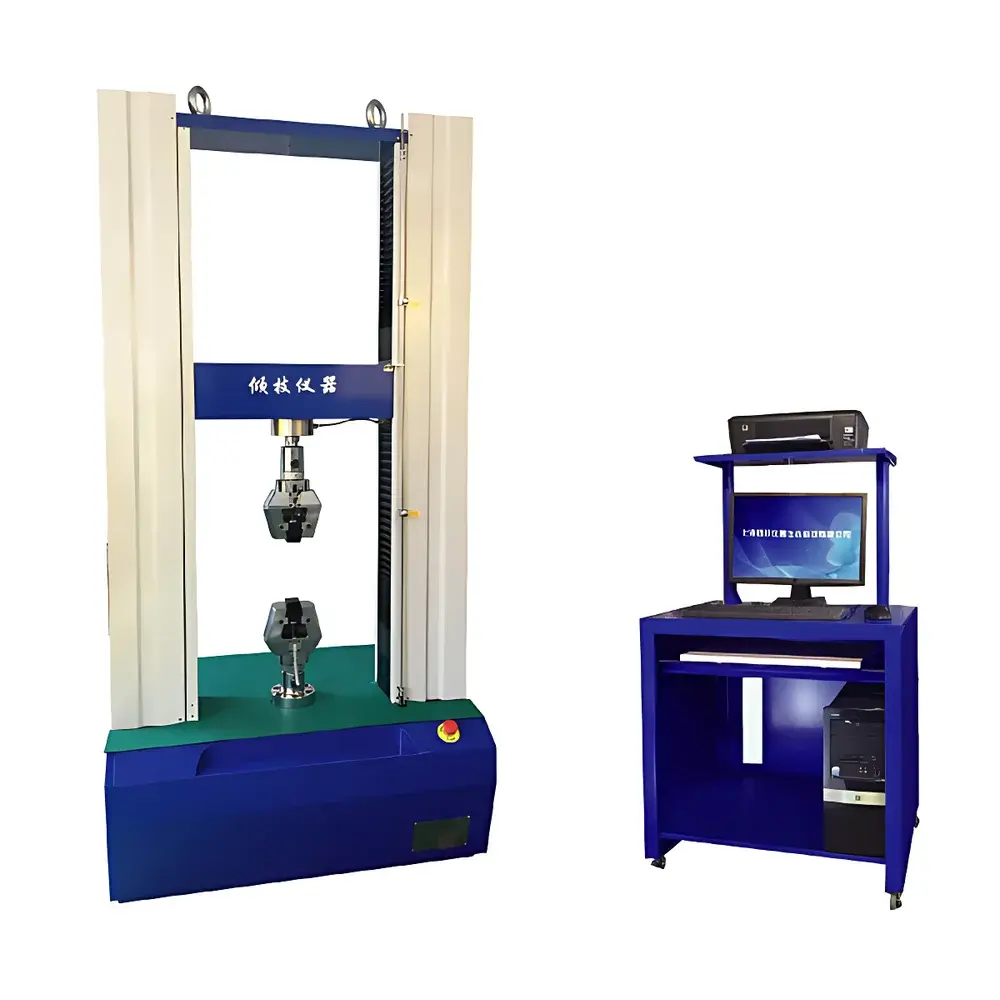
QJ212B 500 kN Universal Tensile and Compression Testing Machine
| Brand | Qinsun |
|---|---|
| Origin | Shanghai, China |
| Model | QJ212B |
| Load Capacity | 500 kN |
| Force Resolution | ±1/250000 (full-scale, no range switching) |
| Effective Test Width | 500 mm |
| Max. Tensile Travel | 600 mm or 800 mm |
| Speed Range | 5–300 mm/min (adjustable) |
| Accuracy | ±1% of reading (load, displacement, strain) |
| Protection | Electronic limit switch, overload protection at 110% of full scale |
| Motor Power | 4 kW |
| Dimensions (W×D×H) | 960 × 650 × 2000 mm |
| Weight | ~850 kg |
| Compliance | ISO 6892-1, ASTM E4, ASTM E8, ASTM D638, ASTM D790, ISO 178, ISO 527, EN 10002-1 |
Overview
The QJ212B 500 kN Universal Testing Machine is a high-capacity electromechanical system engineered for precision mechanical property characterization of metallic, polymeric, composite, ceramic, and elastomeric materials under uniaxial loading conditions. Based on servo-controlled closed-loop force and displacement actuation, the machine implements standard test methodologies defined in ISO 6892-1 (tensile testing of metals), ASTM E8/E4 (tension/compression testing of metallic materials), ASTM D638/D790 (tensile/flexural testing of plastics), and ISO 178/527 (flexural/tensile behavior of rigid plastics). Its modular load frame architecture supports interchangeable fixtures—including wedge-action grips, compression platens, bend jigs, peel fixtures, and shear adapters—enabling standardized execution of tensile, compression, flexure, peel, tear, shear, puncture, and low-frequency fatigue tests within a single platform. The system operates under Windows-based control software with real-time data acquisition at up to 1 kHz sampling rate, ensuring high-fidelity capture of stress–strain, load–displacement, and time-dependent response curves.
Key Features
- High-force capacity up to 500 kN with dual-range load cell options (10–500 kN) and constant resolution of ±1/250,000 full scale—no manual range switching required
- Precision crosshead positioning via AC servo motor and ball-screw drive, delivering smooth, repeatable motion across the full speed range of 5–300 mm/min
- Robust two-column steel frame with reinforced base and top beam, designed to minimize deflection and ensure axial alignment per ASTM E4 calibration requirements
- Integrated electronic limit switches and programmable over-travel protection, plus automatic overload shutdown at 110% of selected load range
- Dual-speed manual jog control for rapid sample setup and fine-positioning; automated return-to-start function post-test
- Real-time graphical display of test curves (load vs. displacement, stress vs. strain, modulus vs. time) with dynamic zoom, overlay, and curve arithmetic functions
- Compliance with ISO 7500-1 Class 1 accuracy requirements for static force measurement systems
Sample Compatibility & Compliance
The QJ212B accommodates specimens conforming to standard geometries defined in ASTM, ISO, and EN test methods—including flat sheet, round bar, notched tensile coupons, I-beam flexure samples, and laminated composites. Grip configurations support both mechanical wedge-action clamping and pneumatic/hydraulic actuation for high-grip-force applications. All test procedures adhere to GLP-aligned data integrity principles: each test record includes timestamped metadata (operator ID, environmental conditions, calibration status), digital signature fields, and audit-trail-enabled editing history. The system supports export of raw ASCII data files compatible with third-party analysis tools (MATLAB, Python, OriginLab) and generates PDF reports compliant with ISO/IEC 17025 documentation requirements.
Software & Data Management
Control and analysis are performed using Qinsun’s proprietary WinTest v4.x software suite, built on Microsoft .NET Framework and certified for Windows 10/11 (64-bit). The software provides full 21 CFR Part 11 readiness through role-based user access control, electronic signatures, and immutable audit logs for all test parameter modifications and result exports. Data acquisition supports synchronized multi-channel input—including extensometer displacement, strain gauge signals, and environmental chamber feedback. Curve processing tools include automatic yield point detection (0.2% offset method), tangent/ secant modulus calculation, fracture energy integration, and cyclic hysteresis loop analysis. All datasets are stored in encrypted SQLite databases with optional network backup and centralized server synchronization.
Applications
This system is routinely deployed in quality control laboratories, R&D centers, and third-party testing facilities for mechanical validation of structural components, weld integrity assessment, polymer formulation development, composite layup optimization, biomedical implant verification, and aerospace fastener qualification. Typical use cases include determination of ultimate tensile strength (UTS), yield strength (Rp0.2), elongation at break, Young’s modulus, compressive yield stress, flexural modulus, interlaminar shear strength (ILSS), and creep compliance under controlled loading profiles. It also supports ISO 1099-compliant low-cycle fatigue testing with programmable load waveforms (sinusoidal, trapezoidal, block loading).
FAQ
What international standards does the QJ212B support out-of-the-box?
The system is pre-configured with test templates for ISO 6892-1, ASTM E8, ASTM D638, ASTM D790, ISO 178, and EN 10002-1. Custom protocol definitions can be added via the software’s script editor.
Is the system suitable for testing brittle ceramics or high-strength alloys?
Yes—when equipped with appropriate high-rigidity fixtures and calibrated load cells, the QJ212B meets ISO 7500-1 Class 1 requirements for materials with yield strengths exceeding 1,200 MPa and fracture toughness values down to sub-millimeter crack lengths.
Can test data be exported in CSV or XML format for LIMS integration?
Yes—WinTest supports direct export to CSV, XML, and PDF formats. An optional OPC UA interface module enables real-time data streaming to enterprise MES or LIMS platforms.
Does the machine require annual recalibration by an accredited body?
Per ISO/IEC 17025 and ASTM E74 guidelines, we recommend traceable recalibration every 12 months using NIST-traceable deadweight standards; full calibration certificates with uncertainty budgets are provided upon service completion.
What safety certifications does the host system carry?
The QJ212B complies with CE marking requirements under Machinery Directive 2006/42/EC and EMCD 2014/30/EU, including EN ISO 12100 risk assessment and EN 60204-1 electrical safety compliance.



