
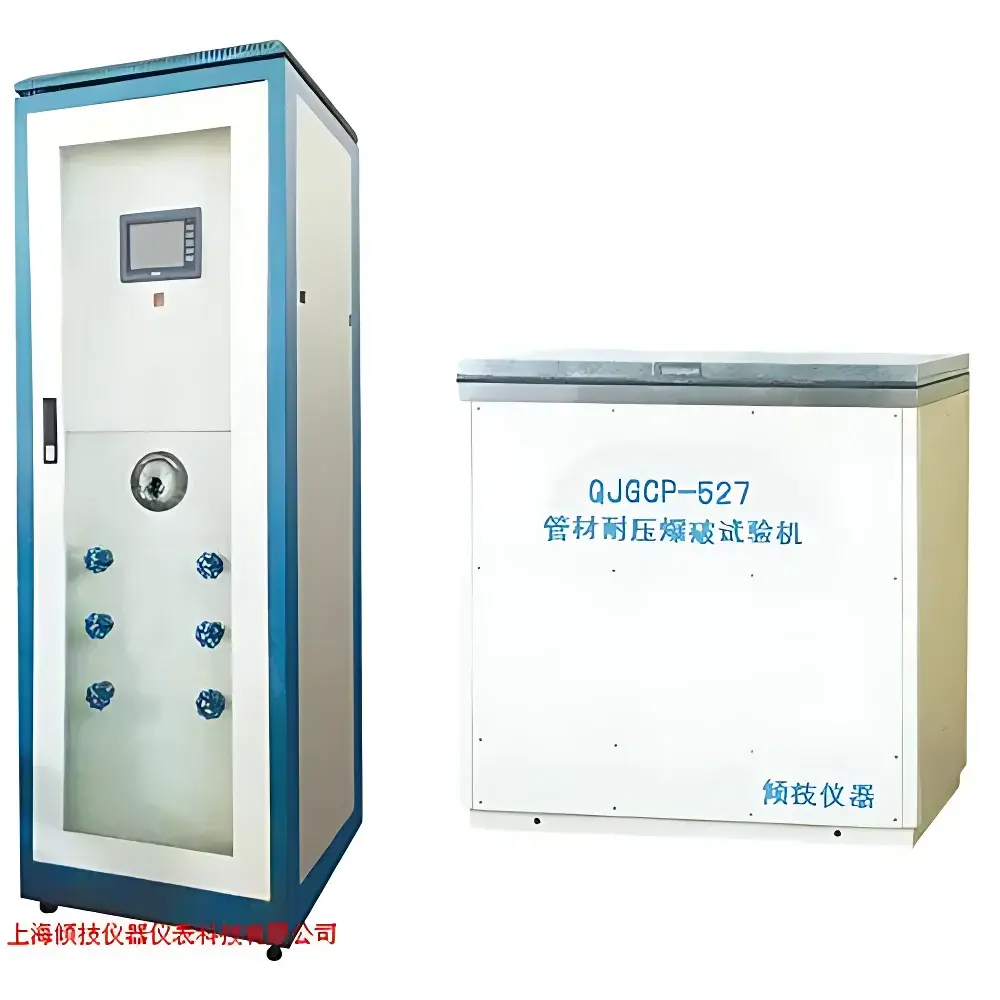
Qingji GCP-527 Plastic Pipe Hydrostatic Pressure & Burst Testing Machine
| Brand | Qingji |
|---|---|
| Origin | Shanghai, China |
| Model | GCP-527 |
| Pressure Range | 0–55 MPa |
| Pressure Resolution | 0.001 MPa |
| Pressure Control Accuracy | ±0.1% of setpoint |
| Temperature Control Range | Ambient to 95 °C |
| Temperature Display Accuracy | ±1 °C |
| Test Duration Range | 0 min to 9999.59 h |
| Time Resolution | 1 s |
| Power Supply (Pressure System) | AC 380 V, 1.5 kW |
| Power Supply (Temperature System) | AC 380 V, 9 kW |
| Compliance | ISO 1167, GB/T 6111 |
Overview
The Qingji GCP-527 Plastic Pipe Hydrostatic Pressure & Burst Testing Machine is a precision-engineered static pressure endurance and burst resistance evaluation system designed for thermoplastic and composite piping materials used in fluid conveyance applications. It operates on the principle of controlled hydrostatic (or pneumatic) pressurization under stabilized thermal conditions, enabling standardized long-term hydrostatic strength (LTHS) determination and instantaneous burst pressure measurement per internationally recognized test protocols. The instrument implements closed-loop digital pressure regulation with real-time feedback, coupled with PID-controlled thermal immersion media circulation, ensuring stable boundary conditions throughout extended test durations—critical for generating reproducible data required in material qualification, product certification, and regulatory submission dossiers.
Key Features
- Programmable pressure ramping, holding, and stepwise cycling across 0–55 MPa range with 0.001 MPa resolution and ±0.1% control fidelity—enabling precise emulation of service stress profiles.
- Integrated thermostatic bath system maintaining uniform temperature from ambient to 95 °C (±1 °C), compliant with ISO 1167 Part 1 & 2 and GB/T 6111 requirements for temperature-dependent pressure testing.
- Three independent test channels supported by a single central control unit—allowing concurrent evaluation of multiple specimens under identical or differentiated pressure/temperature/time profiles.
- Dual-power architecture: dedicated 1.5 kW variable-frequency drive for high-fidelity pressure generation and 9 kW heating/circulation subsystem for rapid thermal equilibration and stability.
- Automated data acquisition with timestamped pressure, temperature, and elapsed time logging at user-defined intervals; built-in calculation engine computes burst pressure, hoop stress, and time-to-failure metrics per ASTM D1598 and ISO 1167 Annex C conventions.
- Thermal-resistant immersion tank constructed from stainless steel 316 with corrosion-resistant sealing interfaces, compatible with water, glycol-water mixtures, and other non-aggressive heat transfer media.
Sample Compatibility & Compliance
The GCP-527 accommodates rigid and semi-rigid thermoplastic pipes—including PVC-U, PE 80/100, PP-R, ABS, and multilayer composites—with diameters configurable via user-selected fixture sets (fixtures sold separately). Specimen mounting follows ISO 1167 Clause 6 and GB/T 6111 Section 5 guidelines for end-capping, sealing, and support geometry. All pressure transducers are traceably calibrated to NIST-equivalent national standards. The system supports full audit trails for GLP-compliant laboratories and meets functional prerequisites for FDA 21 CFR Part 11 readiness when integrated with validated third-party LIMS or ELN platforms.
Software & Data Management
The embedded controller runs deterministic real-time firmware supporting ISO-compliant test sequence definition—including constant-pressure hold, linear ramp, multi-step cycling, and burst-triggered emergency shutdown. Raw sensor data (pressure, temperature, time) is stored in CSV-compatible binary format with embedded metadata (operator ID, sample ID, test standard, environmental log). Optional PC-based software provides graphical trend analysis, Weibull distribution fitting for failure probability modeling, and automated report generation conforming to ISO 1167 Annex D templates. Exported datasets retain full traceability for internal QA review or external accreditation audits (e.g., CNAS, UKAS, A2LA).
Applications
- Determination of minimum required strength (MRS) and design coefficient (C) derivation for PE and PP pipe grades per ISO 9080.
- Validation of pressure class ratings (e.g., PN10, PN16, PN20) for municipal water and gas distribution systems.
- Accelerated life testing of cross-linked polyethylene (PEX) and multilayer barrier pipes under elevated temperature/pressure combinations.
- Quality assurance screening of extruded pipe batches prior to field installation—detecting microstructural defects, interfacial delamination, or inconsistent wall thickness effects.
- Supporting technical documentation for CE marking (PED 2014/68/EU Annex I compliance assessment) and NSF/ANSI 14 certification submissions.
FAQ
What standards does the GCP-527 directly support?
ISO 1167-1:2019, ISO 1167-2:2019, GB/T 6111–2018, ASTM D1598, and EN 921 for hydrostatic endurance and burst testing of thermoplastic piping.
Can the system perform both long-term creep rupture and instantaneous burst tests in one setup?
Yes—the same pressure train and thermal bath serve both test modes; only the control profile (time-dependent hold vs. rapid ramp-to-failure) differs.
Is third-party calibration documentation provided with shipment?
Each unit ships with a factory calibration certificate covering pressure transducers and temperature sensors, traceable to national metrology institutes per ISO/IEC 17025 requirements.
Are custom fixtures available for non-standard pipe geometries?
Yes—Qingji offers OEM fixture design services for oval, corrugated, or reinforced profiles, subject to dimensional specifications and material compatibility review.
Does the system meet electromagnetic compatibility (EMC) and safety directives for EU deployment?
The GCP-527 complies with IEC 61000-6-2 (immunity) and IEC 61000-6-4 (emission), and carries CE marking under Machinery Directive 2006/42/EC with full technical file available upon request.



