
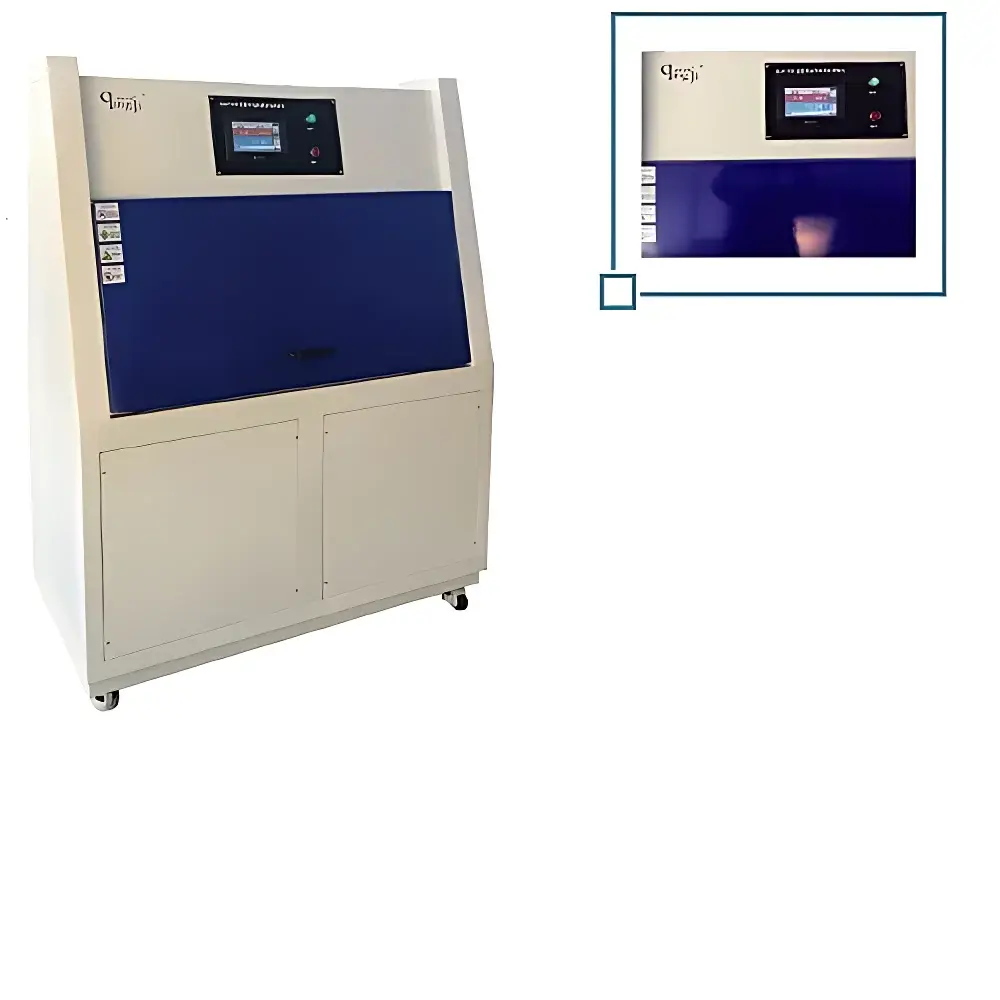
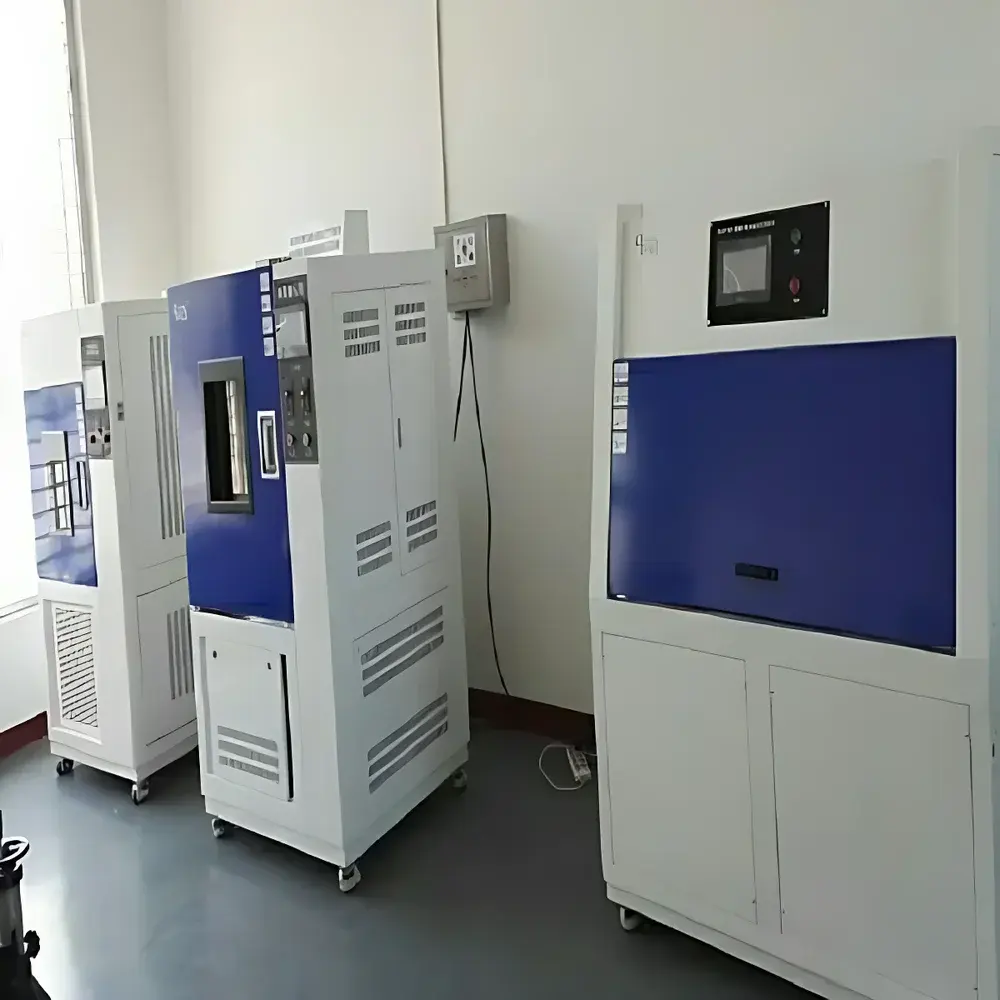
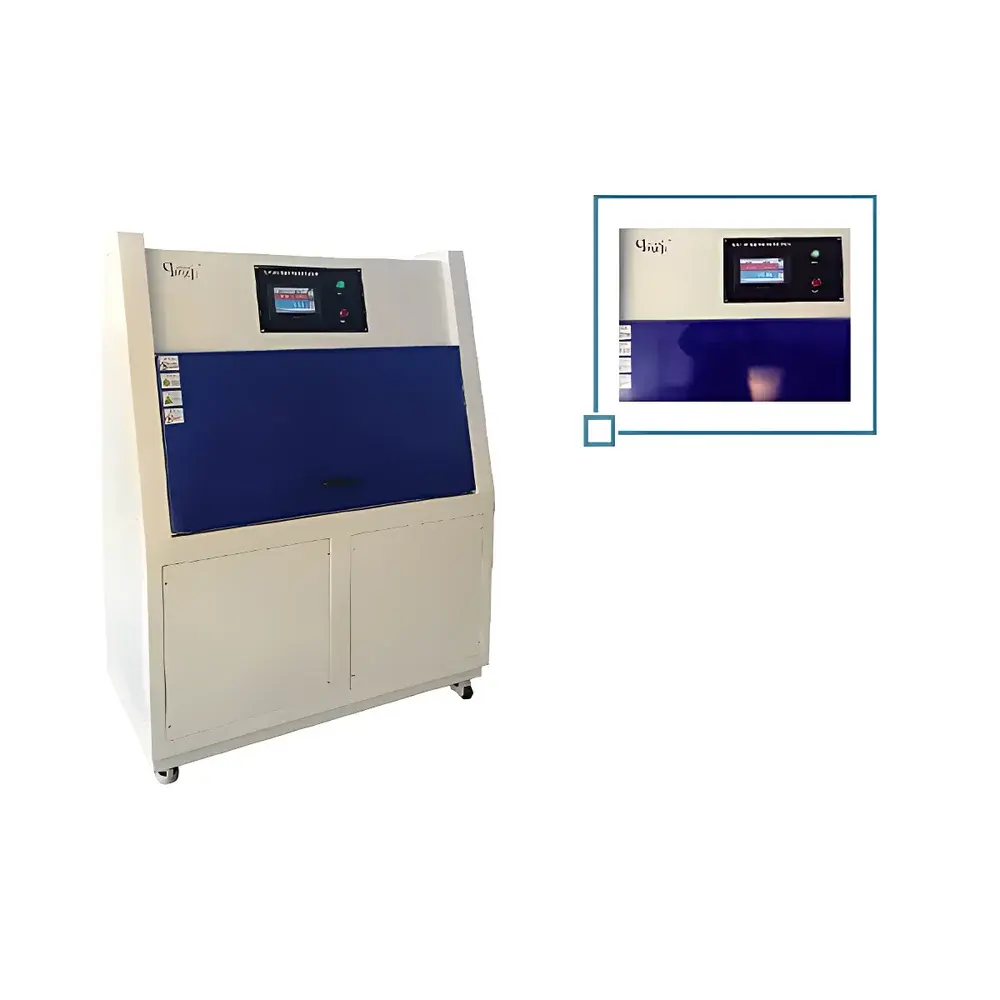
Qingji QUV1003 UV Aging Test Chamber
| Brand | Qingji |
|---|---|
| Origin | Shanghai, China |
| Model | QUV1003 |
| Irradiance Range | 0.72 W/m² (at 313 nm) |
| Cycle Options | 4 h UV irradiation + 4 h condensation OR 8 h UV irradiation + 4 h condensation |
| Illumination Temperature Range | RT+10°C to 70°C |
| Black Panel Temperature Range | RT+10°C to 70°C |
| UV Spectrum | UV-B, 280–315 nm |
| Chamber Internal Dimensions (L×W×H) | 450 × 1165 × 500 mm |
| Temperature Uniformity | ±3°C |
| Relative Humidity During Condensation | ≥75% RH |
| Specimen-to-Lamp Distance | 55 mm |
| Lamp Center Spacing | 65–70 mm |
| Standard Specimen Size | 75 × 150 mm |
| Water Consumption | ~8 L/day (deionized or distilled water required) |
| External Dimensions (D×W×H) | 600 × 1325 × 1480 mm |
Overview
The Qingji QUV1003 UV Aging Test Chamber is an engineered environmental test system designed to accelerate material degradation under controlled ultraviolet radiation, thermal stress, and moisture exposure—mimicking key outdoor weathering factors including solar UV irradiance, dew formation, and thermal cycling. Based on the fundamental principles of photochemical degradation and hydrolytic aging, the QUV1003 employs fluorescent UV-B lamps (280–315 nm) to replicate the most damaging short-wavelength portion of terrestrial sunlight. Its operational architecture follows ASTM G154, ISO 4892-3, and GB/T 14522–1993 standards for accelerated UV exposure testing, enabling quantitative assessment of surface deterioration mechanisms such as chalking, gloss loss, color shift, cracking, embrittlement, and polymer chain scission.
Key Features
- UV-B spectral output (280–315 nm) with calibrated irradiance control at 0.72 W/m² @ 313 nm—ensuring reproducible photodegradation kinetics across test runs
- Dual-cycle programmability: configurable sequences of 4 h UV exposure + 4 h condensation or 8 h UV + 4 h condensation, supporting both ISO-compliant and custom aging protocols
- Precise black panel temperature control (RT+10°C to 70°C), critical for correlating specimen surface temperature with real-world thermal loading during solar exposure
- Uniform illumination zone maintained via optimized lamp array geometry (center spacing 65–70 mm) and fixed 55 mm specimen-to-lamp distance
- Condensation cycle executed via bottom-mounted water reservoir and controlled chamber wall cooling—generating realistic dew-like moisture without direct spray interference
- Stainless steel interior chamber (450 × 1165 × 500 mm internal volume) resistant to UV-induced corrosion and humidity-related oxidation
- Integrated temperature uniformity ≤ ±3°C across specimen plane, validated per ASTM E2309 and ISO 17025 traceable calibration practices
Sample Compatibility & Compliance
The QUV1003 accommodates standard flat specimens measuring 75 × 150 mm, compatible with industry-standard mounting racks and multi-position sample holders. It supports polymeric films, coatings, automotive trim, architectural sealants, geotextiles, and elastomeric composites. All operational parameters align with internationally recognized test standards including ASTM G154 (Cycle 1 & 4), ISO 4892-3 (Method A, UV-B), and GB/T 14522–1993 for mechanical industrial materials. The chamber’s design enables full traceability of exposure conditions—temperature, irradiance, and cycle timing—supporting GLP-compliant reporting and audit-ready documentation for QC/QA laboratories.
Software & Data Management
While the QUV1003 operates via intuitive manual control interface with digital PID controllers, it supports external data logging via RS-232/485 outputs. Users may integrate third-party SCADA systems or LabVIEW-based acquisition platforms to record time-stamped irradiance, black panel temperature, and chamber humidity—enabling post-test correlation with spectral reflectance (ASTM E308), tensile strength (ISO 527), or colorimetric delta-E values (CIE L*a*b*). The system meets foundational requirements for FDA 21 CFR Part 11 compliance when paired with validated electronic lab notebook (ELN) solutions featuring audit trails and user access controls.
Applications
- Evaluation of UV stabilizers in polyolefins, PVC, and acrylic resins
- Correlation studies between accelerated QUV exposure and natural weathering in automotive exterior components
- Qualification of protective coatings for marine and aerospace applications per MIL-STD-810H Method 505.6
- Assessment of photostability in medical device polymers subject to ISO 10993-12 biocompatibility testing
- Pre-screening of architectural cladding materials prior to outdoor Florida or Arizona exposure trials
- Failure analysis of encapsulants and adhesives used in photovoltaic module manufacturing
FAQ
What UV spectrum does the QUV1003 generate, and how is it calibrated?
The unit utilizes UV-B fluorescent lamps emitting within 280–315 nm, with peak intensity centered near 313 nm. Irradiance is factory-calibrated to 0.72 W/m² at 313 nm using NIST-traceable radiometers.
Is distilled water mandatory for the condensation cycle?
Yes—deionized or distilled water is required to prevent mineral deposition on chamber walls and lamp surfaces, which would otherwise attenuate UV transmission and compromise temperature uniformity.
Can the QUV1003 meet ISO 4892-3 Annex A requirements for irradiance monitoring?
When equipped with optional calibrated UV radiometer integration (e.g., Q-Sun UV sensor kit), the system satisfies Annex A’s requirement for continuous irradiance measurement and automatic exposure dose calculation.
What maintenance intervals are recommended for lamp replacement and calibration verification?
UV lamps should be replaced every 1,600 hours of operation or at 12-month intervals—whichever occurs first. Annual recalibration of temperature sensors and irradiance output is advised per ISO/IEC 17025 laboratory practice guidelines.



