
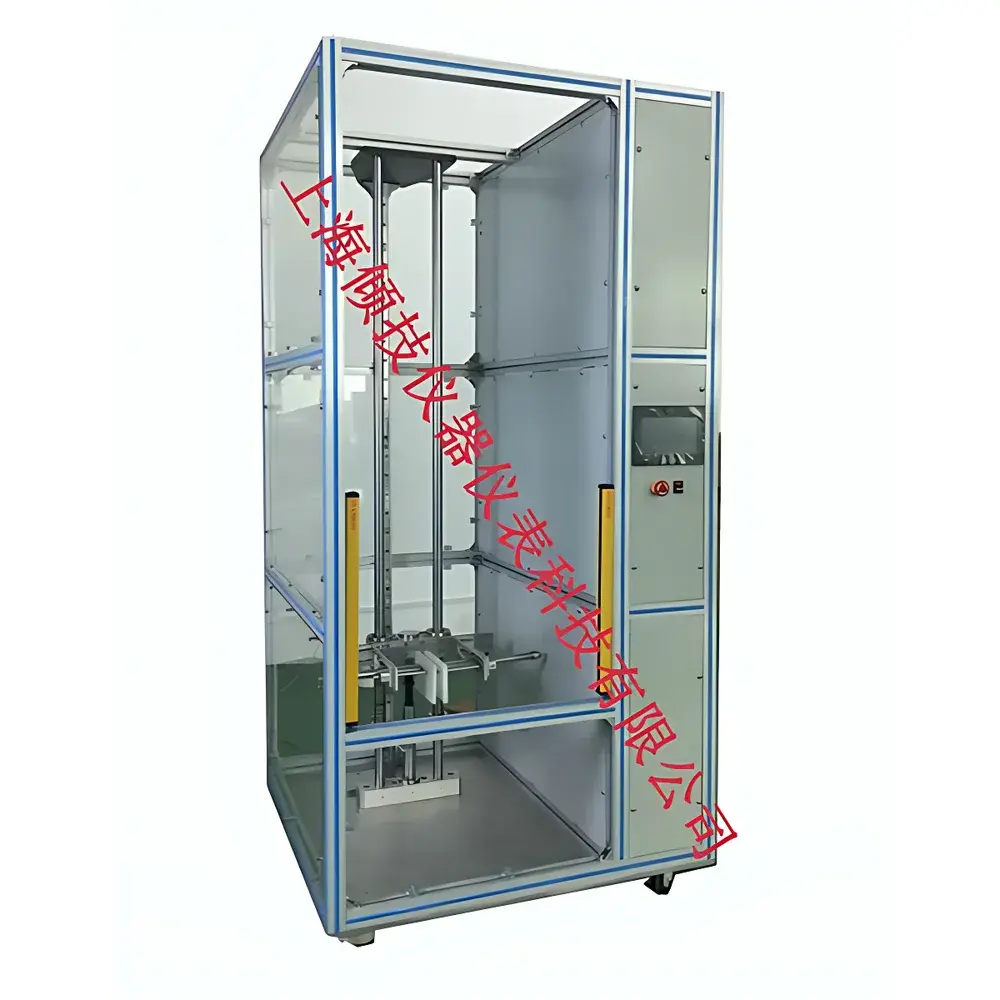
Qingji QJLCD-30 Smartphone Controlled Drop Tester
| Brand | Qingji |
|---|---|
| Origin | Shanghai, China |
| Model | QJLCD-30 |
| Drop Height Range | 400–1800 mm |
| Max. Specimen Weight | 700 g |
| Max. Specimen Dimensions | 350 × 350 × 50 mm |
| Drop Surface Dimensions | 350 × 350 × 50 mm |
| Drop Angle Options | 0°, 45°, 90° |
| Positioning Accuracy | ±0.5 mm |
| Vacuum Suction Cups | Six Ø16 mm units |
| Power Supply | AC 220 V ±10%, 50 Hz |
| Rated Power | 400 W |
| Compressed Air Requirement | ≥0.6 MPa, clean and dry |
| Overall Dimensions | 800 × 900 × 2400 mm |
| Net Weight | 270 kg |
| Compliance | IEC 60068-2-32 |
Overview
The Qingji QJLCD-30 Smartphone Controlled Drop Tester is an electromechanically actuated, programmable impact testing system engineered for standardized mechanical durability evaluation of portable electronic devices—particularly smartphones, tablets, wearables, and compact consumer electronics. It operates on the principle of controlled free-fall under gravity, with precise vertical positioning and angular orientation to replicate real-world drop scenarios onto defined impact surfaces. Unlike conventional manual or pneumatic drop testers, the QJLCD-30 integrates a servo-motor-driven lifting mechanism coupled with PLC-based logic control and a 7-inch industrial touchscreen HMI, enabling repeatable, traceable, and audit-ready test execution. Its design conforms strictly to the acceleration boundary conditions and procedural requirements outlined in IEC 60068-2-32 (Environmental testing – Part 2-32: Tests – Test Ed: Free fall), ensuring metrological consistency across laboratories and production QA environments.
Key Features
- Three-axis programmable orientation: Independent vacuum cup mounting enables sequential testing of flat faces, edges, and corners—covering all 6 faces, 12 edges, and 8 vertices of rectangular specimens per IEC-defined drop sequences.
- Precision height control: Servo motor + timing belt drive achieves ±0.5 mm positional repeatability across the full 400–1800 mm drop range, minimizing gravitational acceleration variance between tests.
- Multi-angle drop capability: Fixed-angle release positions at 0° (face-down), 45° (edge-down), and 90° (corner-down) are mechanically indexed and verified via calibrated inclinometer feedback.
- Integrated data acquisition: Real-time logging of drop height, calculated terminal velocity (v = √2gh), estimated peak deceleration (derived from height and surface compliance), cycle count, and elapsed test time—all timestamped and exportable via USB.
- Rigid impact base options: Standard configurations include precision-ground granite (Ra ≈ 0.59 µm) and cured Portland cement board (Ra ≈ 1.29 µm), both dimensionally stable and compliant with IEC-specified surface hardness and flatness tolerances.
- Industrial-grade control architecture: PLC core ensures deterministic timing (<10 ms response latency), while the HMI supports recipe-based test setup, user-level access control (operator/engineer/admin), and event logging with ISO/IEC 17025-aligned metadata tagging.
Sample Compatibility & Compliance
The QJLCD-30 accommodates specimens up to 350 mm × 350 mm × 50 mm and 700 g—covering the vast majority of modern smartphones, phablets, smartwatches, TWS earbuds cases, and handheld medical monitors. Its modular vacuum chuck system (six Ø16 mm cups, individually controllable) allows secure fixation of asymmetric or curved devices without mechanical clamping-induced stress. All operational parameters—including height setpoints, angle selection, dwell time pre-release, and cycle repetition—are fully configurable to align with internal reliability protocols or external standards including IEC 60068-2-32, MIL-STD-810H Method 516.8 (Drop), and GB/T 4857.5 (Chinese national packaging drop standard). The system’s mechanical rigidity, surface flatness certification, and air-supply filtration specifications meet GLP-compliant laboratory infrastructure requirements.
Software & Data Management
The embedded HMI firmware supports CSV export of raw test logs—including date/time stamps, operator ID, specimen ID, height, angle, pass/fail flag (user-assignable), and cumulative cycle count. No proprietary software installation is required; exported files are natively readable in Excel, LabVIEW, or LIMS platforms. Audit trails record all parameter modifications, emergency stops, and calibration events with immutable timestamps. While the base configuration does not include 21 CFR Part 11-compliant electronic signatures, optional firmware upgrade packages support role-based authentication, electronic signature capture, and encrypted log archiving—enabling deployment in FDA-regulated medical device manufacturing and validation labs.
Applications
- Pre-production design validation of housing materials, structural adhesives, and internal component mounting schemes.
- Comparative durability benchmarking across OEM supplier tiers using identical drop vectors and surface conditions.
- Quality gate testing in final assembly lines—integrated via digital I/O signals into MES systems for automated pass/fail routing.
- Root-cause analysis of field return failures by replicating reported drop orientations and correlating with post-test X-ray CT or acoustic emission scans.
- Accelerated life modeling where cumulative drop cycles serve as input variables in Weibull reliability analysis frameworks.
FAQ
What standards does the QJLCD-30 explicitly comply with?
It is designed and verified to meet the mechanical and procedural requirements of IEC 60068-2-32. Optional calibration certificates (traceable to NIM or CNAS-accredited labs) can be provided upon request.
Can the drop surface be customized beyond granite and cement board?
Yes—custom impact surfaces including stainless steel, aluminum alloy, tempered glass, or polymer composites can be fabricated to match specific product use-case environments (e.g., automotive center consoles or retail display fixtures).
Is remote monitoring or network connectivity supported?
Standard configuration includes USB data export only. Ethernet or Modbus TCP interfaces are available as factory-installed options for integration into centralized test management systems.
What maintenance intervals are recommended for long-term accuracy?
Vacuum cup inspection and replacement every 10,000 cycles; servo motor encoder calibration annually; granite surface flatness verification biannually using Class 0 granite reference plates.
Does the system support variable-height multi-drop sequences within a single test program?
Yes—up to 99 programmable drop steps per test routine, each with independent height, angle, dwell time, and pass/fail criteria assignment.



