
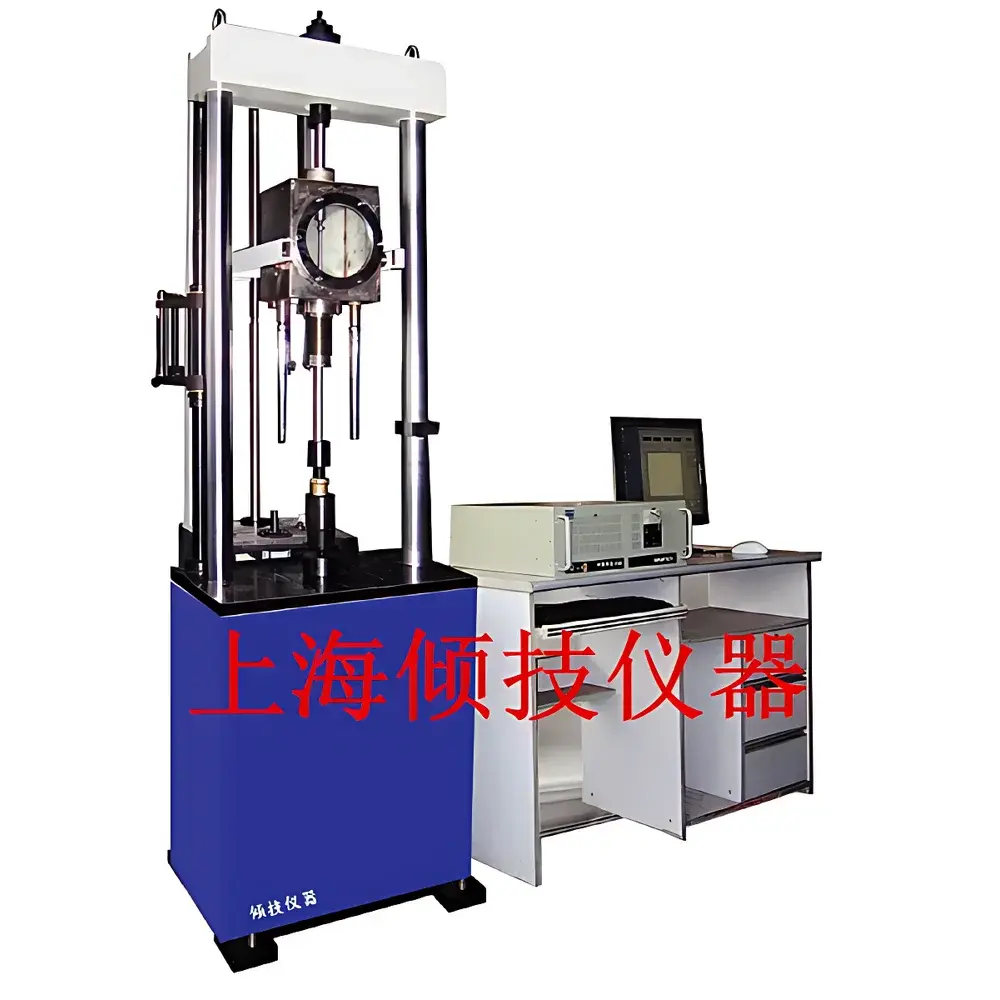
QJBV212P Electronic Stress Corrosion Testing Machine
| Origin | Shanghai, China |
|---|---|
| Manufacturer Type | Authorized Distributor |
| Origin Category | Domestic (China) |
| Model | QJBV212P |
| Price | USD 21,000 (FOB Shanghai) |
| Max Test Load | 100 kN |
| Force Measurement Range | 1–100% FS |
| Force Accuracy | ≤ ±0.5% of reading |
| Force Stability | ≤ ±0.5% of set value |
| Crosshead Travel | ≥80 mm |
| Stroke Speed Range | 0.01–60 mm/min |
| Strain Rate Range | 1×10⁻⁶ to 1 mm/s |
| Specimen Dimensions | Ø10 mm × 180 mm (30 mm gauge length) |
| Operating Temperature Range | RT+10°C to 60°C |
| Temp. Uniformity | ≤ ±2°C |
| Corrosion Cell Volume | ≥400 mL |
| Control Architecture | Dual-ARM Digital Controller with Adaptive PID |
| Communication | Ethernet (TCP/IP), DCS-integrated |
| Compliance | GB/T 15970.7–2000, HB 7235–1995 |
Overview
The QJBV212P Electronic Stress Corrosion Testing Machine is an engineered platform for evaluating the susceptibility of metallic materials and components to environmentally assisted cracking under sustained tensile loading in aggressive chemical environments. It operates on the principle of slow strain rate testing (SSRT), where a controlled, low-rate uniaxial deformation is applied to a standardized specimen immersed in a defined corrosive medium—enabling quantitative assessment of time-to-failure, crack initiation threshold, and fracture morphology under coupled mechanical and electrochemical stress. Designed specifically for research laboratories, quality control departments, and materials certification bodies, the system supports full compliance with GB/T 15970.7–2000 (“Methods for Determination of Stress Corrosion Cracking Susceptibility — Part 7: Slow Strain Rate Testing”) and HB 7235–1995 (“Slow Strain Rate Stress Corrosion Testing Method for Metallic Materials”), both of which align structurally with ISO 7539-7 and ASTM G129 practices.
Key Features
- Monolithic cast-steel load frame eliminates residual welding stresses and ensures structural rigidity under full 100 kN load; frame deformation remains negligible during long-duration tests (>1,000 hours), preserving alignment integrity between actuator, load cell, and specimen grip axes.
- Dual-ARM digital controller architecture separates real-time motion control from high-throughput data acquisition and processing—enabling synchronous logging of force, displacement, temperature, and environmental parameters at up to 1 kHz sampling rate without latency or buffer overflow.
- Adaptive PID control algorithm automatically adjusts loop gains based on material stiffness and load history, eliminating manual tuning across diverse alloys (e.g., stainless steels, aluminum alloys, titanium grades) and ensuring ≤±0.5% force stability over extended test durations.
- Integrated 7-inch industrial touchscreen HMI allows local test setup—including strain rate profile definition, hold steps, load limits, and thermal ramping—without external PC dependency; dual mechanical end-stop limit switches provide hardware-level overtravel protection independent of software logic.
- Corrosion chamber assembly features chemically resistant PTFE-coated stainless steel construction, modular sealing interfaces, and calibrated immersion depth markers to ensure reproducible electrolyte volume (≥400 mL) and consistent electrode geometry per test.
Sample Compatibility & Compliance
The QJBV212P accommodates standard cylindrical specimens per GB/T 15970.7 (Ø10 mm × 180 mm, 30 mm gauge length), with optional custom fixtures available for flat-sheet, notched, or pre-cracked geometries. Temperature control is maintained via integrated PID-heated bath (RT+10°C to 60°C, ±2°C uniformity) compatible with aqueous chloride, hydrogen sulfide, caustic, and acidic solutions. All firmware and measurement algorithms are traceable to NIST-traceable calibration standards. The system’s data structure supports audit-ready export formats (CSV, XML) compliant with GLP and ISO/IEC 17025 documentation requirements. While not certified to FDA 21 CFR Part 11 out-of-the-box, the software architecture permits integration with third-party electronic signature and audit trail modules for regulated environments.
Software & Data Management
The proprietary test control and analysis suite provides real-time visualization of force-displacement curves, strain rate profiles, and time-dependent degradation metrics (e.g., time to necking, reduction in area, ductility loss). Raw datasets include synchronized timestamps, environmental metadata (temperature, solution pH if externally monitored), and controller diagnostic logs. Export functions support direct import into MATLAB, Python (via Pandas), and commercial statistical packages (Minitab, JMP). Batch reporting templates generate ASTM/ISO-aligned summary reports including failure mode classification (intergranular vs. transgranular), threshold stress estimation (KISCC), and comparative scatter plots across alloy heats or heat treatments.
Applications
- Evaluation of pipeline steels (X65, X70) in simulated sour gas (H₂S + CO₂) environments per NACE TM0177.
- Qualification of aerospace aluminum alloys (e.g., AA7075-T6) under marine salt-spray exposure per ASTM G36.
- Assessment of nuclear-grade stainless steels (304L, 316L) in high-temperature pressurized water reactor (PWR) coolant simulants.
- Development and validation of corrosion inhibitors for offshore oilfield tubing materials.
- Accelerated life modeling of welded joints subjected to combined residual stress and chloride-induced SCC.
FAQ
Does the QJBV212P support automated multi-specimen sequential testing?
Yes—the controller firmware supports queued test protocols with automatic load-cell zeroing, specimen alignment verification, and post-test unloading sequences. Up to eight specimens can be scheduled in a single batch with configurable inter-test cooldown and solution refresh intervals.
Can the system interface with external potentiostats or pH meters?
Yes—via RS-485 or analog 0–10 V inputs, enabling synchronized electrochemical parameter logging (Ecorr, ipass) alongside mechanical data.
Is calibration documentation provided with shipment?
Each unit ships with a factory calibration certificate covering load cell (100 kN), displacement transducer (±0.01 mm resolution), and temperature sensor (±0.5°C accuracy), traceable to CNAS-accredited metrology labs.
What maintenance is required for long-term reliability?
Annual verification of load cell linearity and thermal chamber uniformity is recommended; all corrosion-wetted components are field-replaceable using standard tools—no proprietary service keys required.
Is remote monitoring supported over corporate networks?
Yes—Ethernet TCP/IP connectivity enables secure remote access via VPN-tunneled VNC or dedicated SCADA clients, with role-based user permissions and encrypted data transmission.



