
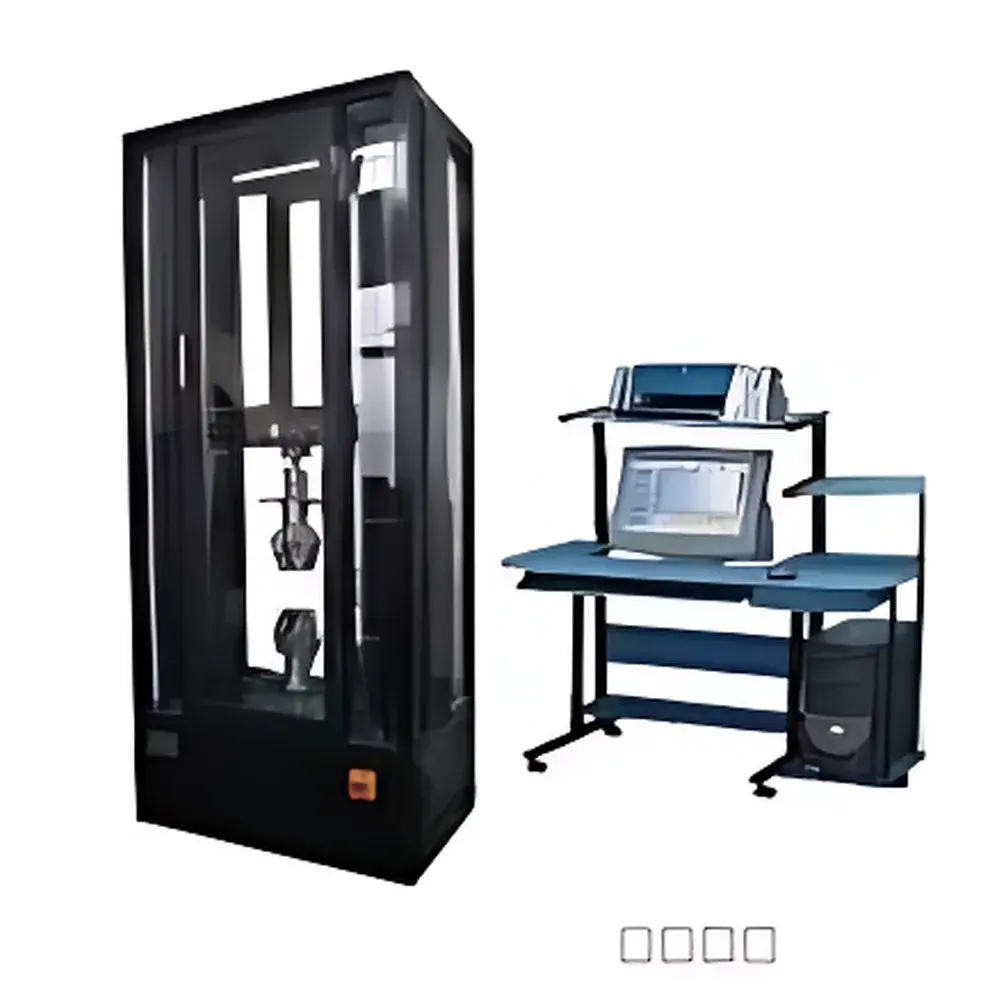
QJ212 Universal Testing Machine for Aluminum Alloy Flexural Strength Testing
| Brand | Qinsun |
|---|---|
| Origin | Shanghai, China |
| Manufacturer Type | Authorized Distributor |
| Country of Manufacture | China |
| Model | QJ212 |
| Price | USD 21,000 (FOB Shanghai) |
| Max Load Capacity | 500 kN |
| Effective Test Width | 500 mm |
| Effective Tensile Stroke | 600 / 800 mm |
| Speed Range | 0.001–1000 mm/min |
| Load Resolution | ±1/250,000 full scale |
| Speed Accuracy | ±1% of indicated value |
| Displacement Accuracy | ±0.5% of indicated value |
| Strain Measurement Accuracy | ±0.5% of indicated value |
| Safety Features | Electronic travel limit protection, overload protection at 110% of rated capacity |
| Dimensions (W×D×H) | 1000 × 680 × 2450 mm |
| Weight | 1250 kg |
Overview
The QJ212 Universal Testing Machine is an electromechanical static testing system engineered for high-precision mechanical characterization of metallic materials—including aluminum alloys—under flexural, tensile, compressive, shear, and fatigue loading conditions. Designed in accordance with the fundamental principles of uniaxial force application and displacement-controlled actuation, the QJ212 implements a servo-controlled AC motor drive coupled with a precision ball-screw transmission system to deliver stable, repeatable load application across its full 500 kN capacity range. Its modular frame architecture supports standardized three-point and four-point bending configurations per ASTM E290, ISO 7438, and GB/T 232, enabling accurate determination of flexural yield strength, modulus of elasticity in bending, and fracture behavior of extruded, cast, or wrought aluminum alloys (e.g., 6061-T6, 7075-T6). The machine operates under closed-loop control, continuously synchronizing load, displacement, and strain feedback signals to ensure traceable, GLP-compliant test execution.
Key Features
- High-resolution load measurement system with ±1/250,000 full-scale resolution, maintaining consistent sensitivity across the entire 10–500 kN range without range switching or recalibration.
- Adjustable crosshead speed from 0.001 to 1000 mm/min, calibrated to ±1% accuracy per ISO 5893, supporting quasi-static to high-rate deformation protocols.
- Electromechanical safety architecture including dual-mode electronic travel limits, automatic overload cutoff at 110% of nominal capacity, and emergency stop circuitry compliant with IEC 60204-1.
- Motorized crosshead with independent fast/slow speed modes and jog functionality for precise specimen alignment and pre-load positioning.
- Rigid, single-column-free C-frame construction (1000 × 680 × 2450 mm), optimized for minimal deflection during high-load bending tests; total mass of 1250 kg ensures vibrational stability during dynamic cycles.
- Integrated digital controller with real-time PID tuning capability, enabling adaptive response to material nonlinearity during plastic deformation phases.
Sample Compatibility & Compliance
The QJ212 accommodates standard aluminum alloy test specimens per ASTM B557M (tension), ASTM E290 (bend), and ISO 15630-2 (reinforcement testing), including rectangular beams (up to 500 mm wide × 60 mm thick), round bars (up to Ø40 mm), and notched Charpy-style flexural coupons. Fixture adaptability includes wedge-grip assemblies for tension, compression platens with self-aligning spherical seats, and standardized bending supports with adjustable span lengths (20–500 mm). All test methods and reporting outputs align with ISO/IEC 17025 requirements for accredited laboratories. System validation documentation supports audit readiness for FDA-regulated aerospace component qualification (per AMS 4027), automotive OEM material release (e.g., Ford WSS-M1A366-B2), and third-party certification against EN 10002-1.
Software & Data Management
Control and analysis are executed via Qinsun’s Windows-based QTest software, which provides real-time graphical display of force-displacement, stress-strain, and moment-curvature curves. The software supports multi-curve overlay, dynamic scaling, point-and-click data annotation, and export to CSV, Excel, or XML formats for integration into LIMS or statistical process control platforms. Audit-trail functionality records operator ID, timestamp, calibration status, and parameter changes—meeting FDA 21 CFR Part 11 requirements when deployed with user authentication and electronic signature modules. Raw data files retain native 1 kHz sampling fidelity, permitting post-test reprocessing with alternate filtering or derivative calculations (e.g., secant modulus, bend ductility index).
Applications
- Determination of flexural strength and modulus for 6xxx- and 7xxx-series aluminum extrusions used in structural aerospace frames and EV battery enclosures.
- Quality assurance testing of heat-treated aluminum castings per ASTM B108, evaluating brittleness transitions after T5/T6 tempering.
- Comparative evaluation of weld joint integrity in Al-Mg-Si alloy MIG welds using guided bend tests per AWS D1.2.
- Low-cycle fatigue characterization of aluminum honeycomb core materials under cyclic 3-point bending (ASTM D7264).
- Validation of finite element models by correlating experimental load-deflection curves with simulated bending stiffness and failure initiation points.
FAQ
Does the QJ212 support ASTM E290-compliant three-point bending tests on aluminum alloy beams?
Yes—the machine includes interchangeable bending fixtures with certified span-to-depth ratios and hardened steel rollers meeting ASTM E290 dimensional tolerances.
Can test data be exported in formats compatible with MATLAB or Python-based analytics pipelines?
Yes—raw time-series data is exportable as tab-delimited ASCII (.csv) with metadata headers, enabling direct ingestion into NumPy, Pandas, or custom curve-fitting scripts.
Is the system suitable for ISO 17025-accredited laboratories requiring uncertainty budget documentation?
Yes—factory calibration certificates include expanded uncertainty statements (k=2) for load, displacement, and speed channels, traceable to NIM (China) and NIST SRMs via interlaboratory comparison reports.
What maintenance intervals are recommended for sustained accuracy over 5+ years of operation?
Biannual verification of load cell linearity and crosshead alignment is advised; annual recalibration of the displacement encoder and speed controller is required for ISO 17025 compliance.



