
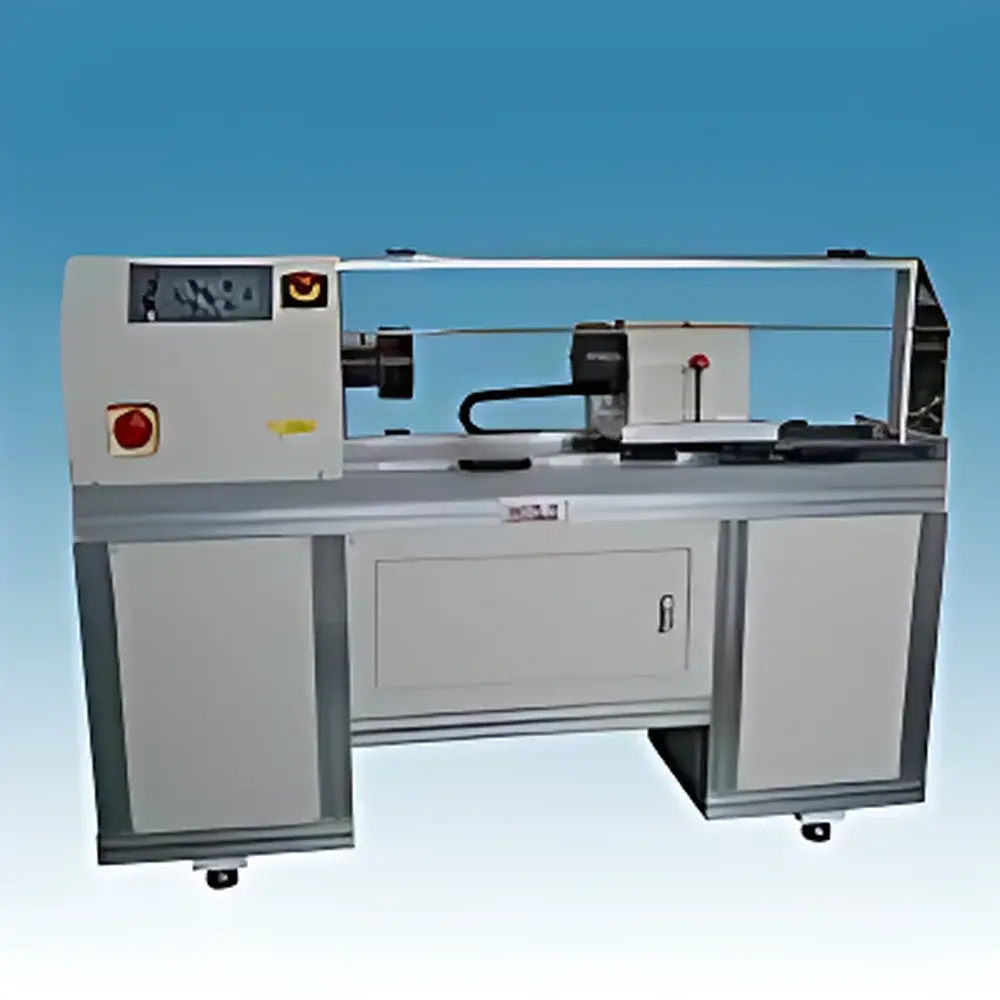
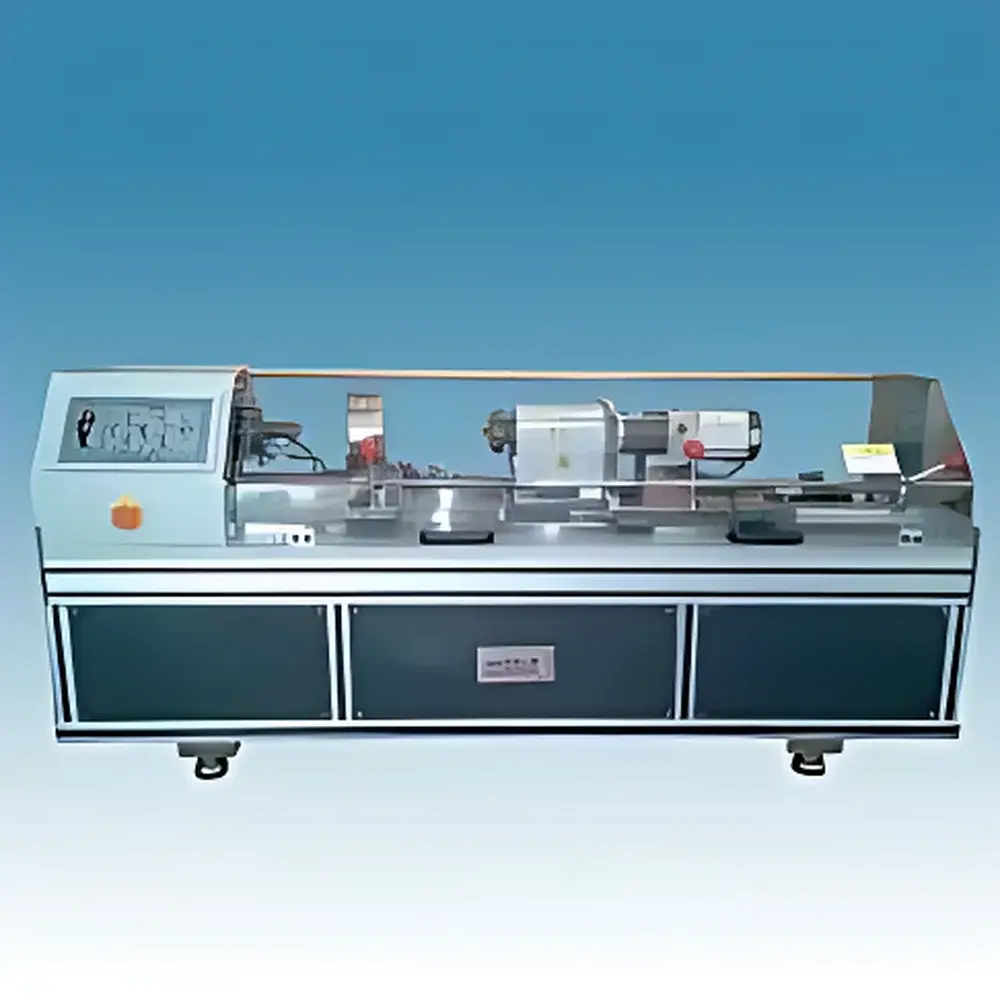
Hengyi HY-2000N·m Belt Pulley Torsion Testing Machine
| Brand | Hengyi (Hengyitest) |
|---|---|
| Origin | Shanghai, China |
| Manufacturer Type | Direct Manufacturer |
| Product Category | Domestic |
| Model | HY-2000N·m NMTFGY |
| Max Torque | 2000 N·m |
| Torque Measurement Range | 2–2000 N·m |
| Torque Resolution | 1/500000 FS |
| Torsion Angle Range | 0–100000° (or continuous rotation) |
| Motor Power | 2 kW |
| Torque Accuracy | ±0.5% FS (typical) |
| Angular Position Accuracy | ±0.5% FS (typical) |
| Speed Control Ratio | 1:2,000,000 |
| Sampling Rate | ~100 Hz |
| Communication Baud Rate | 115.2 kbps |
| Gauge Length Adjustment | 550 mm max |
| Specimen Clamping Range | M8–M32 (customizable) |
| Dimensions (L×W×H) | ≈2800×540×1250 mm |
| Weight | 1700 kg |
| Power Supply | Single-phase 220 V / 2 kW |
Overview
The Hengyi HY-2000N·m Belt Pulley Torsion Testing Machine is a precision-engineered, horizontal-axis torsion testing system designed for static and quasi-static mechanical characterization of rotational components under controlled torque and angular displacement. It operates on the principle of direct torque application via a high-fidelity servo-driven loading train, coupled with real-time measurement of applied torque and rotational angle using traceable transduction technologies — specifically, a calibrated high-stability torque sensor and an imported high-resolution optical encoder. The system conforms to fundamental mechanics-of-materials test paradigms for determining torsional stiffness, yield behavior (non-proportional shear stress τp), shear modulus (G), and ultimate torsional strength. Its architecture supports both component-level validation (e.g., steering gear bushings, pulley hubs, drive shaft couplings) and structural-level torsion testing of assembled subassemblies, making it suitable for R&D laboratories, quality assurance departments, and accredited calibration facilities.
Key Features
- Robust horizontal frame design with high-rigidity steel base and electrostatically coated sheet-metal enclosure for long-term dimensional stability and operator safety.
- Integrated Panasonic AC servo motor system delivering precise speed control across a dynamic range of 0.001°/min to 30°/min, with speed accuracy maintained at ±0.5% of setpoint.
- High-accuracy torque measurement chain: load cell with ±0.5% full-scale repeatability, 1/500,000 internal resolution, and temperature-compensated analog signal conditioning.
- Optical rotary encoder with ≤0.01° angular resolution, enabling reliable detection of micro-rotational deviations during elastic regime analysis.
- Dedicated 32-bit ARM-based embedded controller with 56 MIPS processing capability, supporting real-time closed-loop control, 100 Hz data acquisition, and deterministic response latency.
- High-speed RS-485 communication interface (115.2 kbps) ensuring synchronized data streaming between controller, sensors, and host PC without packet loss or timestamp jitter.
- Modular fixture interface accommodating standardized clamping jaws (M8–M32 thread compatibility), with optional custom jaw sets available for non-standard geometries.
Sample Compatibility & Compliance
The HY-2000N·m system is validated for testing metallic and composite rotational components including but not limited to belt pulleys, steering column bushings, universal joint yokes, transmission flanges, and fastener assemblies. Its 550 mm adjustable gauge length and dual-actuated hydraulic/pneumatic clamping mechanism ensure secure fixation of specimens up to 1700 kg mass without slippage. The machine complies with core mechanical testing standards including ISO 7800 (Metallic materials — Torsion testing), ASTM E143 (Standard Test Method for Shear Modulus at Room Temperature), GB/T 10128 (Chinese standard for metallic material torsion tests), and DIN 50114. Data integrity meets GLP/GMP documentation requirements through audit-trail-enabled software logging, and raw measurement files are exportable in CSV and XML formats for third-party statistical analysis or regulatory submission.
Software & Data Management
The proprietary Hengyi TorsionTest v4.x software suite runs on Windows OS and provides full bidirectional communication with the embedded controller. It supports automated test sequencing (predefined ramp-hold-step profiles), real-time graphical overlay of torque vs. angle curves, and post-test calculation of derived parameters including torsional rigidity (kt = ΔT/Δθ), proportional limit torque (Tp), and plastic deformation onset. All test sessions are time-stamped, user-logged, and stored with metadata (operator ID, calibration certificate ID, environmental conditions). Export functions include PDF reports compliant with ISO/IEC 17025 technical record requirements, as well as ASCII-compatible datasets compatible with MATLAB, Python (NumPy/Pandas), and JMP. Software validation documentation is provided upon request for FDA 21 CFR Part 11 compliance assessments.
Applications
- Quantitative evaluation of torsional fatigue resistance in automotive pulley systems under cyclic loading protocols.
- Determination of shear modulus (G) and τp for aluminum and steel shafts per ASTM E143 and GB/T 10128.
- Verification of torque-angle specifications for OEM-specified fasteners and press-fit assemblies.
- Calibration and verification of industrial torque wrenches and transducers against NIST-traceable reference standards.
- Research-grade torsional creep and stress relaxation studies when paired with environmental chambers (optional).
- Validation of finite element models by correlating experimental torque-angle hysteresis loops with simulated outputs.
FAQ
What standards does this torsion tester support?
It natively supports test procedures defined in ISO 7800, ASTM E143, GB/T 10128, DIN 50114, and JIS Z 2241, with customizable test templates for proprietary OEM specifications.
Can the system perform low-torque measurements below 2 N·m?
The specified lower limit is 2 N·m; for sub-N·m applications, we recommend the HY-200N·m variant equipped with a 0.1 N·m high-sensitivity transducer.
Is remote operation and monitoring supported?
Yes — via Ethernet-connected host PC with optional VNC or TeamViewer integration; all control commands and live data streams are accessible over LAN with role-based authentication.
What maintenance intervals are recommended?
Torque sensor recalibration every 12 months or after 10,000 test cycles; encoder alignment check every 6 months; servo motor thermal inspection quarterly.
Does the system include traceable calibration certificates?
Each unit ships with a factory-issued calibration certificate traceable to CNAS-accredited standards; NIST-traceable certificates are available upon request with additional lead time.



