
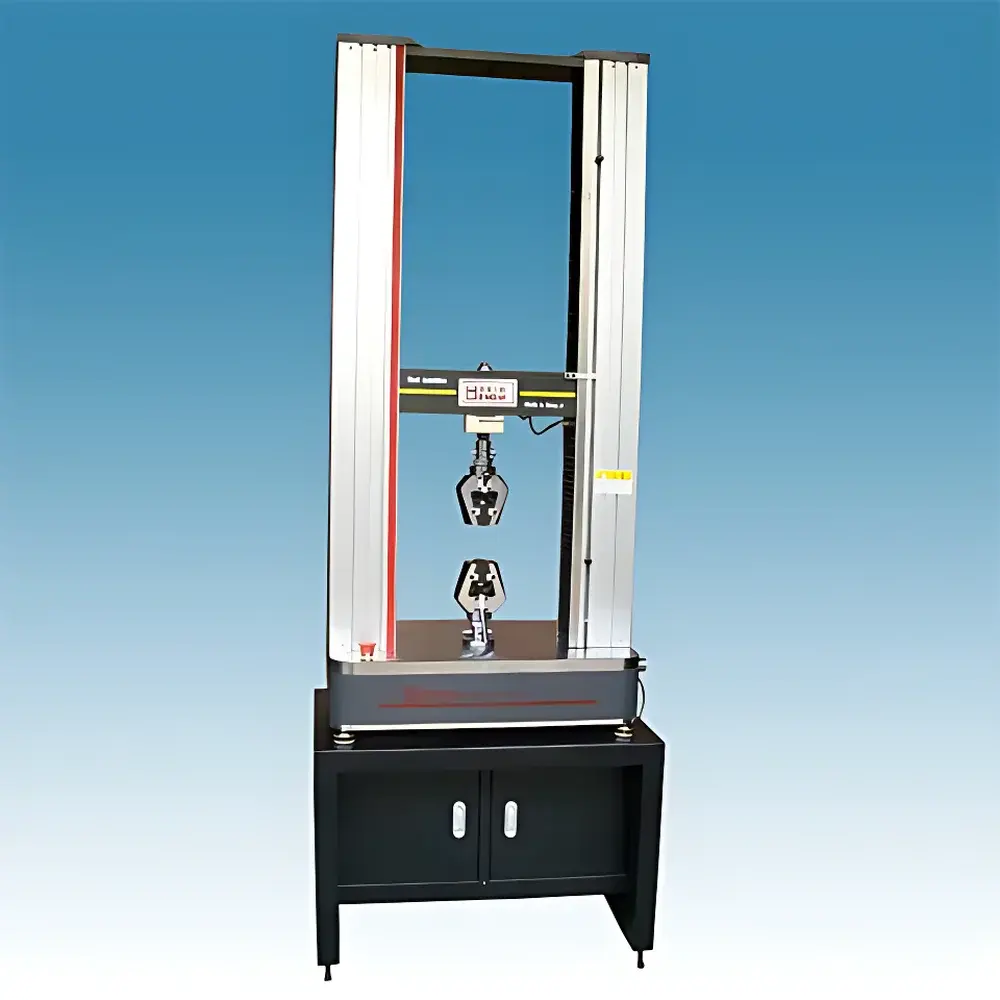
Hengyi HY-3080YUUU Foam Cyclic Compression Strength Tester
| Brand | Hengyi / Hengyitest |
|---|---|
| Origin | Shanghai, China |
| Manufacturer Type | Direct Manufacturer |
| Product Category | Domestic |
| Model | HY-3080YUUU |
| Price Range | USD 2,800 – 7,000 |
| Instrument Type | Electromechanical Universal Testing Machine |
| Maximum Test Load | 30 kN |
| Load Measurement Range | 0.001–100% of Full Scale |
| Load Accuracy | ±0.5% of reading |
| Test Stroke | 800 mm |
| Displacement Resolution | 0.001 mm |
Overview
The Hengyi HY-3080YUUU Foam Cyclic Compression Strength Tester is a dual-column, electromechanical universal testing system engineered for high-reproducibility mechanical characterization of soft, viscoelastic, and compressible materials—particularly polymeric foams, elastomeric cushions, packaging inserts, and cellular biomaterials. It operates on the principle of controlled displacement-driven compression cycling, enabling precise quantification of stress relaxation, permanent set, recovery ratio, and fatigue resistance under repeated loading-unloading sequences per ISO 1856, ASTM D3574, and JIS K6400 standards. Unlike static tensile testers, this system integrates programmable dwell time, variable ramp rates, and multi-cycle sequencing to replicate real-world service conditions such as seating durability, mattress endurance, or gasket compression-set behavior. Its rigid龙门 (gantry) frame—constructed from high-rigidity steel with precision-ground load train components—ensures minimal deflection (<0.02 mm under full 30 kN load), critical for maintaining measurement fidelity during low-force, high-displacement foam testing.
Key Features
- 30 kN electromechanical actuation system with closed-loop servo control, supporting both static and dynamic cyclic protocols (0.001–500 mm/min, ±0.5% speed accuracy)
- High-resolution force transduction: ±0.5% accuracy over 0.001–100% FS, with 500,000-count A/D resolution and no internal range switching
- Displacement measurement via linear encoder with 0.001 mm resolution and ±0.5% linearity across 800 mm travel
- Dual-speed motorized crosshead (fast jog + fine positioning) and electronic limit protection for operator safety and specimen integrity
- Modular load cell options (1 N to 30 kN) calibrated to ISO/IEC 17025-accredited traceability
- Integrated overload protection (110% FS cut-off), real-time system diagnostics, and automatic fault logging
- Compliance-ready architecture: supports audit trails, user-level access control, and electronic signatures in accordance with FDA 21 CFR Part 11 and GLP/GMP requirements when configured with HYtestV7.0 software
Sample Compatibility & Compliance
The HY-3080YUUU accommodates specimens up to 380 mm wide and 800 mm tall, making it suitable for standard foam blocks (e.g., 150 × 150 × 50 mm per ASTM D3574), laminated composites, cushioned assemblies, and pre-formed packaging inserts. It meets mechanical test requirements specified in ISO 1856 (flexible cellular polymeric materials), ASTM D3574 (flexible polyurethane foam), ASTM D1621 (rigid cellular plastics), JIS K6400 (foam resilience), and GB/T 6344 (Chinese national standard for soft foam). The system’s load and displacement metrology are validated per ISO 7500-1 (static calibration) and ISO 5893 (dynamic verification), ensuring data admissibility in regulatory submissions and inter-laboratory round-robin studies.
Software & Data Management
HYtestV7.0 is a multilingual (9-language) test control and analysis platform compliant with ISO 17025 documentation requirements. It enables method-driven test sequencing—including multi-step cyclic compression, hold-relaxation segments, and conditional termination (e.g., “stop after 10,000 cycles” or “terminate at 20% permanent deformation”). Raw data streams (force, displacement, time) are logged at ≥1 kHz and stored in SQL-based relational databases with immutable audit trails. Users can define custom calculation modules (e.g., % compression set = [(t0 − tn) / t0] × 100), generate ASTM-compliant reports, export to CSV/PDF/XLSX, and apply curve-fitting algorithms (linear, exponential, power-law) for viscoelastic modeling. All software configurations support electronic signature workflows and role-based permissions (operator, supervisor, administrator).
Applications
This tester serves quality assurance and R&D laboratories across industries requiring quantitative assessment of compressive durability: automotive interior suppliers evaluating seat foam longevity; medical device manufacturers validating wound dressing compression profiles; packaging engineers certifying protective foam performance under ISTA 3A/3E protocols; and academic researchers studying time-dependent deformation in hydrogels or aerogels. Specific use cases include cyclic compression set testing (ISO 1856 Method B), creep-recovery profiling, stress relaxation kinetics, fatigue life mapping (S-N curves), and comparative evaluation of open- vs. closed-cell foam architectures. Its versatility extends to non-foam applications—such as tensile testing of thin films (0.1–500 µm), peel strength of pressure-sensitive adhesives, and bending stiffness of paperboard—without hardware modification.
FAQ
What international standards does the HY-3080YUUU support for foam compression testing?
It natively supports ISO 1856, ASTM D3574, ASTM D1621, JIS K6400, and GB/T 6344, with preloaded test methods and report templates.
Can the system perform both static and dynamic cyclic tests?
Yes—programmable waveforms (sinusoidal, trapezoidal, square) with frequency up to 5 Hz and amplitude control are available via optional dynamic module firmware.
Is third-party calibration certification included?
Each unit ships with a factory calibration certificate traceable to CNAS-accredited standards; ISO/IEC 17025-certified recalibration services are available upon request.
How is data integrity ensured for regulated environments?
HYtestV7.0 implements 21 CFR Part 11-compliant features: electronic signatures, audit trail logging, data immutability, and secure user authentication.
What is the maximum specimen height accommodated without modification?
800 mm vertical test space is standard; height can be extended to 1200 mm with optional column extension kits.
Related Products



