
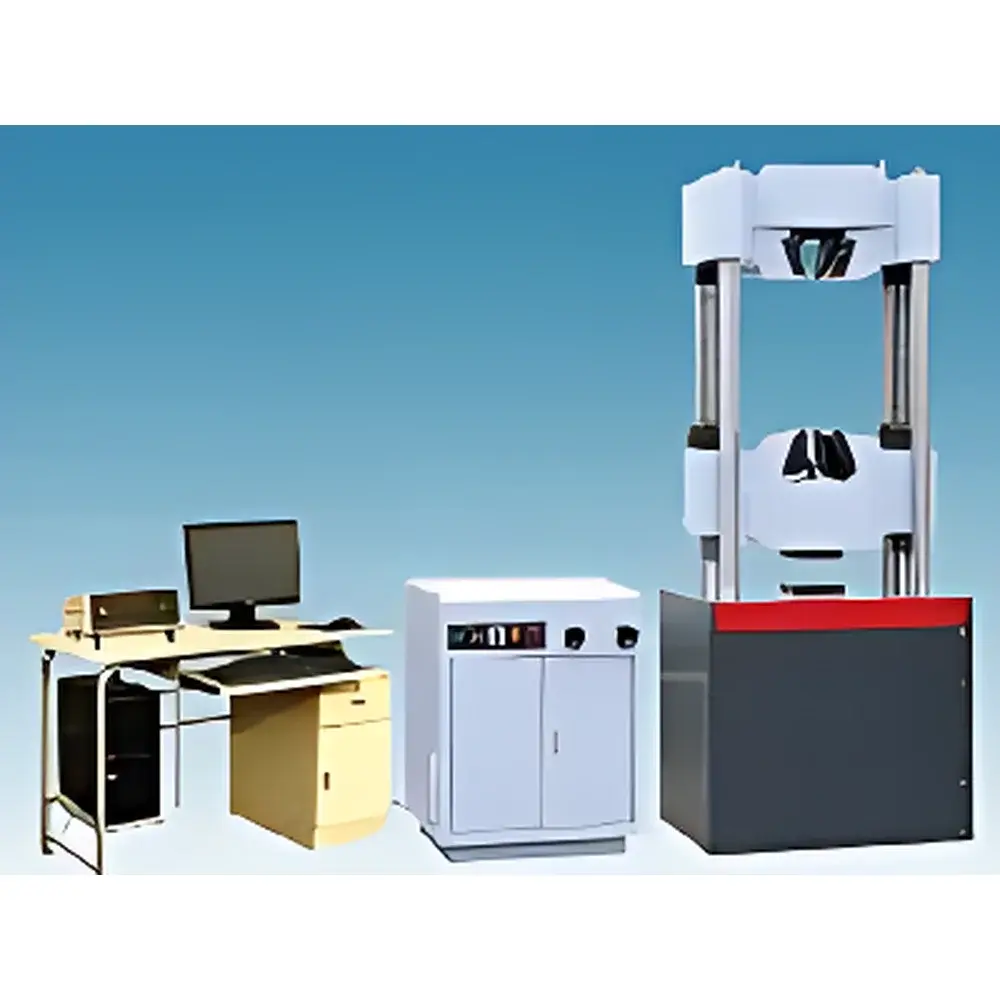
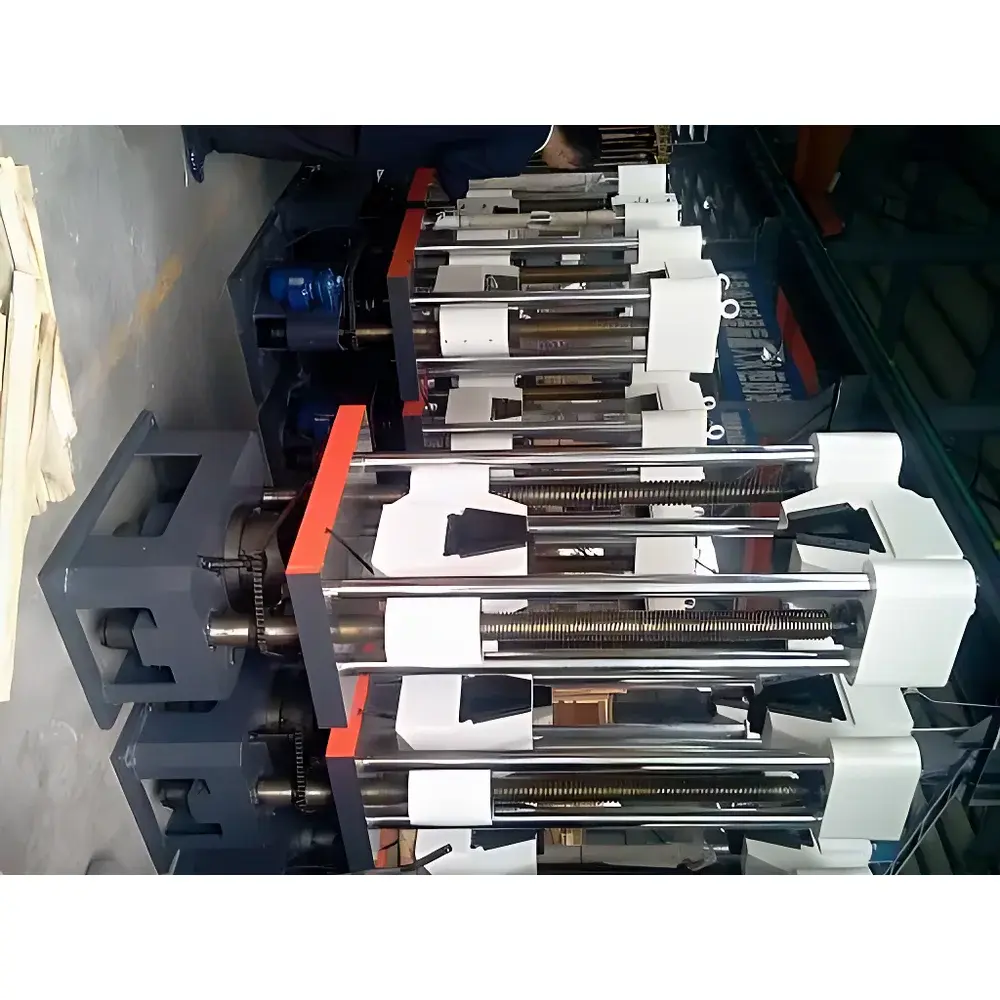
Hengyi HY(WE)100060 Electro-Hydraulic Servo Universal Testing Machine
| Brand | Hengyi |
|---|---|
| Origin | Shanghai, China |
| Manufacturer Type | Direct Manufacturer |
| Instrument Type | Electro-Hydraulic Servo Testing Machine |
| Model | HY(WE)100060RTGGV |
| Load Capacity | 0–1000 kN |
| Load Accuracy | ±0.5% of reading |
| Displacement Accuracy | ±0.5% of reading |
| Deformation Measurement Accuracy | ±0.5% of reading |
| Compression Space | 600 mm |
| Tensile Space | 600 mm |
| Round Specimen Grip Range | Φ20–Φ60 mm |
| Flat Specimen Thickness Range | 0–40 mm |
| Piston Stroke | 150 mm |
| Bending Support Span | 100–600 mm |
| Shear Specimen Diameter | Φ10 mm |
| Stress Rate Control Range | 1–60 N/mm²/s |
| Strain Rate Control Range | 0.00025–0.0025 s⁻¹ |
| Closed-Loop Control Accuracy (Force/Displacement/Strain) | ±1% of setpoint |
| Overall Dimensions (W×D×H) | 880 × 580 × 2860 mm |
| Motor Power | 1.5 kW, 3-phase |
| Weight | 3500 kg |
Overview
The Hengyi HY(WE)100060 Electro-Hydraulic Servo Universal Testing Machine is a high-capacity, precision-engineered mechanical testing system designed for static mechanical characterization of structural materials under controlled loading conditions. It operates on the principle of electro-hydraulic servo control, where proportional hydraulic valves regulate oil flow to a bottom-mounted actuator cylinder, enabling precise force and displacement regulation across tensile, compressive, bending, and shear test modes. The machine complies with core international standards including ASTM E4, ASTM E8/E8M (tensile testing of metals), ASTM C39/C39M (concrete compression), ISO 6892-1, ISO 15630-1, and GB/T 228.1—2021, supporting traceable, repeatable, and auditable mechanical property determination in quality control, R&D, and certification laboratories. Its robust dual-column frame architecture, integrated load cell feedback loop, and real-time closed-loop control ensure stable load application even during high-force ramping or hold phases — essential for evaluating yield behavior, ultimate strength, modulus of elasticity (E), offset yield strength (RP0.2), upper/lower yield points (ReH/ReL), and fracture elongation.
Key Features
- Bottom-mounted hydraulic actuator with 1000 kN maximum capacity and ±0.5% load measurement accuracy per ISO 7500-1 Class 1 calibration requirements
- Electro-hydraulic proportional control system enabling seamless transition between force-, displacement-, and strain-controlled test modes with ±1% setpoint accuracy
- Automated test parameter calculation: Fm, Rm, ReH, ReL, RP0.2, E, Agt, Ag, and other standardized mechanical properties per ASTM/ISO reporting conventions
- Integrated high-resolution optical encoder (displacement) and calibrated extensometer-ready interface for direct strain measurement
- Full-range automatic load cell calibration and range switching without manual intervention
- Adjustable test space: 600 mm tensile and compression clearance; 100–600 mm variable bending span; piston stroke of 150 mm for extended deformation testing
- Dual-grip configuration supporting round specimens (Φ20–Φ60 mm) and flat specimens (0–40 mm thickness) with mechanical self-tightening jaw design
- Industrial-grade PC-based control system with localized English-language software interface, supporting GLP-compliant audit trails and electronic signature readiness
Sample Compatibility & Compliance
The HY(WE)100060 accommodates metallic alloys (steel, aluminum, titanium), polymer composites, cementitious materials (concrete, mortar), ceramics, and geotechnical specimens. Its modular fixture interface supports standard ASTM E8, ISO 6892-1, ASTM C39, ASTM D695, ISO 14125, and ISO 178 compliant test setups. All force, displacement, and strain measurements are traceable to national metrological standards via factory calibration certificates issued per ISO/IEC 17025-accredited procedures. The system meets mechanical safety requirements outlined in ISO 12100 and EN 698, and its control architecture supports validation documentation for FDA 21 CFR Part 11 compliance when deployed in regulated GMP/GLP environments — particularly relevant for medical device component qualification and construction material certification.
Software & Data Management
The embedded Windows-based control software provides real-time synchronized acquisition of load, displacement, and optional extensometer signals at configurable sampling rates up to 1 kHz. It features full curve post-processing capabilities: point-and-click curve traversal, multi-curve overlay comparison, region-specific slope analysis (e.g., elastic modulus derivation), and automatic identification of critical inflection points. Test reports conform to ASTM E1392 and ISO 14556 templates and export natively to PDF, Excel (.xlsx), and universal CSV formats. Audit trail logs record operator ID, timestamp, parameter changes, calibration events, and test abort/restart actions — supporting regulatory review and internal QA audits. Data encryption, user role management (admin/operator/viewer), and networked backup options are available as configurable modules.
Applications
This system is routinely deployed in metallurgical QA labs for batch verification of structural steel plates and reinforcing bars; in civil engineering institutes for compressive strength validation of precast concrete elements; in aerospace material suppliers for tensile and bend testing of aluminum-lithium sheet stock; and in university mechanics labs for teaching fundamental stress–strain relationships. Its programmable rate control enables creep testing protocols (under constant load), relaxation testing (under constant strain), and cyclic loading sequences — provided external waveform generation modules are integrated. The machine also serves as a platform for developing custom test methods aligned with emerging industry specifications such as those from SAE, API, or EN standards committees.
FAQ
What standards does this machine comply with for tensile testing?
It conforms to ASTM E8/E8M, ISO 6892-1, and GB/T 228.1—2021 for metallic materials, with optional add-ons available for ISO 527 (plastics) and ASTM D3039 (composites).
Can the system perform closed-loop strain control using an extensometer?
Yes — the controller accepts analog inputs from clip-on or video extensometers, enabling true strain-controlled ramping and hold tests per ASTM E2309.
Is the software compatible with LIMS or ERP integration?
The system supports OPC UA and TCP/IP-based data export, allowing bidirectional communication with laboratory information management systems (LIMS) and enterprise resource planning (ERP) platforms.
What maintenance is required for long-term hydraulic system reliability?
Scheduled replacement of hydraulic oil (ISO VG 46) every 2,000 operating hours, annual calibration of pressure transducers and load cells, and quarterly inspection of sealing surfaces and valve response times are recommended.
Does the machine support third-party calibration services?
Yes — all load cells and displacement sensors are certified to ISO 376 and ISO 7500-1, and accredited third-party calibration providers can perform on-site verification using reference standards traceable to NIST or CNAS.
Related Products



