
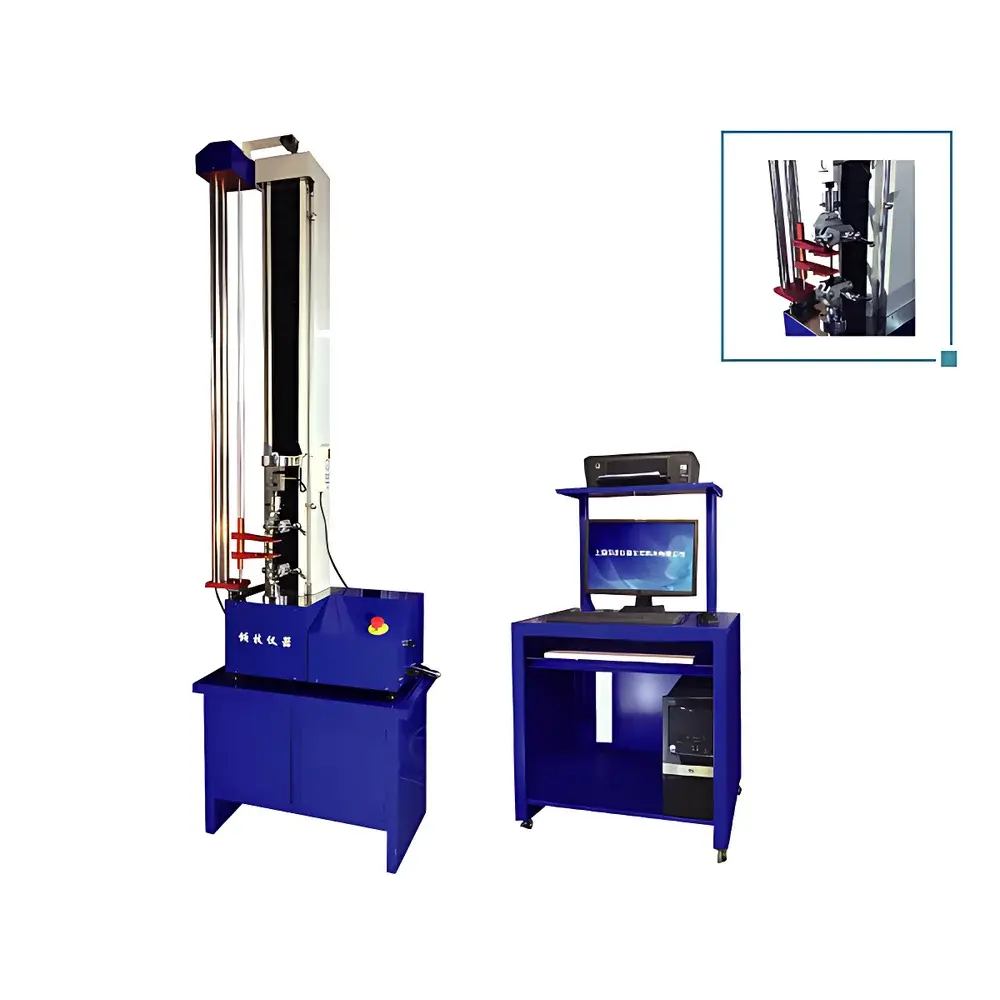
Qinji QJ210A Glove Tensile Testing Machine
| [Brand | Qinji |
|---|---|
| Origin | Shanghai, China |
| Instrument Type | Electronic Universal Tensile Tester |
| Max Test Load | 5 kN |
| Force Measurement Range | 0.2–100% of Full Scale |
| Force Accuracy | Class 0.5 (ISO 7500-1 / ASTM E4) |
| Crosshead Travel | 800 mm |
| Effective Test Width | 150 mm |
| Test Speed Range | 0.01–500 mm/min |
| Speed Accuracy | ±0.5% of indicated value |
| Displacement Resolution | 0.001 mm (500,000-count encoder) |
| Force Resolution | Constant full-scale resolution, no range switching |
| Load Cell | High-precision imported strain-gauge sensor (USA-made) |
| Drive System | Panasonic AC servo motor + Taiwan-made precision gearmotor + preloaded ball screw |
| Control System | Full-digital servo controller with closed-loop feedback |
| Compliance | Fully supports GB, ISO 527, ISO 37, ASTM D412, ASTM D638, ASTM D882, JIS K6251, YY/T 0615.1, EN 455-2, EN 149, EN 13795] |
Overview
The Qinji QJ210A Glove Tensile Testing Machine is a microprocessor-controlled universal testing system engineered for high-reproducibility mechanical characterization of thin, flexible polymeric materials—including medical gloves, surgical masks, nonwoven fabrics, and protective barrier films. Based on the fundamental principles of uniaxial tensile mechanics per ISO 527-1 and ASTM D638, the instrument applies controlled axial force to standardized specimens while continuously measuring load, displacement, and strain in real time. Its modular architecture integrates a high-rigidity dual-column frame, precision-ground ball-screw actuation, and a closed-loop servo control system—ensuring stable loading rates, minimal thermal drift, and long-term calibration stability. Designed specifically for regulatory-compliant quality assurance in medical device manufacturing and PPE certification labs, the QJ210A delivers traceable, auditable data suitable for GLP and GMP environments.
Key Features
- Class 0.5 force accuracy certified per ISO 7500-1 and ASTM E4—guaranteeing measurement uncertainty ≤ ±0.5% of reading across the entire 0.2–100% FS range
- Constant-resolution force acquisition: 500,000-count A/D conversion with no auto-ranging or gain switching, eliminating step errors during low-load transitions
- Adjustable crosshead speed from 0.01 to 500 mm/min, calibrated to ±0.5% of setpoint—enabling compliance with both slow-strain-rate (e.g., ISO 37 rubber tear) and high-speed peel (e.g., ASTM D903) protocols
- Dual-mode return control: programmable automatic return post-fracture or manual rapid return (up to 500 mm/min) for high-throughput lab workflows
- Integrated safety architecture: hardware-based electronic limit switches, software-defined overload cutoff (110% FS), and real-time diagnostic monitoring of motor current, encoder feedback, and thermal status
- Modular fixture interface compatible with standardized grips (pneumatic, wedge, roller, and custom-designed clamps) for glove finger-tension, flat-sheet tensile, and mask strap peel tests per YY/T 0615.1 and EN 455-2
- Self-diagnosing control firmware with automatic zero-reset, load-cell linearity verification, and system calibration traceability to NIST-traceable reference standards
Sample Compatibility & Compliance
The QJ210A accommodates specimens ranging from 1 mm wide elastomeric glove fingers to 25 mm wide nonwoven mask body strips, with adjustable gauge lengths from 10 mm to 250 mm. Its 150 mm effective test width and 800 mm vertical travel enable full-stroke evaluation of elongation-at-break for highly extensible materials (e.g., nitrile, latex, and thermoplastic elastomer blends). The system meets mechanical testing requirements specified in ISO 37 (vulcanized rubber tear strength), ISO 527-3 (plastics—thin films), ASTM D412 (rubber tensile properties), ASTM D882 (thin plastic sheeting), EN 149 (FFP respirator strap retention), EN 13795 (surgical drapes and gowns), and YY/T 0615.1 (sterile medical gloves). All test methods are implemented with parameter-locking functionality to prevent unauthorized deviation from validated SOPs—supporting FDA 21 CFR Part 11 compliance when paired with audit-trail-enabled software.
Software & Data Management
Bundled PC-based testing software provides ISO/IEC 17025-aligned data acquisition, analysis, and reporting. The interface supports multi-channel synchronized recording (load, displacement, time, extension), real-time curve overlay, and automated calculation of tensile strength, elongation at break, modulus (100%, 200%, 300%), yield point, and tear resistance. Raw data export is available in CSV, Excel, and XML formats; PDF reports include operator ID, timestamp, environmental conditions (optional hygrometer/thermometer integration), equipment calibration ID, and digital signature fields. Audit trail logs record all user actions—including method edits, result deletions, and calibration events—with immutable timestamps and user authentication. Optional 21 CFR Part 11 modules provide electronic signatures, role-based access control, and secure data archiving compliant with pharmaceutical and medical device QA/QC documentation requirements.
Applications
- Medical glove integrity testing: finger-tip tensile strength, palm-thickness elongation, and seam burst resistance per ISO 11193-1 and ASTM D5279
- Surgical mask strap retention force and earloop elongation under static load (EN 14683 Annex A)
- Nonwoven fabric characterization: tensile strength anisotropy (machine vs. cross direction), puncture resistance (ASTM F1306), and delamination peel strength
- Quality control of disposable PPE: batch-to-batch consistency verification against internal specifications or national standards (e.g., GB 19083, YY 0469)
- R&D validation of novel barrier materials: stress–strain curve derivation for finite element modeling inputs
- Regulatory submission support: generation of raw datasets and summary statistics required for CE marking, FDA 510(k), or NMPA registration dossiers
FAQ
Does the QJ210A comply with ISO/IEC 17025 calibration requirements?
Yes—the system is supplied with a factory calibration certificate traceable to national metrology institutes, and includes built-in procedures for user-performed periodic verification using certified reference load cells and displacement standards.
Can the machine perform cyclic fatigue testing on glove materials?
While primarily configured for monotonic tensile and tear tests, optional waveform control modules enable programmed sinusoidal, triangular, or trapezoidal loading profiles for low-cycle fatigue assessment up to 5 Hz.
Is third-party validation support available for 21 CFR Part 11 implementation?
Qinji provides IQ/OQ documentation templates and on-site validation assistance by qualified engineers, including risk assessment, test protocol development, and UAT execution per GAMP 5 guidelines.
What maintenance intervals are recommended for sustained accuracy?
We recommend biannual verification of force and displacement systems, annual recalibration of the load cell and encoder, and quarterly lubrication of the ball screw assembly using ISO VG 68 synthetic grease.
Are custom fixtures for irregular glove geometries available?
Yes—Qinji’s application engineering team designs and validates bespoke grip solutions (e.g., contoured mandrels, vacuum-assisted finger holders) with mechanical drawings and installation validation reports provided prior to delivery.



