
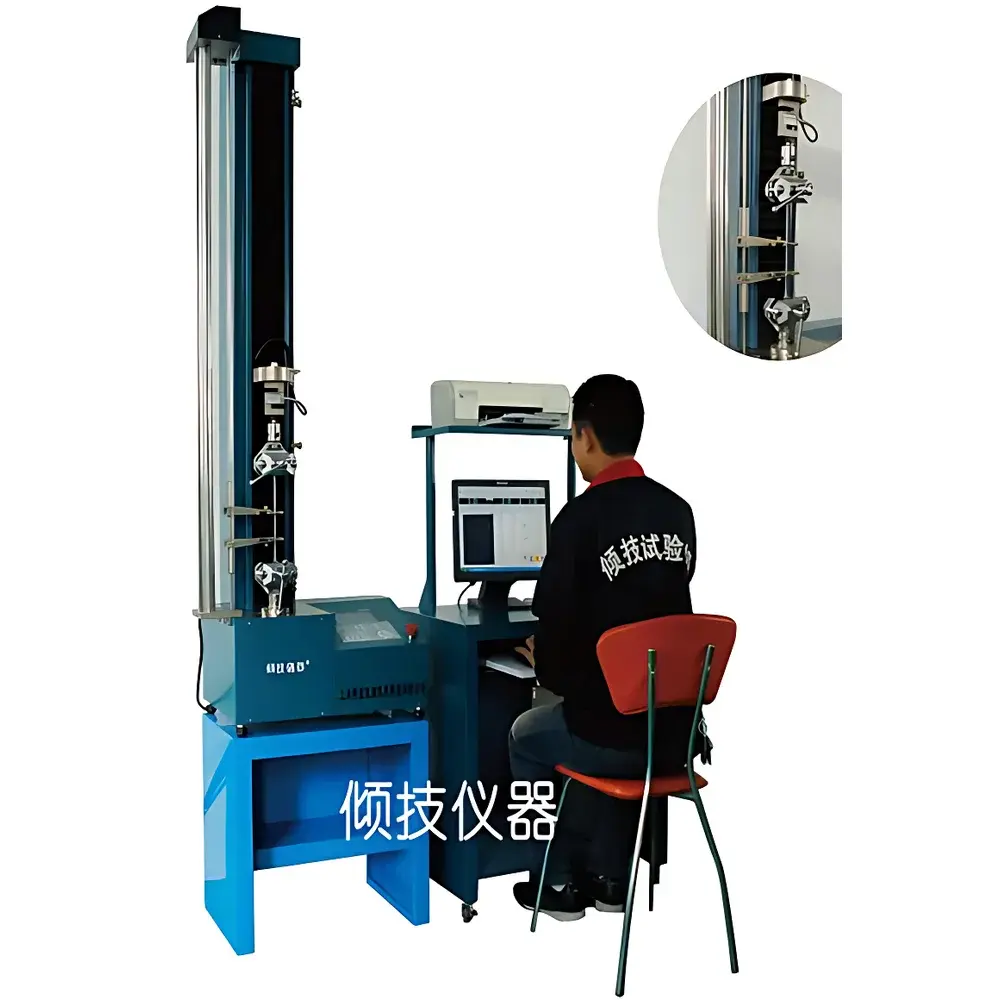
Qinsci shqj210A Universal Testing Machine for Polymer Film Mechanical Characterization
| Brand | Qinsci |
|---|---|
| Model | shqj210A |
| Type | Electromechanical Universal Testing Machine |
| Max Load Capacity | 5 kN |
| Accuracy Class | 0.5 |
| Load Resolution | 500,000 counts (full-scale, no range switching) |
| Effective Test Width | 150 mm |
| Effective Stroke | 800 mm |
| Speed Range | 0.01–500 mm/min (±0.5% accuracy) |
| Displacement & Strain Measurement Accuracy | ±0.5% of reading |
| Load Cell | High-precision U.S.-sourced sensor |
| Controller | Panasonic全数字交流伺服系统 |
| Safety Protection | Software-based overload diagnosis, electronic limit switches, 110% over-load auto-hold |
| Power Supply | 200 V AC, 400 W |
| Dimensions (L×W×H) | 590 × 355 × 1640 mm |
| Weight | ~85 kg |
| Compliance | ASTM D882, ISO 527-3, GB/T 1040.3, JIS K7127, YY/T 0681.1, QB/T 2358, ASTM D3330, ASTM F88, ISO 11339 |
Overview
The Qinsci shqj210A Universal Testing Machine is an electromechanical tensile-compression testing system engineered for precise mechanical characterization of thin polymeric films, laminates, and flexible packaging materials. It operates on the principle of controlled uniaxial force application via a high-fidelity servo-driven crosshead, enabling accurate measurement of stress–strain behavior, yield strength, elongation at break, modulus, peel adhesion, puncture resistance, and shear integrity. Designed specifically for R&D laboratories, QC departments, and contract testing facilities, the system delivers traceable, repeatable, and standards-compliant data across diverse film substrates—including PET, BOPP, PE, CPP, PVDC-coated films, aluminum foil laminates, and biomedical barrier films. Its modular load frame architecture supports rapid fixture interchangeability without recalibration, ensuring operational continuity during multi-test workflows.
Key Features
- 0.5-class accuracy per ISO 7500-1 and ASTM E4, verified with NIST-traceable calibration certificates
- Full-scale load capacity up to 5 kN with seamless internal resolution of 500,000 counts—no manual range switching required
- High-stiffness dual-column frame with precision-ground ball screws and preloaded linear guides for minimal deflection under load
- Panasonic digital AC servo motor and controller delivering smooth, low-noise motion control from 0.01 to 500 mm/min (±0.5% speed accuracy)
- Integrated real-time display of force (N, kN, lbf, gf, kgf), displacement (mm), and extension (%) on a dedicated LCD interface
- Dual-mode return functionality: manual high-speed return to home position or programmable automatic return post-test
- Multi-layer safety architecture including software-based overload detection (110% threshold), hardware limit switches, and emergency stop circuitry
- Ergonomic enclosure with powder-coated extruded aluminum panels and industrial-grade epoxy finish for long-term corrosion resistance
Sample Compatibility & Compliance
The shqj210A accommodates specimens up to 150 mm wide and 800 mm gauge length, making it suitable for standard film strips (e.g., 15 mm × 150 mm per ASTM D882), peel coupons (90°/180°), tear propagation samples (Elmendorf, trouser), and puncture probes (e.g., 1.0 mm diameter stylus). Fixture sets—including pneumatic film grips, floating roller peel fixtures, loop tack holders, and dart impact adapters—are customizable per specimen geometry and test method requirements. The system complies with ISO 17025–accredited testing practices when operated within documented SOPs and calibrated annually. It supports full traceability for GLP/GMP environments through optional audit trail logging, user access controls, and electronic signatures aligned with FDA 21 CFR Part 11 requirements.
Software & Data Management
The machine interfaces with Qinsci’s proprietary TESTMaster v4.2 software (Windows 10/11 compatible), enabling full PC-based test configuration, real-time curve visualization, automated pass/fail evaluation against preset limits, and export of raw ASCII data (.csv) or formatted PDF reports compliant with ISO/IEC 17025 reporting clauses. All test parameters—including preload, target strain rate, hold time, cycle count, and failure criteria—are programmable via intuitive wizard-driven templates. Data integrity safeguards include timestamped metadata embedding, checksum validation, and version-controlled method files. Optional integration with LIMS platforms is supported via TCP/IP API and ODBC drivers.
Applications
- Tensile property mapping of biaxially oriented polypropylene (BOPP) and polyester (PET) films used in food packaging
- Peel strength quantification of heat-seal layers in medical pouches per ISO 11607-2 and ASTM F88
- Puncture resistance assessment of pharmaceutical blister lidding foils (YY/T 0681.1)
- Adhesion performance of pressure-sensitive labels (ASTM D3330) and transfer tapes
- Mechanical aging studies under accelerated humidity/temperature conditions using environmental chamber coupling
- Quality conformance verification for automotive interior trim films (SAE J2527) and solar backsheet materials (IEC 62788-5-1)
FAQ
What standards does the shqj210A support out-of-the-box?
It natively supports test method templates for ASTM D882, ISO 527-3, GB/T 1040.3, JIS K7127, YY/T 0681.1, QB/T 2358, and ASTM F88. Custom methods can be built using the script editor.
Is calibration certification included with shipment?
Yes—a factory-issued ISO/IEC 17025–traceable calibration certificate covering load, displacement, and speed is provided with each unit.
Can the system be integrated into an existing laboratory network?
Yes, via Ethernet connectivity and standardized communication protocols (TCP/IP, Modbus TCP); remote monitoring and batch report generation are supported.
What maintenance intervals are recommended?
Biannual lubrication of lead screws and annual verification of load cell linearity and encoder feedback are advised; full recalibration is recommended every 12 months or after 10,000 cycles.
Are fixtures supplied with the base configuration?
A standard set of pneumatic film grips (15 mm jaw width) and parallel plate compression platens is included; application-specific fixtures are quoted separately based on specimen dimensions and test type.



