
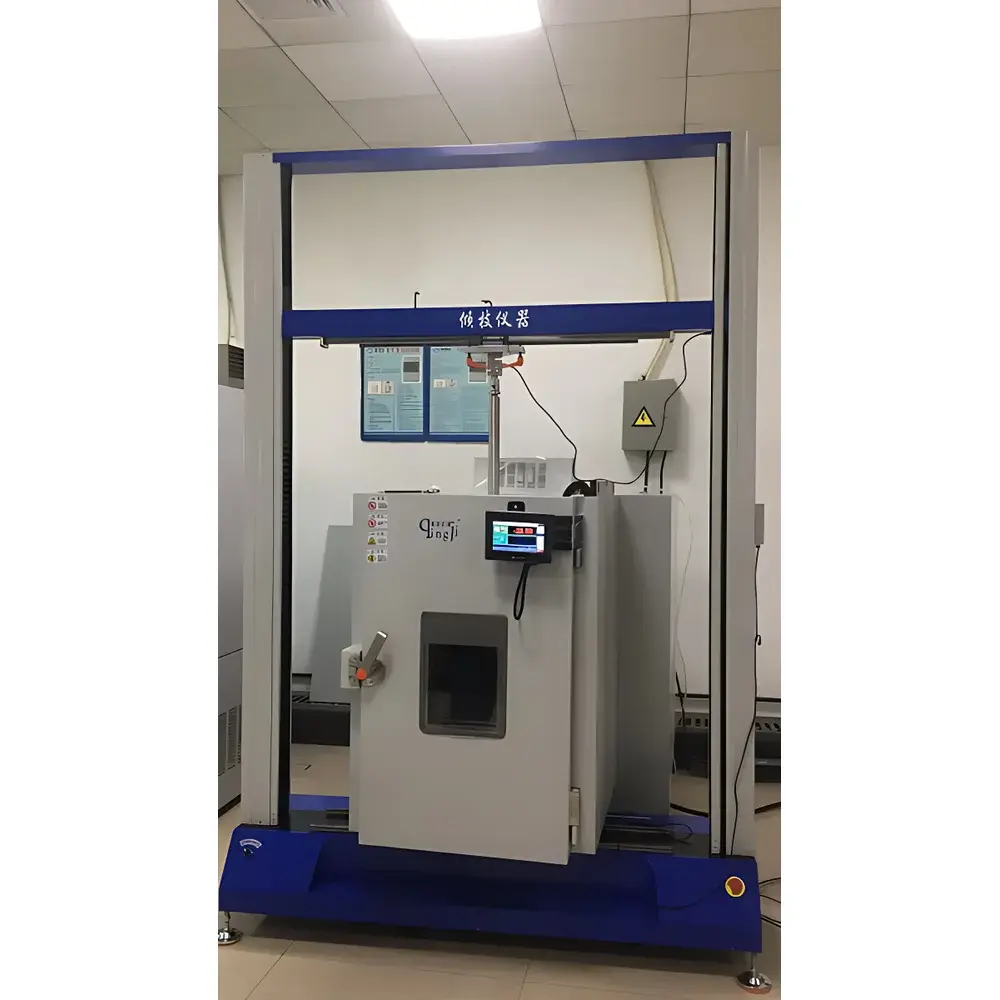
QJ211B High-Temperature Flexural Testing Machine
| Brand | Qinsun |
|---|---|
| Origin | Shanghai, China |
| Model | QJ211B |
| Load Capacity | 20 kN |
| Load Accuracy | ±0.5% |
| Temperature Range | −70 °C to +350 °C (isothermal hold at 350 °C) |
| Temperature Ramp Rate | ≥5 °C/min |
| Temperature Controller Resolution | 0.1 °C |
| Crosshead Speed Range | 0.001–500 mm/min |
| Speed Accuracy | ±0.5% |
| Displacement Measurement Accuracy | ±0.5% |
| Strain/Deformation Measurement Accuracy | ±0.5% |
| Effective Test Width | 420 mm |
| Effective Test Height (standard) | ~800 mm (extendable) |
| Safety Features | Electronic travel limit protection, emergency stop button |
| Machine Weight | 135 kg |
Overview
The QJ211B High-Temperature Flexural Testing Machine is an electromechanical universal testing system engineered for precise mechanical characterization of structural and functional materials under controlled thermal environments. It integrates a high-stiffness dual-column frame with a programmable environmental chamber capable of sustained isothermal operation from −70 °C to +350 °C—enabling standardized flexural, compressive, tensile, peel, shear, and low-cycle fatigue tests per ASTM D790, ISO 178, GB/T 9341, JIS K7203, and DIN EN ISO 14125. Unlike ambient-only systems, the QJ211B employs a modular chamber design: the temperature-controlled enclosure can be physically detached during room-temperature testing, increasing workspace flexibility and simplifying specimen handling for multi-condition comparative studies. Its closed-loop servo control architecture ensures stable load application and displacement tracking across wide thermal gradients, maintaining metrological integrity even during dynamic thermal cycling.
Key Features
- Modular high-temperature chamber with independent PID-controlled heating/cooling circuits and real-time thermal uniformity monitoring
- Load cell accuracy of ±0.5% full scale (FS), traceable to national standards, with optional calibration certificates compliant with ISO/IEC 17025
- Precision crosshead actuation via AC servo motor with speed resolution down to 0.001 mm/min and repeatability better than ±0.5% of set value
- Dual-channel digital controller supporting simultaneous acquisition of load, displacement, and temperature data at up to 100 Hz sampling rate
- Integrated safety interlocks including electronic travel limits, hardware-based emergency stop circuitry, and over-temperature cutoff
- Structural frame rated for 20 kN static capacity with axial alignment tolerance <0.02 mm/m, minimizing bending moment error in flexural mode
- Expandable vertical test space (standard 800 mm; customizable up to 1200 mm) to accommodate tall specimens or custom fixtures
Sample Compatibility & Compliance
The QJ211B accommodates standard flexural specimens per ASTM D790 (e.g., 80 × 10 × 4 mm rectangular bars) as well as non-standard geometries via interchangeable three-point and four-point bending fixtures. It supports thermoplastic polymers, thermosets, composites, ceramics, metallic alloys, and elastomeric foams—provided specimen dimensions fall within the 420 mm effective width and maximum height envelope. All test procedures adhere to GLP-aligned documentation protocols. The system meets electromagnetic compatibility (EMC) requirements per IEC 61326-1 and is designed to support audit readiness for ISO 9001, ISO/IEC 17025, and FDA 21 CFR Part 11 when paired with validated software configurations.
Software & Data Management
Control and analysis are performed using Qinsun’s proprietary TESTSuite v4.x software, a Windows-based platform supporting multistep test sequencing, real-time curve overlay, and automated report generation in PDF/Excel formats. Raw data files (.tdms) store timestamped load, displacement, temperature, and strain values with embedded metadata (operator ID, calibration date, environmental conditions). Audit trails record all user actions—including parameter edits, test aborts, and data exports—with tamper-proof timestamps. Optional 21 CFR Part 11 compliance packages include electronic signatures, role-based access control, and encrypted database logging for regulated QC/QA environments.
Applications
- Thermal-dependent flexural modulus and strength evaluation of aerospace-grade carbon-fiber laminates at elevated service temperatures
- Interlaminar shear behavior of epoxy matrix composites during glass transition (Tg) scanning tests
- Creep rupture analysis of high-performance engineering plastics under combined mechanical and thermal stress
- Validation of solder joint reliability in printed circuit board assemblies subjected to thermal cycling and bending loads
- Quality control of ceramic substrates used in power electronics modules operating at >250 °C junction temperatures
- Development of fire-retardant polymer blends where char formation alters flexural rigidity under heat exposure
FAQ
Can the environmental chamber be removed for ambient-only testing?
Yes—the chamber mounts via precision-machined dovetail rails and can be fully detached without tools, freeing the full 420 mm × 800 mm test zone for large or unconventional specimens.
Is the system compatible with third-party extensometers or video-based strain measurement?
Yes—digital I/O ports and analog voltage outputs enable synchronization with LVDT extensometers, clip-on strain gauges, or machine-vision systems supporting DIC (Digital Image Correlation) analysis.
What calibration documentation is provided upon delivery?
Each unit ships with a factory calibration certificate covering load cell, displacement encoder, and temperature sensor verification against NIST-traceable references, valid for 12 months.
Does the system support cyclic loading profiles at fixed temperature?
Yes—TESTSuite permits definition of complex waveforms (sine, triangle, trapezoidal) with amplitude, frequency, and dwell time parameters, all while maintaining isothermal chamber conditions.
How is thermal gradient stability maintained across the specimen during high-temperature flexure tests?
The chamber features forced-air convection with dual axial fans and insulated baffle plates, achieving ±2 °C uniformity across a 60 mm × 60 mm zone at 350 °C per ASTM E220.



