
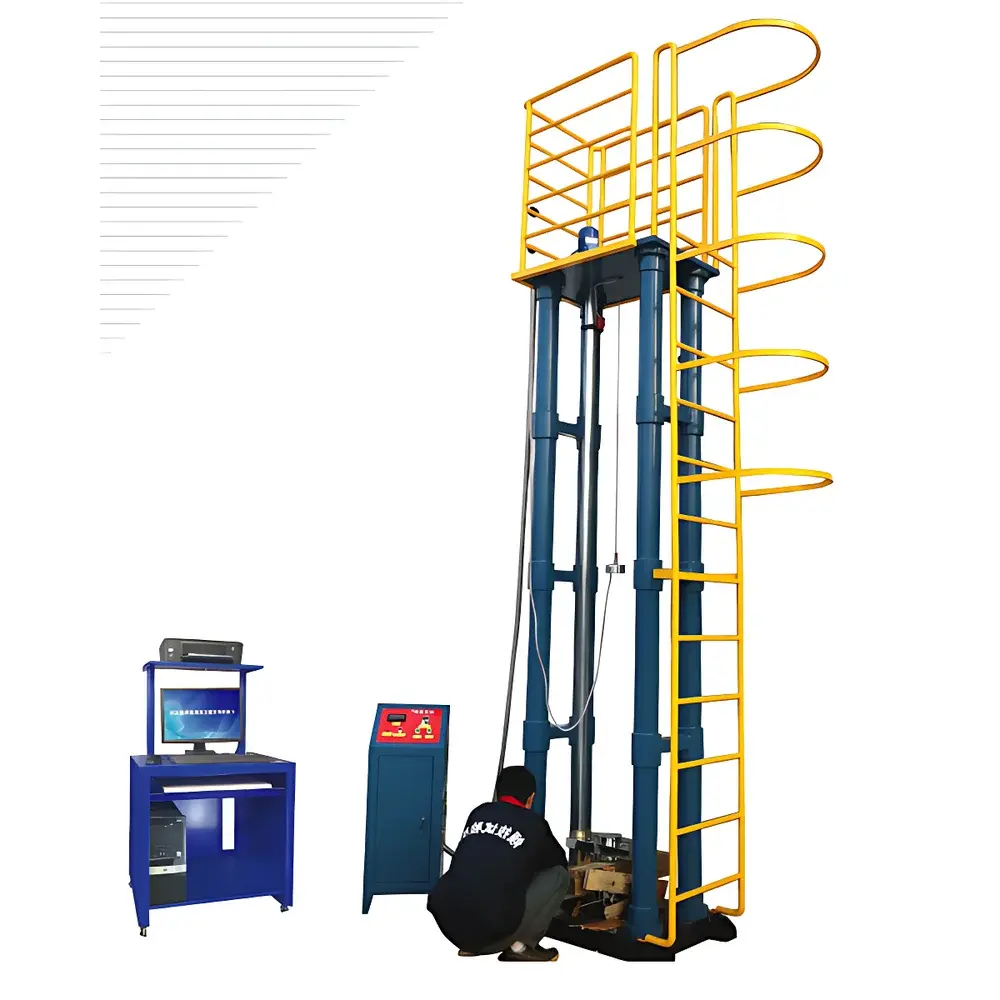
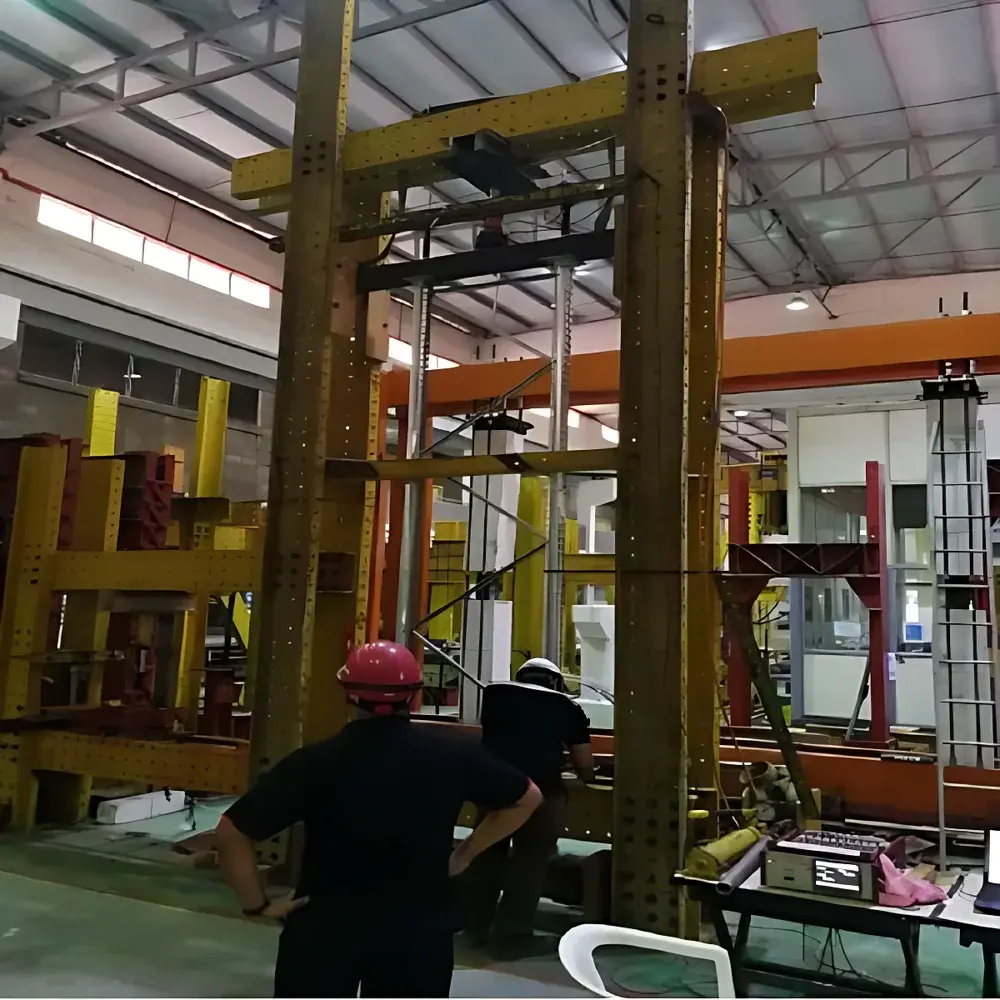
QJLC Plastic & Metal Pipe Drop Weight Impact Tester
| Origin | Shanghai, China |
|---|---|
| Manufacturer Type | Authorized Distributor |
| Origin Category | Domestic (China) |
| Model | QJLC |
| Quotation | ¥68,000 CNY |
| Instrument Type | Drop Weight Impact Tester |
| Impact Energy | 300 J |
| Impact Velocity | 3.5 m/s |
| Hammer Mass Range | 0.5 kg to 6.3 kg |
| Load Cell Range | 0.5 kg to 6.3 kg (equivalent force range: ~4.9 N to 61.8 N) |
| Maximum Lift Height | ≤2000 mm |
| Hammer Head Radii | R50 for Φ25 mm & Φ90 mm impactors |
| Height Accuracy | ±2 mm |
| Specimen Diameter Range | Φ16 mm to Φ800 mm |
| Power Supply | 220 V, 50 Hz |
| Dimensions (W×D×H) | 800 × 800 × 4100 mm |
| Net Weight | 380 kg |
Overview
The QJLC Plastic & Metal Pipe Drop Weight Impact Tester is a precision-engineered mechanical impact testing system designed in strict accordance with international and national standards for evaluating the resistance of rigid and semi-rigid tubular and sheet materials to sudden dynamic loading. It operates on the fundamental principle of gravitational potential energy conversion: a calibrated hammer mass is elevated to a defined height and released under free-fall conditions, delivering a controlled impact energy onto the specimen surface. The resulting failure mode—crack initiation, fracture propagation, or deformation—is assessed visually or via optional high-speed imaging integration. This apparatus is explicitly engineered for standardized compliance testing of thermoplastic pipes (e.g., PVC-U, PE, MPP, PP-R), corrugated structures (e.g., double-wall corrugated pipes), rigid sheets, and non-metallic engineering components such as glass and ceramic specimens. Its mechanical architecture ensures minimal energy loss during drop transmission, high repeatability across test cycles, and traceable calibration paths aligned with ISO/IEC 17025 laboratory accreditation requirements.
Key Features
- Adjustable hammer mass configuration (0.5–6.3 kg) enabling precise energy tuning from low-impact screening to high-energy structural validation
- Dual-standard impactor heads (Φ25 mm & Φ90 mm, both with R50 spherical radius) compliant with GB/T 14152 and ASTM D2444 geometries
- Electromechanical lift mechanism with touchscreen-controlled height adjustment (0–2000 mm), resolution ≤1 mm, positional accuracy ±2 mm
- Pneumatic anti-rebound locking system prevents secondary impact and ensures single-event energy delivery
- Optical beam interruption sensors monitor hammer release timing and verify free-fall trajectory integrity prior to each test
- Vertical guide column with precision-ground surface finish and 0.5–1.0 mm clearance tolerance relative to hammer sleeve, minimizing lateral deviation
- Stainless-steel base frame anchored to reinforced concrete foundation (Φ120 mm × 500 mm pit required), ensuring static stability and vibration isolation
Sample Compatibility & Compliance
The QJLC tester accommodates cylindrical specimens ranging from Φ16 mm to Φ800 mm in outer diameter, supporting both supported and suspended test configurations per standard protocols. It is validated for use with polymeric piping systems including but not limited to PVC-U pressure/drainage pipes (GB/T 5836, GB/T 10002.1), PE water supply conduits (GB/T 13663), MPP power ducts (JTT 529–2016), and structured-wall profiles (GB/T 18477). The system fully satisfies the mechanical and metrological requirements of GB/T 14152 (Tensile Impact Test for Thermoplastic Pipes), GB/T 14153 (Impact Resistance Classification), GB/T 6112 (Plastic Pipes – Drop Weight Impact Test), and JB/T 9389 (Technical Specifications for Drop Weight Impact Testing Machines). All hardware and operational procedures are documented to support GLP-compliant testing environments and facilitate audit readiness per ISO/IEC 17025 Clause 6.4.
Software & Data Management
While the base QJLC model features an embedded industrial HMI touchscreen for manual parameter input and real-time height display, optional PC-based software modules provide expanded functionality including automated test sequencing, digital logbook generation, pass/fail classification per threshold criteria, and exportable CSV/Excel reports. Data capture includes timestamped test records, hammer mass, lift height, calculated impact energy (E = m·g·h), observed failure type (e.g., “crack”, “split”, “no failure”), and operator ID. Audit trail capabilities meet minimum traceability expectations for regulated quality control laboratories operating under GMP-aligned workflows. Calibration certificates for load cells and height encoders are supplied with NIST-traceable documentation upon installation.
Applications
- Quality assurance of extruded plastic pipe batches prior to field installation
- Comparative evaluation of material formulations (e.g., impact modifier content, filler dispersion)
- Validation of aging effects (thermal, UV, hydrolytic) on impact resilience
- Structural qualification of large-diameter HDPE stormwater conduits
- R&D support for novel composite pipe designs incorporating fiber reinforcement or multi-layer architectures
- Third-party certification testing per CE marking requirements for construction products (EN 1452, EN 1519)
FAQ
What standards does this instrument directly support?
GB/T 14152, GB/T 14153, GB/T 6112, GB/T 5836, GB/T 10002.1, GB/T 10002.3, GB/T 13664, GB/T 16800, GB/T 18477, JB/T 5125, and JTT 529–2016.
Is the hammer mass calibrated and certified?
Yes — all hammer masses are individually certified for nominal mass value with uncertainty ≤±0.2% and supplied with traceable calibration certificates.
Can the system be integrated into a LIMS environment?
Via optional RS-232/RS-485 or Ethernet interface modules, raw test data and metadata can be exported to external LIMS platforms using ASCII or Modbus RTU protocols.
What maintenance intervals are recommended?
Monthly visual inspection of guide rod lubrication (light machine oil), quarterly verification of optical sensor alignment, and annual recalibration of height encoder and load cell by authorized service provider.
Does it comply with ISO 179 or ISO 8256?
No — those standards apply to pendulum-type Charpy/Izod impact testers; the QJLC is designed exclusively for drop-weight methodology per ISO 6603-2 and GB/T 14152.



