
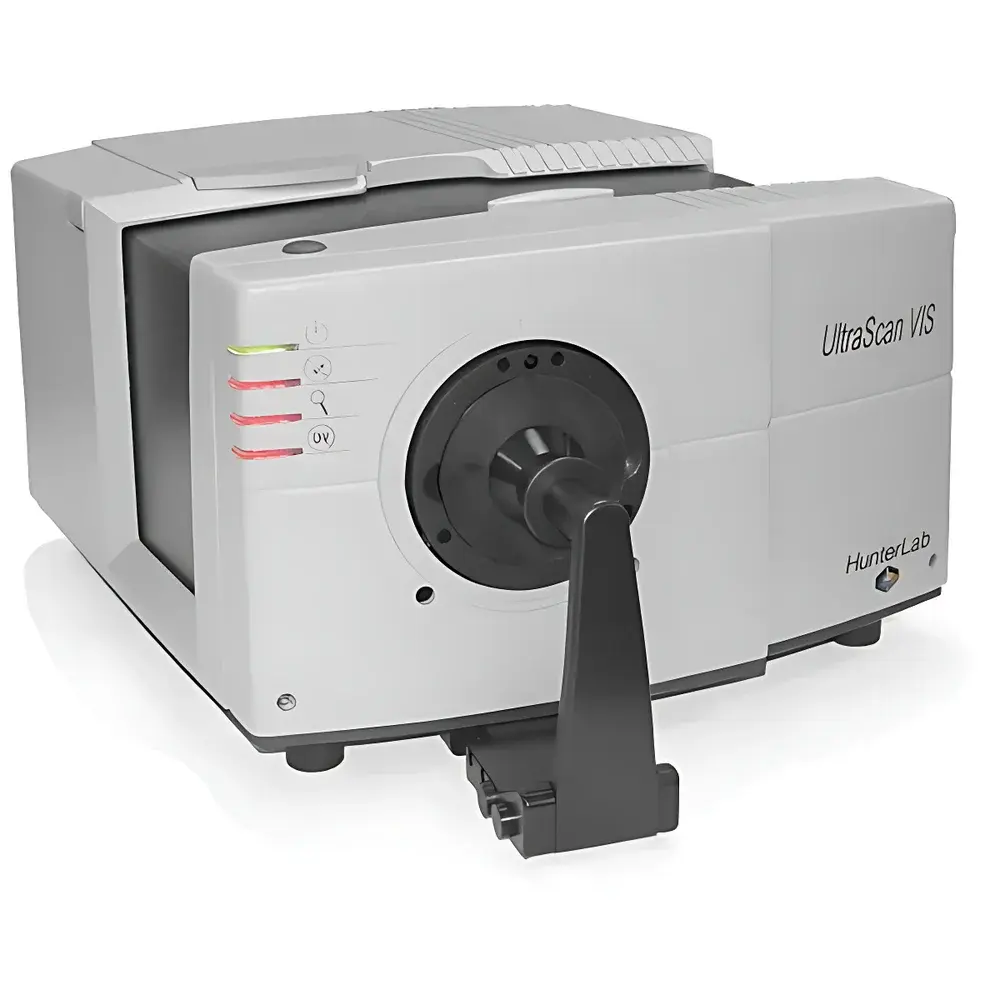
HunterLab UltraScan VIS Benchtop Spectrophotometer
| Brand | HunterLab |
|---|---|
| Origin | USA |
| Manufacturer Status | Authorized Distributor |
| Origin Category | Imported |
| Model | USVIS |
| Product Type | Spectrophotometric Colorimeter |
| Instrument Type | Benchtop |
| Optical Geometry | d/8° Integrating Sphere |
| Light Source | Pulsed Xenon Lamp |
| Spectral Range | 360–780 nm |
| Repeatability | ≤ 0.03 ΔE*ab (CIE Lab, mean of 20 measurements on certified white tile) |
Overview
The HunterLab UltraScan VIS is a high-precision benchtop spectrophotometer engineered for rigorous color measurement across reflective, transmissive, and translucent materials in laboratory and production environments. Operating on the CIE-compliant d/8° integrating sphere geometry with pulsed xenon illumination, it delivers traceable, reproducible spectral data from 360 nm to 780 nm — fully covering the human visible spectrum and extending into the near-UV range critical for fluorescence assessment. Its dual-beam optical architecture employs two diode array detectors with 10 nm effective bandwidth, enabling full-spectrum acquisition in under one second. The instrument adheres to international standards including CIE No. 15, ASTM E308, ASTM D2244, ISO 7724, ISO 11664, USP , and AATCC Test Method 16, ensuring metrological validity for regulated and non-regulated applications alike.
Key Features
- d/8° Integrating Sphere Geometry: Supports both specular component included (SCI) and specular component excluded (SCE) modes automatically via software-controlled baffle positioning — essential for distinguishing surface appearance effects (e.g., gloss, texture) from intrinsic color.
- Pulsed Xenon Light Source: Emulates CIE Standard Illuminant D65 with stable spectral output; flash duration is microsecond-scale, eliminating thermal loading and photodegradation of light-sensitive samples such as polymers, pharmaceuticals, or biological fluids.
- Two Measurement Apertures: Switches automatically between Large Area View (LAV: 19 mm optical diameter) and Small Area View (SAV: 6.3 mm optical diameter), with real-time verification of aperture alignment, sample placement, and lens position to prevent operator-induced error.
- Expanded Transmittance Capability: Features an oversized transmission compartment (open on three sides + top), accommodating cuvettes up to 80 mm pathlength, films, sheets, and irregularly shaped transparent media — supporting both directional (d/0°) and total (d/8°) transmittance per ASTM D1003 and ISO 13468.
- UV Control System: Includes motorized UV filter insertion for quantitative fluorescence correction using calibrated fluorescent standards (e.g., for optical brighteners in textiles or paper), compliant with USP requirements for UV-adjusted color evaluation.
- Real-Time Instrument Validation: Built-in NIST-traceable white tile, green reference tile, and didymium filter enable daily performance verification — detecting wavelength drift, photometric deviation, or detector degradation before measurement execution.
Sample Compatibility & Compliance
The UltraScan VIS accommodates diverse physical forms without modification: opaque solids (e.g., plastics, ceramics), semi-crystalline films, viscous liquids (≥1 mL volume), high-temperature solutions (up to 300 °C with optional heated cell holders), and delicate optics (e.g., contact lenses, AR-coated glass). Its mechanical design includes ergonomic spring-loaded sample clamps with 180° rotation and telescoping extension, enabling secure positioning of uneven or thick specimens. All measurements comply with GLP/GMP documentation requirements through audit-trail-enabled software (Universal Software v7.x), which records user ID, timestamp, calibration status, and raw spectral data per FDA 21 CFR Part 11. Regulatory validation packages are available for pharmaceutical, food, and cosmetic industries requiring IQ/OQ/PQ protocols.
Software & Data Management
Controlled via HunterLab’s Universal Software platform, the UltraScan VIS supports automated workflows, method-based measurement sequencing, and multi-instrument fleet synchronization. Spectral data is stored in vendor-neutral XML format with embedded metadata (illuminant, observer, geometry, aperture, UV setting), facilitating third-party integration with LIMS, MES, and ERP systems. Statistical process control (SPC) tools include trend analysis, tolerance mapping (ΔE*, ΔL*, Δa*, Δb*), and pass/fail reporting against master standards. Raw reflectance/transmittance spectra (at 10 nm intervals) are exportable for advanced modeling (e.g., Kubelka-Munk, colorant formulation, metamerism prediction). Software updates maintain conformance with evolving ISO/CIE technical reports and regulatory guidance documents.
Applications
Validated use cases span quality assurance, R&D, and regulatory submission across multiple sectors: quantification of yellowness index (ASTM E313) and whiteness (CIE Whiteness, Ganz), APHA/Pt-Co and Gardner color scales for petrochemicals and beverages, haze and clarity per ASTM D1003, and transmission color of ophthalmic solutions per USP . In coatings and pigments, it supports batch-to-batch consistency checks and spectral match prediction. For food manufacturers, it measures browning index in dairy products and anthocyanin stability in fruit juices. Textile labs apply it to assess dye lot uniformity under multiple illuminants (D65, A, F2) and evaluate fluorescent whitening agent (FWA) efficacy. Academic researchers utilize its high signal-to-noise ratio and low inter-instrument variability (<0.08 ΔE*ab across units) for cross-laboratory studies in material science and sensory perception.
FAQ
What standards does the UltraScan VIS comply with?
It meets CIE Publication 15:2018, ASTM E308–22, ASTM D2244–21, ISO 7724–1:2017, ISO 11664–4:2019, USP , and AATCC TM16–2022 for both reflectance and transmittance measurements.
Can it measure fluorescent samples?
Yes — with optional UV calibration kit and motorized UV filter, it performs quantitative fluorescence correction per USP using D65-simulated excitation and certified fluorescent standards.
Is inter-instrument agreement guaranteed?
Each unit undergoes factory characterization against primary standards at HunterLab’s NIST-accredited metrology lab; typical inter-instrument agreement is ≤0.08 ΔE*ab on ceramic tiles, supporting multi-site color control networks.
How is long-term stability maintained?
Daily verification using built-in white, green, and didymium references detects spectral drift or photometric decay; automatic recalibration routines preserve accuracy over years of continuous operation.
Does it support Good Manufacturing Practice (GMP) compliance?
Yes — Universal Software provides full 21 CFR Part 11 compliance with electronic signatures, audit trails, role-based access control, and secure data archiving for pharmaceutical, medical device, and food-grade applications.




