
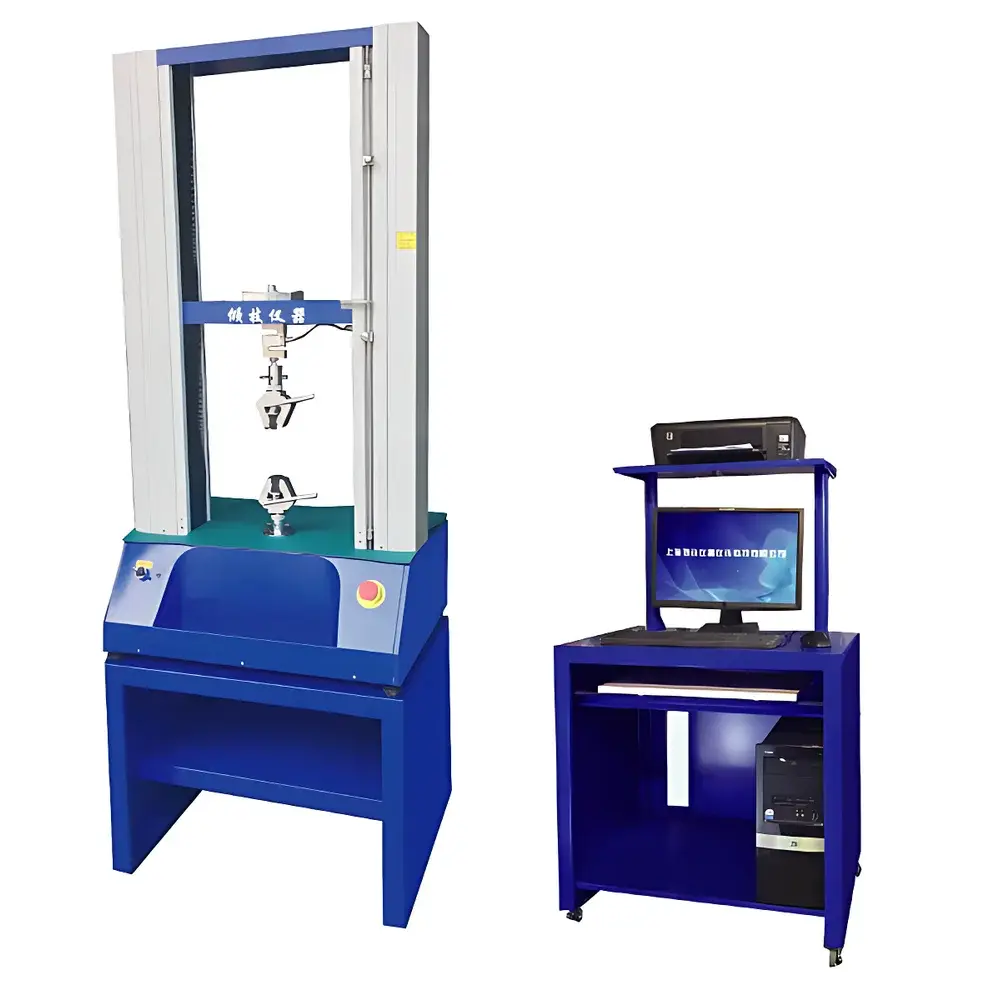
QJ211S Aluminum-Plastic Composite Pipe Peel Testing Machine
| Origin | Beijing, China |
|---|---|
| Manufacturer Type | Authorized Distributor |
| Origin Category | Domestic (PRC) |
| Model | QJ211S |
| Quotation | USD 6,300 (FOB) |
| Instrument Type | Electromechanical Tensile Testing Machine |
| Maximum Test Load | 30 kN |
| Load Range | 0–30 kN (fully adjustable) |
| Load Accuracy Class | Grade 1 (per ISO 7500-1 / ASTM E4) |
| Effective Stroke | 800 mm |
| Displacement Resolution | ±0.5% of reading |
| Load Cell Accuracy | 0.01% of full scale |
| Speed Range | 0.001–500 mm/min |
| Speed Accuracy | ±0.5% |
| Width Between Columns | ~420 mm |
| Weight | ~140 kg |
| Safety Protection | Electronic stroke limit, emergency stop button, overload cut-off, mechanical hard-stop |
Overview
The QJ211S Aluminum-Plastic Composite Pipe Peel Testing Machine is a precision-engineered electromechanical tensile testing system designed specifically for quantitative peel adhesion evaluation of multilayer composite tubing—particularly aluminum-plastic (Al/PE or Al/PVC) pipes widely used in plumbing, heating, and gas distribution systems. It operates on the principle of controlled uniaxial tension applied to a standardized peel specimen, where interfacial bond strength between the aluminum foil layer and thermoplastic polymer matrix is measured via force-displacement response under defined peeling geometry (typically 90° or 180°). Compliant with ISO 8510-2, ASTM D903, and GB/T 2790, this machine delivers traceable, repeatable peel force data essential for quality assurance in pipe manufacturing, R&D validation, and supplier qualification protocols.
Key Features
- Modular electromechanical architecture supporting interchangeable load cells (up to 30 kN capacity), enabling seamless transition between peel, tensile, compression, bending, and shear testing configurations.
- High-resolution closed-loop servo control system with real-time feedback ensures precise speed regulation (0.001–500 mm/min) and consistent loading profiles across low-force peel regimes and high-load structural integrity tests.
- Automated test sequence execution: auto-zeroing at start, automatic return-to-initial-position upon specimen failure, programmable multi-step loading (e.g., constant-rate peel → dwell → ramped separation), and dynamic load range switching without manual intervention.
- Dual-safety architecture: electronic stroke limit protection integrated with hardware-based mechanical end-stop; overload cutoff triggered at >105% of selected range; emergency stop button compliant with IEC 60204-1.
- Windows-based control software with intuitive GUI supports customizable test templates, real-time plotting of force vs. displacement curves, and synchronized digital video capture (optional) for failure mode correlation.
Sample Compatibility & Compliance
The QJ211S accommodates standardized peel specimens prepared per GB/T 18997.1–2003 (aluminum-plastic composite pipes), ISO 11339 (adhesive peel testing), and ASTM D1876 (T-peel). Fixture adaptability includes pneumatic side-action grips for thin-walled tubular sections, self-aligning wedge clamps for flat laminates, and specialized peel jigs for 90° and 180° geometries. All mechanical components meet ISO 26203-1 dimensional stability requirements. Calibration certificates are traceable to NIM (National Institute of Metrology, China) and compatible with ISO/IEC 17025 laboratory accreditation frameworks. Data acquisition complies with GLP audit trails and supports 21 CFR Part 11 electronic signature readiness when paired with validated software modules.
Software & Data Management
The embedded Windows OS platform runs proprietary test control software certified for CE and RoHS compliance. It enables automated parameter calculation per ISO 6892-1 (tensile), ASTM D882 (thin films), and GB/T 228.1 (metallic materials), including peel strength (N/mm), average peel force, maximum peel load, and interfacial delamination onset point. Raw data export is supported in CSV, XML, and PDF formats; curve overlays allow comparative analysis across batches or material variants. Audit logs record operator ID, timestamp, calibration status, environmental conditions (optional sensor integration), and all parameter modifications—ensuring full data integrity for regulatory submissions.
Applications
- Quantitative peel strength assessment of aluminum-plastic composite pipes during incoming QC and final release testing.
- Adhesion performance benchmarking of extrusion-coated, laminated, or adhesive-bonded multilayer structures in HVAC, medical tubing, and food-grade packaging.
- Mechanical validation of polymer-aluminum interface durability under thermal cycling (when integrated with environmental chamber).
- Supporting root cause analysis of delamination failures through synchronized high-speed imaging and force transient detection.
- Compliance testing for certification bodies requiring adherence to EN 1451-1, GB/T 18997, or AS/NZS 4020:2018 (potable water systems).
FAQ
What peel angles does the QJ211S support?
The system is configured for both 90° and 180° peel geometries using dedicated jigs; angular alignment accuracy is maintained within ±0.5° via precision-machined mounting plates.
Is the machine suitable for testing small-diameter tubing (e.g., Ø6–Ø16 mm)?
Yes—customizable mandrel-based fixtures ensure axial alignment and prevent buckling; minimum recommended specimen width is 10 mm for reliable interfacial stress distribution.
Can test data be exported directly to LIMS or ERP systems?
Yes—via configurable ODBC drivers and RESTful API endpoints; metadata fields (sample ID, operator, standard reference, pass/fail flag) are fully programmable.
Does the system meet ISO 17025 calibration requirements?
All load cells are supplied with NIM-traceable calibration certificates; annual recalibration services include uncertainty budget documentation aligned with ISO/IEC 17025:2017 Clause 6.5.
What maintenance intervals are recommended for long-term repeatability?
Lubrication of lead screws and inspection of belt tension every 500 operational hours; load cell verification using certified deadweights every 3 months or after impact events.



