
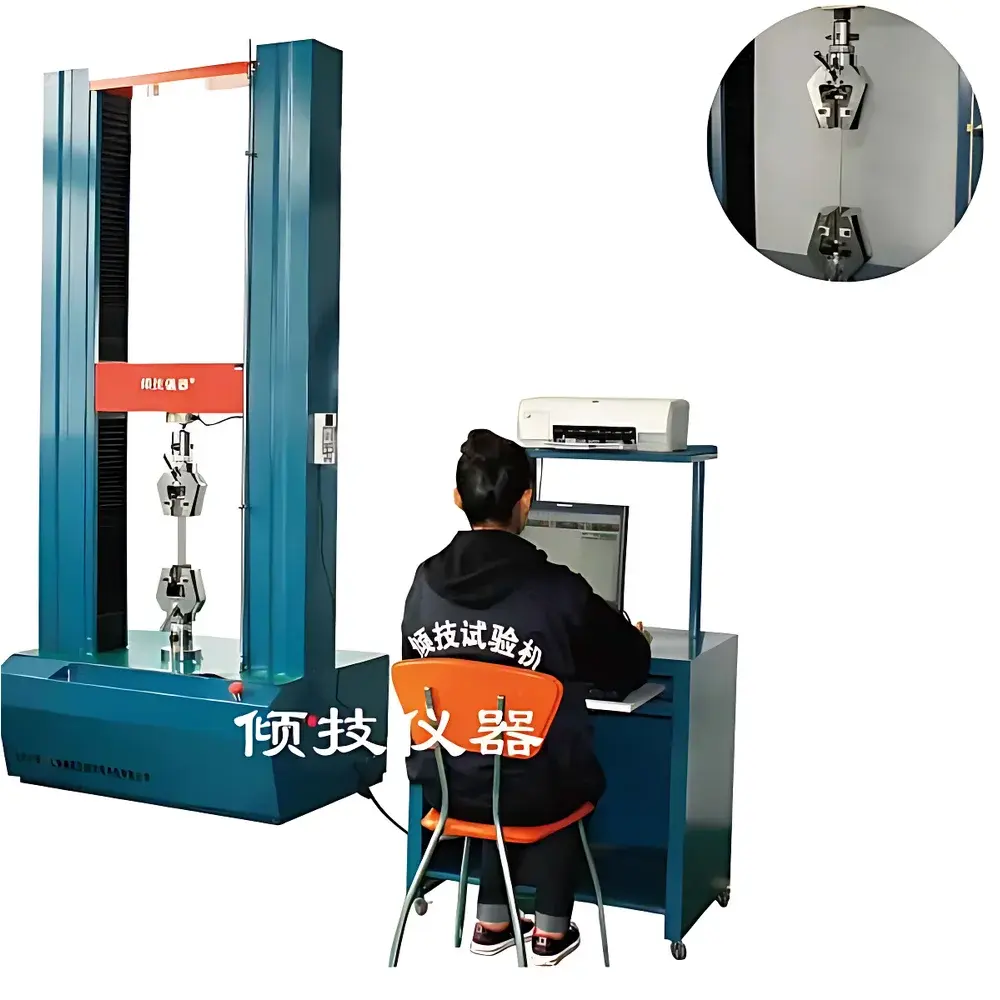
QJ212 Qinge Universal Testing Machine for Glass-Lined Equipment Quality Assessment
| Brand | Qinge |
|---|---|
| Origin | Shanghai, China |
| Model | QJ212 |
| Type | Electromechanical Universal Testing Machine |
| Max Load Capacity | 10–500 kN (configurable) |
| Load Resolution | ±1/250,000 full scale,不分档 (single-range high-resolution transducer) |
| Effective Test Width | 500 mm |
| Effective Tensile Stroke | 600 mm or 800 mm |
| Test Speed Range | 0.001–1000 mm/min |
| Speed Accuracy | ±0.5% of indicated value |
| Displacement Measurement Accuracy | ±0.5% of indicated value |
| Strain/Deformation Measurement Accuracy | ±0.5% of indicated value |
| Crosshead Movement | Dual-speed (fast/slow) motorized control with jog function |
| Safety Protection | Electronic travel limit switches, overload protection at 110% of rated load |
| Return Mode | Manual rapid return or programmable automatic return to home position |
| Dimensions (W×D×H) | 1000 × 680 × 2450 mm |
| Weight | 1250 kg |
| Compliance | ISO 7500-1, ASTM E4, ASTM E8/E21, DIN 51221, JIS Z2241 |
Overview
The QJ212 Qinge Universal Testing Machine is an electromechanical static testing system engineered for the mechanical quality assessment of glass-lined reaction vessels, agitators, and other enamel-coated industrial equipment. Designed specifically to evaluate structural integrity and coating adhesion performance under controlled uniaxial loading, it operates on the principle of servo-controlled force application and high-fidelity displacement feedback. The system complies with fundamental metrological standards for force measurement accuracy (ISO 7500-1 Class 0.5) and is validated for use in mechanical property determination per ASTM E4 (load verification), ASTM E8/E21 (tensile testing of metallic materials), and DIN 51221 (testing machine calibration). Its modular load frame architecture supports configurable capacities from 10 kN up to 500 kN, enabling standardized evaluation of both small-scale enamel coupons and full-scale vessel components under tension, compression, bending, peel, shear, and ring stiffness protocols.
Key Features
- High-resolution force measurement system with ±1/250,000 full-scale resolution across the entire range—no range switching required, ensuring consistent linearity and repeatability.
- Wide test envelope: 500 mm effective width accommodates large-diameter glass-lined flanges and cylindrical specimens; 600 mm or 800 mm tensile stroke options support elongation-critical assessments.
- Precisely regulated speed control from 0.001 to 1000 mm/min, with closed-loop velocity accuracy maintained within ±0.5% of setpoint—critical for strain-rate-sensitive enamel fracture analysis.
- Dual-mode crosshead actuation: fast positioning for setup and slow, fine-tuned motion during data acquisition, enhanced by jog functionality for sub-millimeter alignment.
- Integrated safety architecture including electronic travel limits, hardware-based overload cutoff at 110% of maximum rated load, and programmable auto-return to home position post-test.
- Robust cast-iron base and reinforced steel frame (1250 kg total mass) minimize vibration-induced noise and ensure long-term dimensional stability during cyclic or creep testing.
Sample Compatibility & Compliance
The QJ212 is routinely deployed for evaluating ASTM C1413-compliant enamel adhesion test specimens, ISO 2812-3 pull-off substrates, and custom-designed ring-stiffness fixtures for glass-lined pipe sections. It accepts standard tensile bars (ASTM E8), compression cylinders (ASTM C39), three-point bend fixtures (ASTM D790), and specialized peel jigs per ASTM D903. All test methods are traceable to national metrology institutes via factory calibration certificates aligned with ISO/IEC 17025 requirements. The system supports GLP-compliant documentation workflows when paired with validated software configurations meeting FDA 21 CFR Part 11 audit trail and electronic signature criteria.
Software & Data Management
Control and analysis are executed via a Windows-based proprietary platform that provides real-time graphical display of load–displacement, stress–strain, and time-dependent curves. Users may perform post-test operations—including point-wise data editing, curve overlay, axis scaling, region-of-interest extraction, and multi-curve statistical comparison—without raw data export. The software logs all operator actions, method parameters, calibration events, and environmental metadata (e.g., ambient temperature, humidity if sensor-integrated) to generate compliant test reports in PDF or XLSX format. Optional IQ/OQ documentation packages are available for laboratory validation under GMP or ISO 17025 accreditation frameworks.
Applications
- Quantitative measurement of enamel-to-steel interfacial bond strength via tensile pull-off and shear lap-joint tests.
- Evaluation of thermal shock resistance through controlled compression cycling between defined temperature extremes (when integrated with environmental chambers).
- Ring stiffness testing of glass-lined piping per EN 13476-2 to assess deformation behavior under external pressure loads.
- Mechanical screening of repair coatings and patch materials used in field maintenance of damaged linings.
- Validation of manufacturing process consistency across batches of glass-lined reactors, condensers, and storage tanks.
- Supporting root cause analysis in failure investigations involving chipping, spalling, or delamination phenomena.
FAQ
Is the QJ212 suitable for testing curved or irregularly shaped glass-lined components?
Yes—custom fixture design services are available to accommodate non-standard geometries, including convex/concave surfaces and asymmetric flange profiles.
Can the system be upgraded to higher load capacities after purchase?
Load cell replacement and structural reinforcement kits are offered for field upgrades up to 500 kN, subject to frame compatibility verification.
Does the software meet regulatory requirements for auditable test records?
When configured with optional 21 CFR Part 11 modules, the software provides role-based access control, electronic signatures, and immutable audit trails compliant with pharmaceutical and chemical industry QA/QC mandates.
What maintenance intervals are recommended for long-term reliability?
Preventive maintenance is advised every 12 months or after 2,000 test cycles, including load cell recalibration, lubrication of guideways, and verification of encoder linearity.
Is technical support available internationally?
Qinge provides remote diagnostics, on-site service coordination via regional partners, and multilingual documentation (English, German, Spanish) for global deployment.
Related Products



