
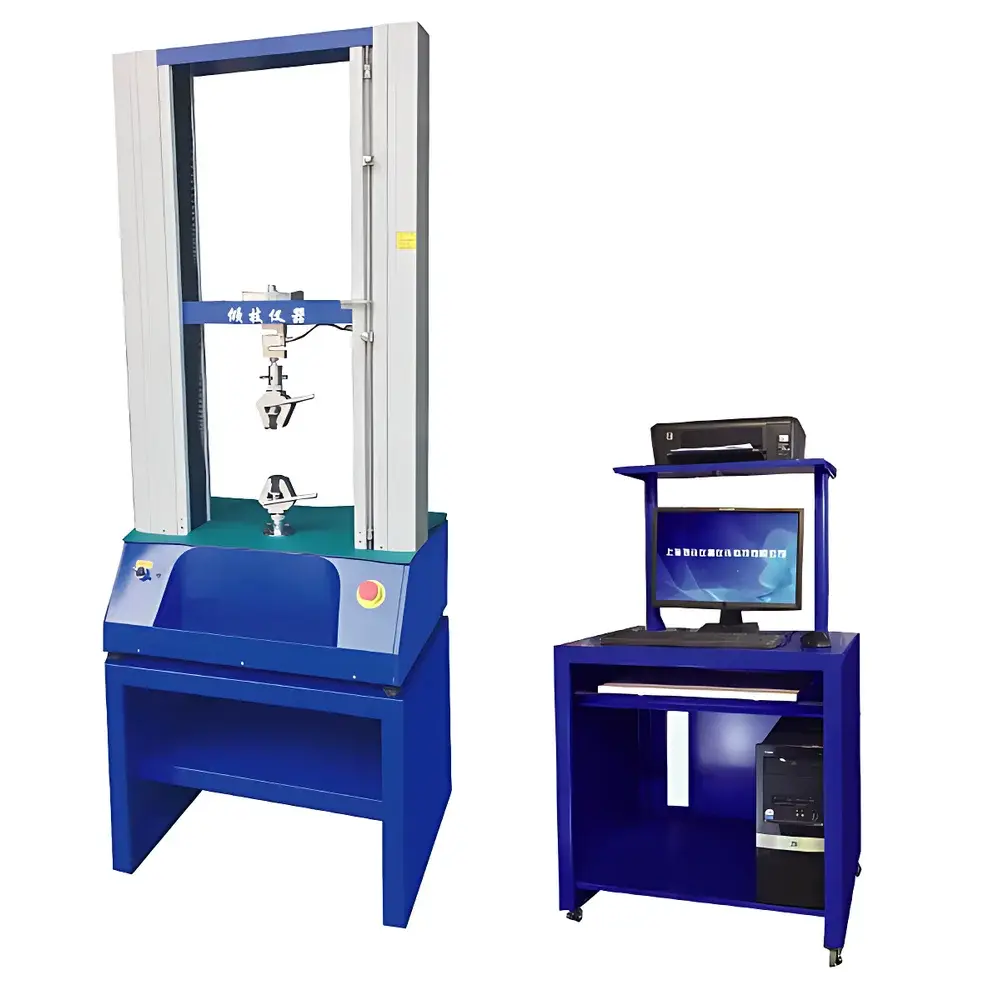
QJ211S Carbon Fiber Composite Tensile Testing Machine
| Origin | Shanghai, China |
|---|---|
| Manufacturer Type | Authorized Distributor |
| Origin Category | Domestic (China) |
| Model | QJ211S |
| Price | USD 7,800 (FOB Shanghai) |
| Instrument Type | Electromechanical Universal Testing Machine |
| Max Test Load | 30 kN |
| Load Range | 0–30 kN (fully adjustable) |
| Load Accuracy Class | Grade 1 (per ISO 7500-1 / ASTM E4) |
| Effective Travel | ~800 mm |
| Crosshead Speed Range | 0.001–500 mm/min |
| Speed Accuracy | ±0.5% of set value |
| Displacement Resolution | ±0.5% of reading |
| Strain Measurement Accuracy | ±0.5% of reading |
| Effective Test Width | ~420 mm |
| Safety Features | Dual-limit protection (electronic stroke limit + emergency stop), overload auto-shutdown |
| Net Weight | ~140 kg |
Overview
The QJ211S Carbon Fiber Composite Tensile Testing Machine is a high-precision electromechanical universal testing system engineered for static mechanical characterization of advanced fiber-reinforced polymer (FRP) composites—particularly carbon fiber–epoxy laminates, prepregs, and cured composite coupons. Designed in accordance with ISO 527-4, ASTM D3039, and GB/T 3354 standards, it implements closed-loop servo-controlled actuation to deliver repeatable, traceable force–displacement–strain data under uniaxial tensile, compressive, flexural, peel, and tear loading conditions. The system is optimized for post-impregnation evaluation of critical mechanical properties including tensile strength, tensile modulus (E), elongation at break, yield point (ReH/ReL), offset yield strength (Rp0.2), ultimate tensile strength (Rm), and tangent modulus (Rt0.5–Rt0.7). Its modular load frame architecture supports interchangeable fixtures and extensometers, enabling standardized specimen preparation per ISO 527-2 Type I or ASTM D3039 Type IV geometries.
Key Features
- High-fidelity 30 kN load cell with 0.01% internal resolution and Grade 1 accuracy per ISO 7500-1, ensuring compliance with ISO 17025-accredited laboratory requirements.
- Full-range speed control from 0.001 to 500 mm/min, calibrated to ±0.5% tolerance across the entire spectrum—critical for strain-rate-sensitive composite response analysis.
- Dual-mode displacement measurement: integrated encoder-based crosshead travel (±0.5% accuracy) plus optional clip-on or non-contact video extensometry for true local strain quantification.
- Windows-based proprietary test software supporting real-time dynamic plotting, multi-curve overlay, automatic parameter extraction (e.g., Rm, E, A%, Rp0.2), and customizable report generation with embedded metadata (operator ID, timestamp, standard reference).
- Robust dual-limit safety architecture: programmable electronic stroke limits synchronized with hardware emergency stop and mechanical end-of-travel buffers—meeting CE machinery directive EN ISO 13857 requirements.
- Auto-return-to-initial-position and auto-zeroing functions reduce operator dependency and minimize inter-test variability.
- Modular sensor interface accommodating multiple load cells (e.g., 1 kN, 5 kN, 30 kN) and environmental chambers (–70°C to +250°C) without firmware modification.
Sample Compatibility & Compliance
The QJ211S accommodates standard composite test specimens per ISO 527-4 (unidirectional CFRP), ASTM D3039 (polymer matrix composites), and GB/T 3354 (carbon fiber reinforced plastics). It supports flat coupons (up to 420 mm wide × 800 mm gauge length), dog-bone geometries, and short-beam shear configurations using interchangeable grips (pneumatic, wedge, or hydraulic). All test protocols are pre-configured for alignment with ISO/IEC 17025 calibration traceability, ASTM E4 force verification procedures, and GLP-compliant audit trails—including user authentication logs, parameter change history, and digital signature support for FDA 21 CFR Part 11 readiness.
Software & Data Management
The embedded Windows application provides full I/O control via USB 2.0 or Ethernet, with native export to CSV, XML, and PDF formats. Raw data files include time-stamped force–displacement–strain arrays with metadata headers compliant with ASTM E1434 and ISO 10360-7. Audit trail functionality records all test modifications, calibration events, and user logins. Software modules support statistical process control (SPC) charting, Weibull modulus calculation for strength distribution analysis, and batch comparison across material lots—enabling QC/QA teams to generate ISO 9001-compliant inspection reports directly from test execution.
Applications
- Tensile property validation of aerospace-grade carbon fiber laminates (e.g., T700/epoxy, M40J/bismaleimide) per Boeing BMS 7-115 or Airbus AITM 1-0003.
- Interlaminar shear strength (ILSS) assessment via short-beam bending per ASTM D2344.
- Compression-after-impact (CAI) specimen preloading and residual strength evaluation when coupled with drop-weight impact accessories.
- Creep and stress-relaxation profiling under constant load (hold function) for thermoset resin systems.
- Quality conformance testing of prepreg tapes and woven fabrics prior to autoclave curing cycles.
- R&D-level investigation of hybrid composites (e.g., CF/glass, CF/aramid) and nanomodified matrices.
FAQ
Does the QJ211S comply with ASTM D3039 and ISO 527-4 for carbon fiber composite testing?
Yes—the system’s load accuracy, speed linearity, and displacement resolution meet the minimum performance criteria specified in both standards, and its software includes preloaded test methods with auto-calculated parameters per ASTM D3039 Annex A1 and ISO 527-4 Clause 8.
Can the machine be integrated into a LIMS or MES environment?
Yes—via OPC UA or TCP/IP API, the controller supports bidirectional communication with laboratory information management systems (LIMS) and manufacturing execution systems (MES) for automated job dispatch and result ingestion.
Is third-party calibration certification available?
Yes—factory calibration is performed per ISO/IEC 17025 by an accredited metrology lab; NIST-traceable certificates with uncertainty budgets are provided upon request.
What extensometer options are supported for modulus measurement?
The system interfaces with contact-type clip-on extensometers (e.g., 10–50 mm gauge lengths, ±1 µm resolution) and non-contact digital image correlation (DIC) systems meeting ASTM E837 requirements.
How is data integrity ensured during long-duration tests?
All data streams are buffered locally on industrial-grade SSD storage with redundant write caching; power-loss recovery preserves unsaved test segments up to the last 5-second interval.



