
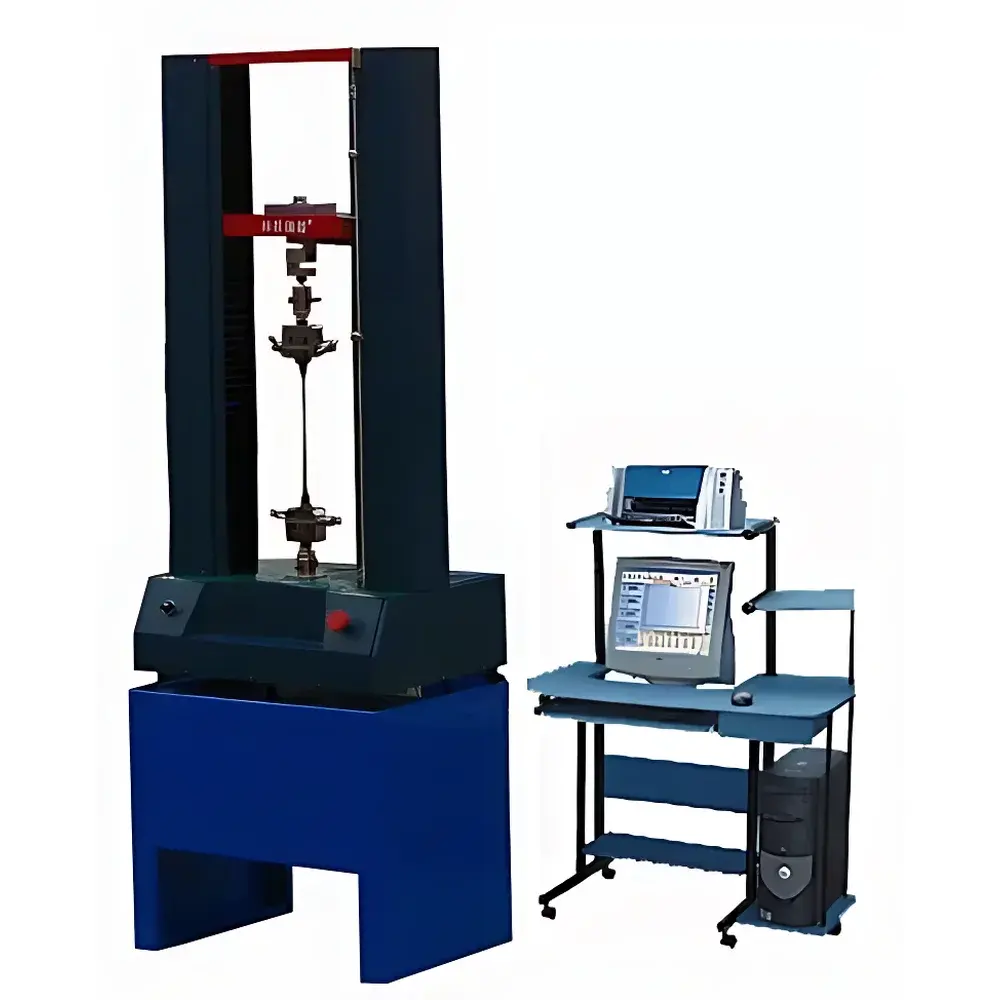
QJ211S Glass Four-Point Bending Tester – Electronic Universal Testing Machine
| Origin | Shanghai, China |
|---|---|
| Manufacturer Type | Authorized Distributor |
| Product Origin | Domestic (PRC) |
| Model | QJ211S |
| Price Range | USD 1,400 – 7,200 |
| Instrument Type | Electromechanical Universal Testing Machine |
| Load Capacity | 10 kN |
| Accuracy Class | 0.5 |
| Effective Test Width | 320 mm |
| Stroke | 500 / 800 mm |
| Speed Range | 0.01–300 mm/min |
| Speed Accuracy | ±0.5% of indicated value |
| Force Resolution | 500,000 counts (full-scale, no range switching) |
| Displacement & Strain Measurement Accuracy | ±0.5% of indicated value |
| Sensor | High-Precision Load Cell (USA-sourced) |
| Controller | Panasonic Full-Digital AC Servo System |
| Control Mode | Closed-Loop Digital Control (Constant Load, Constant Strain, Constant Displacement) |
| Safety Features | Software Diagnostics, Electronic Travel Limit, Overload Protection (110% F.S.), Emergency Stop |
| Weight | ~145 kg |
Overview
The QJ211S Glass Four-Point Bending Tester is an electromechanical universal testing machine engineered for high-precision mechanical characterization of brittle and semi-brittle transparent materials—particularly soda-lime silicate glass, aluminosilicate cover glass (e.g., Gorilla Glass), tempered display substrates, optical lenses, and architectural glazing panels. Unlike three-point bending, which induces non-uniform stress distribution and sensitivity to surface defects, the four-point bending configuration generates a uniform moment region between the two inner loading points, enabling accurate determination of flexural strength (modulus of rupture), fracture toughness, and elastic modulus without edge-effect interference. The system complies with ASTM C1161 (Standard Test Method for Flexural Strength of Advanced Ceramics at Ambient Temperature), ISO 178 (Plastics – Determination of Flexural Properties), and GB/T 1449–2022 (Fiber-reinforced Plastic Composites – Flexural Property Test Methods), making it suitable for R&D labs, QC/QA departments in display manufacturing, and third-party certification laboratories requiring traceable, repeatable mechanical data under standardized loading conditions.
Key Features
- Four-point bending fixture optimized for flat, rigid, and optically transparent specimens—designed to minimize localized stress concentrations and ensure uniform bending moment over the central span.
- 0.5-class force measurement accuracy per ISO 7500-1 and JJG 139–2014, validated across the full 10 kN capacity with no internal range switching; 500,000-count resolution ensures sub-newton sensitivity even at low loads typical for thin (<1.0 mm) cover glass testing.
- Panasonic digital AC servo motor and controller deliver precise speed control from 0.01 to 300 mm/min, with velocity stability maintained within ±0.5% of setpoint—critical for quasi-static fracture initiation studies and creep compliance measurements.
- Integrated dual-mode operation: standalone LCD console for rapid setup and real-time monitoring (force, displacement, strain, time, and load–displacement curve), plus full PC-based control via Windows-compatible software with GLP-compliant audit trail functionality.
- Modular fixture interface supports rapid reconfiguration for three-point bending, tensile testing (with wedge or pneumatic grips), compression (flat platens), shear, and puncture—enabling multi-standard compliance on a single platform.
- Hardware-level safety architecture includes electronic travel limits, automatic overload cutoff at 110% of full scale, and software-driven emergency diagnostics—meeting CE machinery directive requirements (2006/42/EC) and OSHA 1910.212 standards.
Sample Compatibility & Compliance
The QJ211S accommodates rectangular glass specimens up to 320 mm wide and 800 mm long, with thicknesses ranging from 0.3 mm (mobile device cover glass) to 19 mm (structural laminated glazing). Specimen alignment is facilitated by precision-machined V-groove supports and adjustable roller positioning to maintain parallelism and eliminate torsional loading. Fixture geometry adheres strictly to ASTM C1161’s recommended span-to-thickness ratios (e.g., 16:1 for thin substrates) and ISO 178’s support/roller diameter tolerances (±0.1 mm). All calibration certificates are NIST-traceable, and the system supports 21 CFR Part 11-compliant electronic records when configured with user authentication, change logging, and digital signature modules—fulfilling FDA-regulated medical device glass packaging validation (e.g., YY/T 0287, ISO 13485) and automotive glazing certification (SAE J2334, ECE R43).
Software & Data Management
The proprietary test software operates natively on Windows 10/11 and provides full digital control of test parameters—including ramp rate, hold duration, crosshead displacement limits, and conditional stopping logic (e.g., “stop on fracture detection”). Real-time load–displacement curves are rendered with anti-aliased vector graphics; users may overlay multiple test runs, apply polynomial smoothing, extract peak flexural stress, calculate work-of-fracture, and export ASCII/CSV/XLSX datasets directly. Audit trails record operator ID, timestamp, parameter changes, and pass/fail status per test sequence—supporting ISO/IEC 17025 accreditation requirements. Optional PDF report generation includes embedded metadata (calibration dates, environmental conditions, operator signature) and conforms to EN 10002-1 Annex A for mechanical testing documentation.
Applications
- Determination of flexural strength and Weibull modulus for smartphone cover glass qualification per IPC-J-STD-020 and IEC 60068-2-67.
- Interlaminar shear strength assessment of PVB/EVA interlayers in laminated architectural glass assemblies.
- Fracture mechanics evaluation of chemically strengthened glass using pre-cracked specimens (SENB geometry).
- Creep and stress-relaxation behavior of polymer-coated display substrates under sustained flexural loading.
- Validation of edge strength improvement after laser scoring, grinding, or fire-polishing processes.
- Comparative analysis of thermal tempering efficacy across batch production runs via standardized bend-to-failure metrics.
FAQ
What standards does the QJ211S support for glass bending tests?
ASTM C1161, ISO 178, GB/T 1449–2022, JIS R3205, and DIN 52303—all implemented via preconfigured test templates with automatic parameter validation.
Can the system perform tests other than four-point bending?
Yes: with optional fixtures, it executes three-point bending, uniaxial tension (using pneumatic or wedge grips), compression (flat platens), shear (double-lap joint), and puncture (ball impact simulation) per ASTM D638, D695, D5379, and ISO 6892-1.
Is the force sensor calibrated and traceable?
All load cells are factory-calibrated against NIST-traceable deadweight standards, with certificate of calibration included; annual recalibration services are available with certified documentation.
Does the software meet regulatory data integrity requirements?
When deployed with role-based access control, electronic signatures, and audit trail enabled, the system satisfies FDA 21 CFR Part 11, EU Annex 11, and ISO/IEC 17025 clause 7.7 for analytical data management.
What maintenance is required for long-term reliability?
Routine checks include lubrication of lead screws (every 6 months), verification of encoder alignment, and annual verification of force and displacement transducers—detailed in the included GLP-aligned maintenance logbook.



