
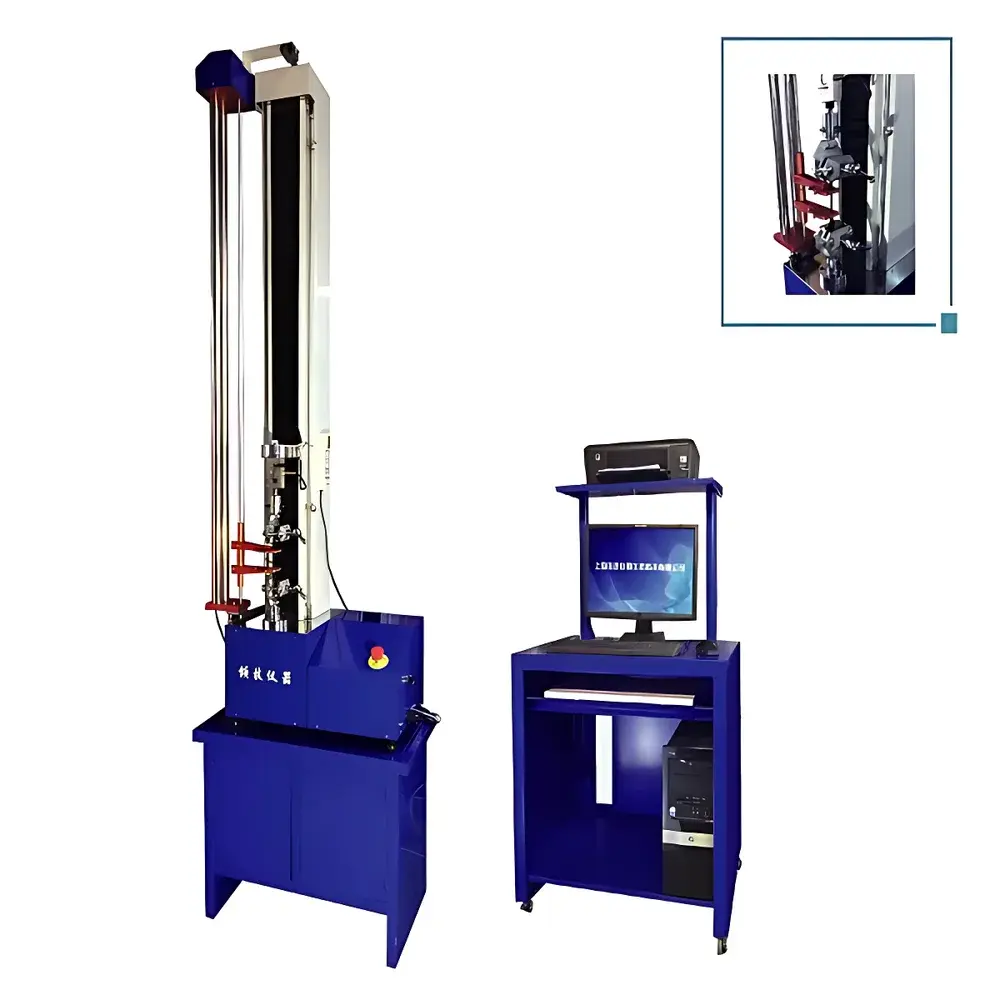
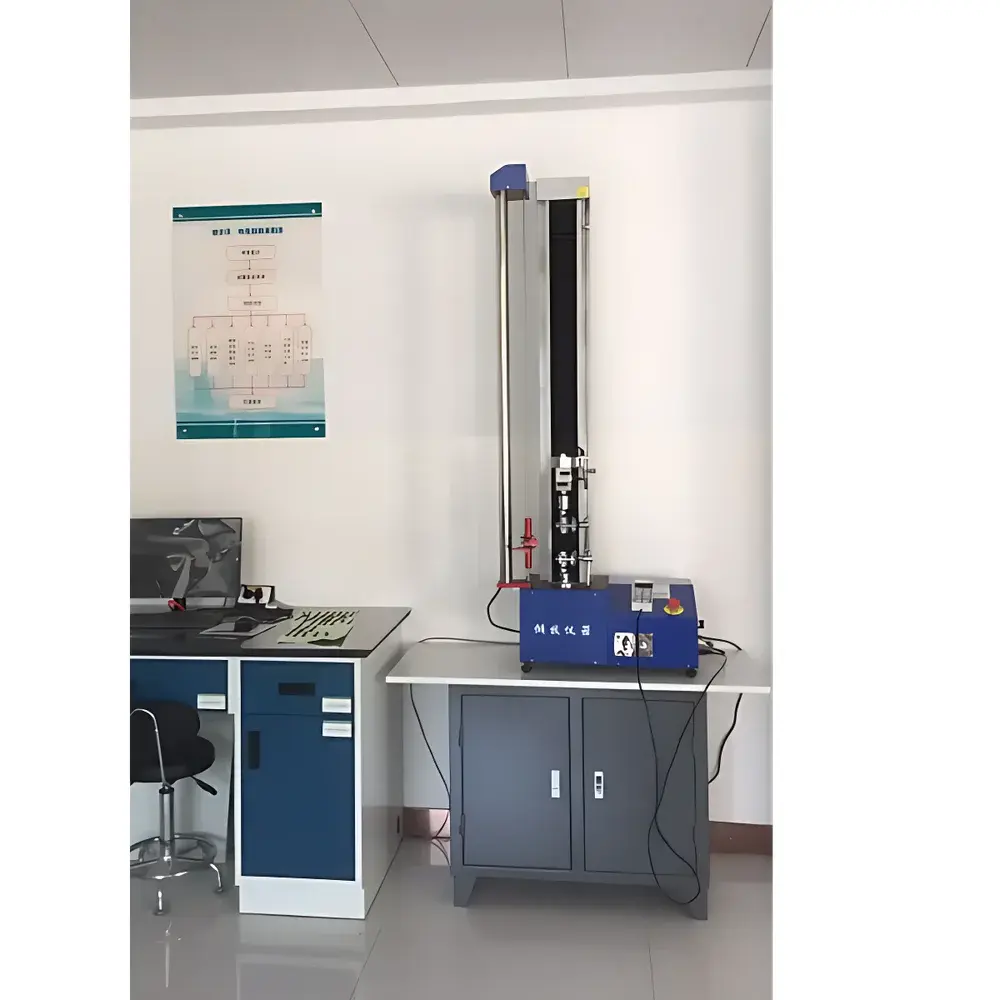
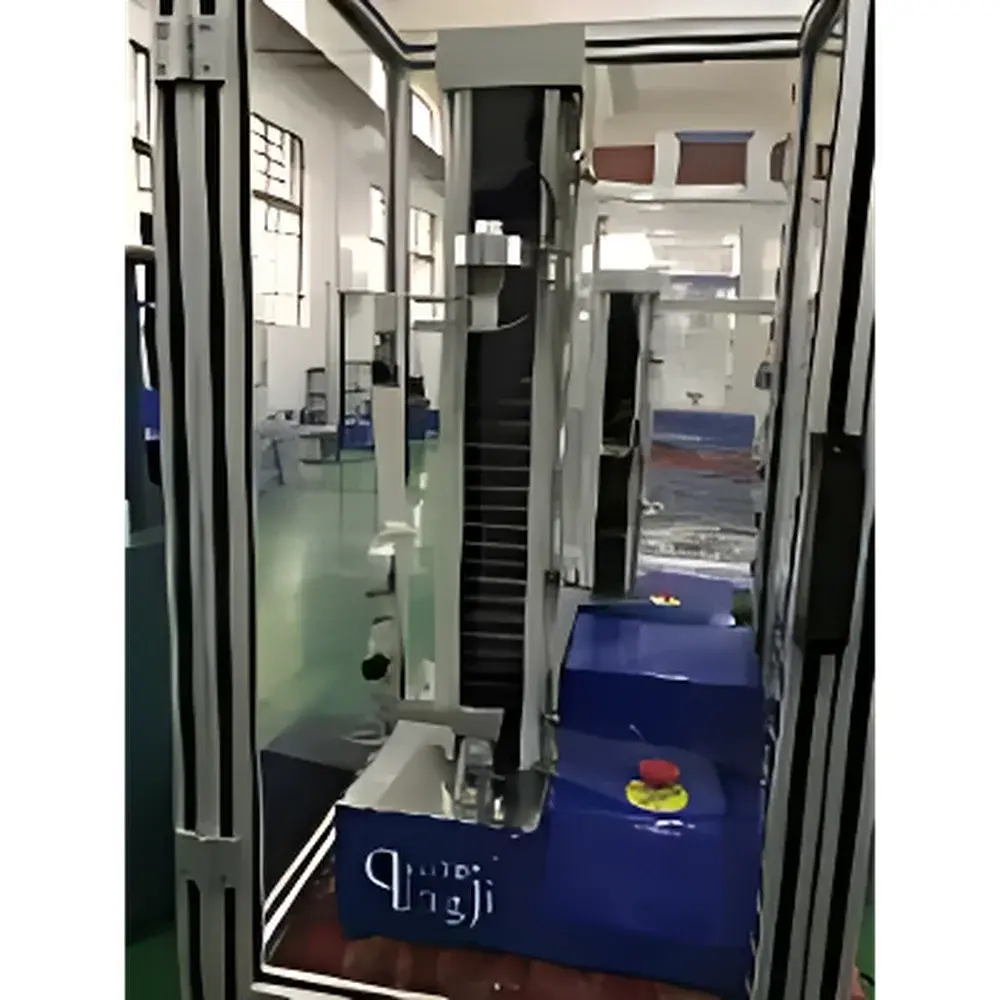
QJ210A-5000N Universal Testing Machine
| Brand | QJ |
|---|---|
| Origin | Shanghai, China |
| Model | 210A-5000N |
| Load Capacity | 0–5000 N |
| Load Accuracy | ±0.5% of full scale |
| Effective Test Width | 150 mm |
| Max Travel Distance | 800 mm |
| Speed Range | 0.01–500 mm/min |
| Speed Accuracy | ±0.5% of indicated value |
| Displacement Accuracy | ±0.5% of indicated value |
| Strain Measurement Accuracy | ±0.5% of indicated value |
| Force Resolution | 500,000 counts (full-scale, no range switching) |
| Control System | Panasonic full-digital AC servo controller |
| Sensor | High-precision U.S.-sourced load cell |
| Software | Windows-based closed-loop test control platform supporting ISO, ASTM, JIS, DIN standards |
| Safety Protection | Electronic limit switches, software-based overload detection (>110% FS), automatic return post-test |
| Power | 400 W |
| Dimensions (W×D×H) | 520 × 480 × 1680 mm |
| Weight | ~85 kg |
Overview
The QJ210A-5000N Universal Testing Machine is a microprocessor-controlled electromechanical testing system engineered for precision mechanical property evaluation of metallic, polymeric, composite, and elastomeric materials within a 0–5000 N force range. Based on the fundamental principles of uniaxial tensile, compressive, flexural, peel, tear, shear, puncture, and low-cycle fatigue testing, this machine complies with internationally recognized test methodologies defined in ASTM E4, ASTM D638, ASTM D790, ISO 6892-1, ISO 178, ISO 1133, JIS Z2241, and DIN 53455. Its modular architecture integrates a high-rigidity dual-column frame, a precision-ground ball-screw actuation system, and a real-time closed-loop control loop that synchronizes load, displacement, and strain feedback at sub-millisecond intervals. Designed for laboratory and quality control environments, the QJ210A-5000N delivers consistent repeatability and traceable metrological performance suitable for internal validation, supplier qualification, and regulatory documentation under GLP-compliant workflows.
Key Features
- Full-scale load capacity of 5000 N with ±0.5% accuracy across the entire measurement range — certified to ISO 7500-1 Class 0.5
- Force resolution of 500,000 digital counts without auto-ranging or hardware switching, ensuring linearity and stability from 0.02% to 100% of full scale
- Adjustable crosshead speed from 0.01 to 500 mm/min, calibrated to ±0.5% of setpoint per ASTM E2658
- Panasonic full-digital AC servo drive system with integrated encoder feedback for position and velocity control
- U.S.-sourced high-stability load cell with temperature-compensated Wheatstone bridge design and hermetic sealing
- Dual-mode operation: manual jog control and programmable automated test sequences with multi-step ramp/hold profiles
- Integrated safety subsystem including electronic upper/lower limit switches, software-based over-travel detection, and automatic shutdown at >110% overload
- Motorized crosshead with independent fast/slow speed modes and programmable return-to-start functionality
- Modular fixture interface compatible with standardized wedge-action grips, compression platens, bend fixtures, and custom-designed tooling
Sample Compatibility & Compliance
The QJ210A-5000N accommodates specimens up to 150 mm wide and 800 mm in active gauge length, supporting standard test geometries per ISO 527-2 (tensile bars), ASTM D3039 (composite laminates), ISO 14129 (adhesive lap shear), and ASTM D1876 (T-peel). All mechanical components meet RoHS Directive 2011/65/EU requirements. The system’s measurement uncertainty budget is documented per ISO/IEC 17025:2017 Annex A.3, and its software architecture supports audit-ready data integrity features including user-level access control, electronic signatures, and time-stamped event logs — facilitating alignment with FDA 21 CFR Part 11 and EU Annex 11 expectations where required by internal SOPs.
Software & Data Management
Control and analysis are executed via a Windows-native, fully configurable test platform offering real-time graphical display of stress–strain, load–displacement, and time-based curves. The software implements true closed-loop control algorithms for constant-rate-of-loading (CRL), constant-rate-of-extension (CRE), and constant-strain-rate (CSR) protocols. Raw data are stored in ASCII CSV and proprietary binary formats with embedded metadata (operator ID, timestamp, calibration ID, environmental conditions). Users may perform post-test operations including curve overlay, differential analysis, modulus calculation (tangent/secant/initial), yield point identification (0.2% offset), and fracture energy integration. Export options include PDF reports with embedded charts, Excel-compatible spreadsheets, and image exports (PNG/SVG). All data files are immutable after finalization; revision history and operator annotations are retained separately in the audit trail database.
Applications
- Tensile strength and elongation at break of thermoplastics, thermosets, and biopolymers
- Compressive yield strength and modulus of foams, ceramics, and structural adhesives
- Flexural modulus and failure load of fiber-reinforced composites per ASTM D7264
- Peel adhesion of pressure-sensitive tapes and laminated packaging films
- Tear resistance of rubber sheets and nonwovens using trouser or crescent notches
- Shear strength of bonded joints in aerospace and automotive assemblies
- Puncture resistance of medical membranes and protective textiles
- Low-cycle fatigue behavior of elastomeric seals and gaskets under controlled strain amplitude
FAQ
What international standards does the QJ210A-5000N support out of the box?
The system includes preconfigured test templates for ASTM D638, ASTM D790, ISO 6892-1, ISO 178, and JIS Z2241, with customizable parameter sets for other methods.
Is the software compliant with FDA 21 CFR Part 11 requirements?
While the base software provides electronic signature capability and audit trail logging, formal Part 11 compliance requires site-specific validation documentation and IT infrastructure controls — which are supported through optional GxP validation packages.
Can I integrate third-party extensometers or video-based strain measurement systems?
Yes — the system features analog and digital I/O ports (±10 V, TTL) for synchronization with external displacement sensors, LVDTs, or DIC systems via trigger signals and real-time data streaming.
What maintenance is required during the first year of operation?
No scheduled maintenance is required; however, quarterly verification of load cell linearity and crosshead positioning accuracy using NIST-traceable reference standards is recommended per ISO 7500-1.
Does the machine support batch testing and report automation?
Yes — the software allows creation of test batches with identical parameters, automatic pass/fail flagging against user-defined limits, and scheduled PDF report generation with company branding and logo insertion.



