
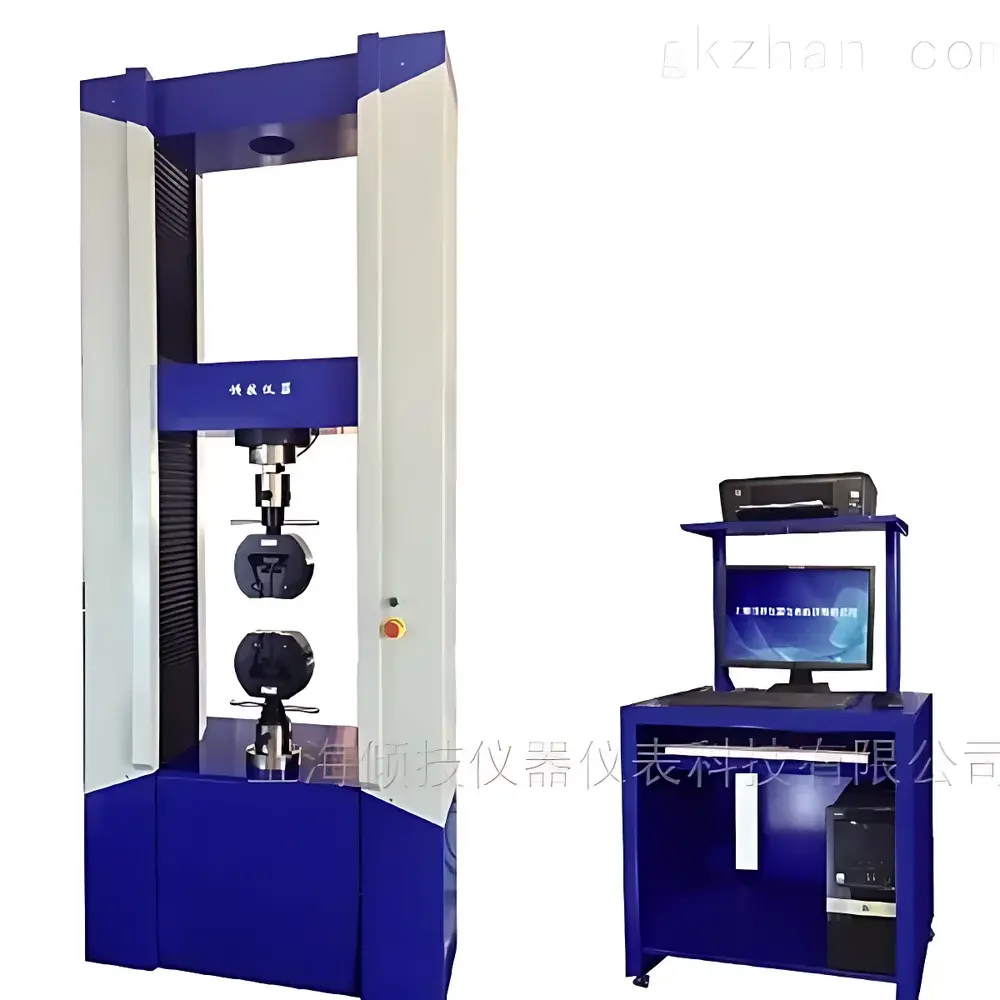
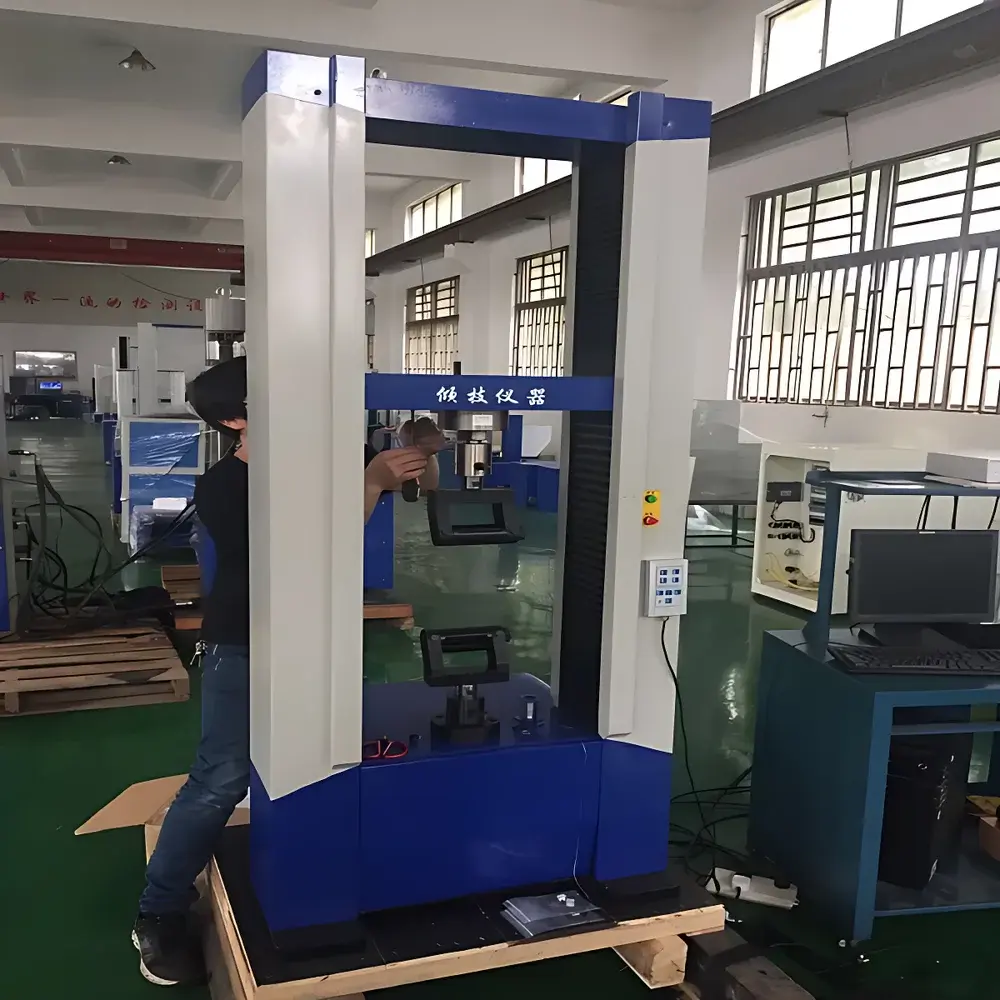
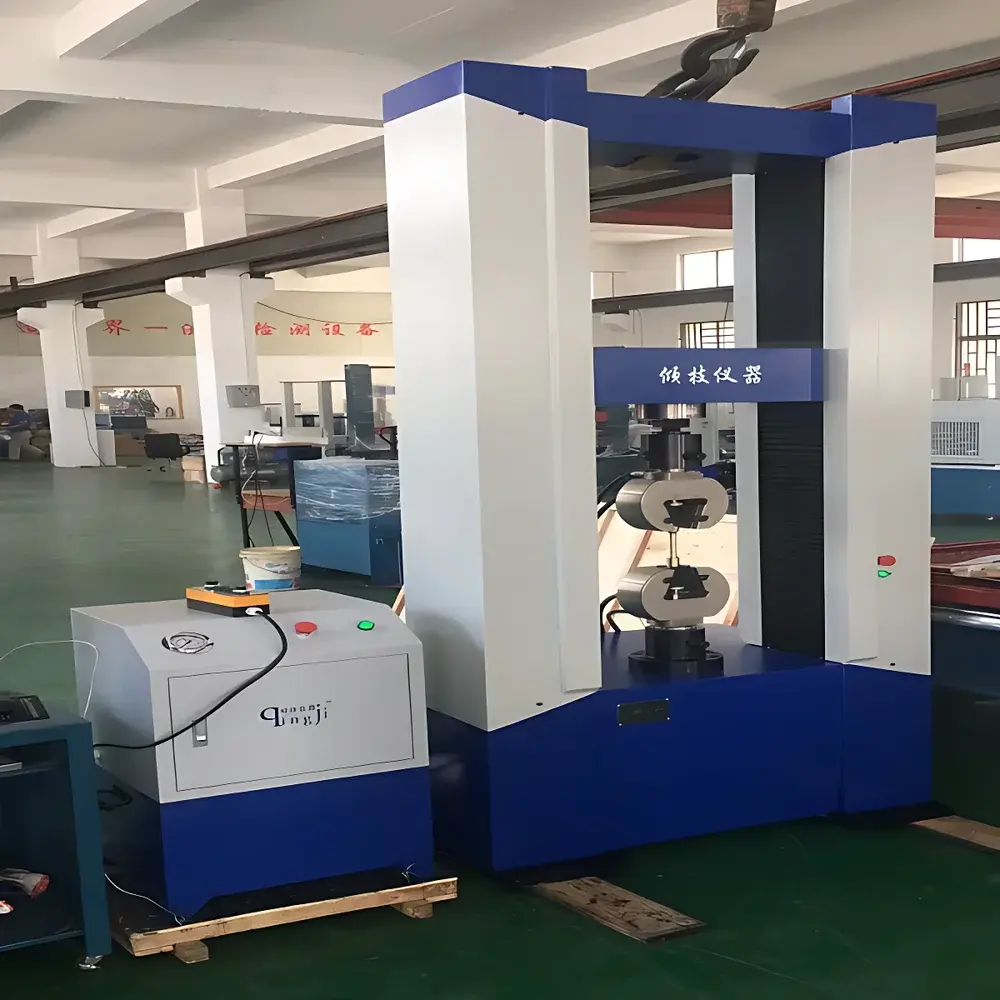
QJ212 Steel Strand Tensile Testing Machine – Qinsun Universal Electromechanical Testing System
| Brand | Qinsun |
|---|---|
| Origin | Shanghai, China |
| Model | QJ212 |
| Instrument Type | Electromechanical Universal Testing Machine |
| Load Capacity | 0–500 kN |
| Load Accuracy | ±0.5% |
| Force Resolution | ±1/250,000 (full-scale, no range switching) |
| Effective Test Width | 500 mm |
| Effective Tensile Travel | 600 mm or 800 mm |
| Test Speed Range | 0.001–1000 mm/min |
| Speed Accuracy | ±0.5% of indicated value |
| Displacement Measurement Accuracy | ±0.5% of indicated value |
| Strain/Deformation Measurement Accuracy | ±0.5% of indicated value |
| Safety Protection | Electronic limit switches, overload protection at 110% of full scale |
| Dimensions (W×D×H) | 1000 × 680 × 2450 mm |
| Weight | 1250 kg |
Overview
The QJ212 Steel Strand Tensile Testing Machine is a high-precision electromechanical universal testing system engineered for static mechanical property evaluation of prestressed steel strands, wire ropes, anchorages, and related structural reinforcement materials. Based on closed-loop servo-controlled load application and displacement feedback, the system complies with fundamental principles of uniaxial tensile mechanics as defined in ISO 6892-1, ASTM E8/E21, EN 10002-1, and GB/T 228.1. It delivers repeatable, traceable force-displacement data under controlled strain rates, supporting both standard-compliant qualification testing and R&D-grade material characterization. The machine integrates a rigid dual-column frame architecture with high-stiffness crosshead guidance, ensuring minimal deflection during high-load tests up to 500 kN—critical for accurate modulus and yield point determination in high-strength steel strand applications.
Key Features
- Full-range force resolution of ±1/250,000 without auto-ranging or manual range switching—enabling seamless transition from low-force pre-tensioning to ultimate tensile failure detection.
- Adjustable test speed from 0.001 mm/min (for creep or relaxation studies) to 1000 mm/min (for rapid proof testing), all governed by digital PID control with ≤±0.5% speed fidelity.
- Dual-mode crosshead actuation: precision fine-speed mode for loading control and independent fast-speed mode for rapid positioning—reducing setup time without compromising measurement integrity.
- Integrated electronic limit protection and programmable over-travel cutoff prevent mechanical damage during abnormal test conditions.
- Robust safety architecture includes automatic overload shutdown at 110% of selected load range and hardware-based emergency stop circuitry compliant with IEC 60204-1.
- Modular extensometer interface supports clip-on, video, or non-contact strain measurement options for Poisson’s ratio and plastic strain analysis per ISO 527 or ASTM D638.
Sample Compatibility & Compliance
The QJ212 accommodates standardized steel strand specimens (e.g., 7-wire φ15.2 mm, φ12.7 mm, φ15.7 mm) per ASTM A416, ISO 6934-4, and GB/T 5224. Its 500 mm effective test width and ≥600 mm tensile travel accommodate anchorage assemblies, wedge grip systems, and full-length strand tensioning configurations. The system supports multi-step test protocols—including tensile strength, yield force (0.2% offset), elongation at break, and elastic modulus calculation—with automated compliance to ISO 17025 documentation requirements when paired with validated software. All force transducers are calibrated to ISO 376 Class 1 accuracy, and system-level verification follows ASTM E4 procedures using certified reference standards.
Software & Data Management
Controlled via Windows-based QinsunTest v3.x software, the platform provides real-time dynamic plotting of stress–strain, load–displacement, and time-based curves with configurable sampling rates up to 100 Hz. Data export conforms to ASTM E1434 and ISO/IEC 17025 traceability standards: CSV, XML, and PDF reports include operator ID, calibration certificate IDs, environmental timestamps, and audit trail logs. Software supports GLP-compliant user access levels (admin/operator/observer), electronic signatures per FDA 21 CFR Part 11, and encrypted database storage. Curve manipulation functions—overlay, differential analysis, tangent modulus extraction, and automatic yield point detection—are fully scriptable for batch processing across production lots.
Applications
- Quality assurance testing of prestressed concrete tendons in bridge, railway, and building infrastructure projects.
- Verification of anchorage system performance—including wedge slippage, bond efficiency, and fatigue pre-conditioning cycles.
- R&D evaluation of novel alloyed steel strands, corrosion-resistant coatings, and polymer-coated strands under simulated service environments.
- Third-party certification testing for CE marking (EN 10138), CCC (GB/T 5224), and international tender compliance (FIDIC, JIS G3536).
- Educational use in civil engineering laboratories for hands-on demonstration of Hookean behavior, necking onset, and fracture mechanics in high-strength metallic wires.
FAQ
What standards does the QJ212 support out-of-the-box?
It natively implements test methods from ASTM A416, ISO 6934-4, EN 10138-2, GB/T 5224, and JIS G3536—with configurable parameter templates and report formats aligned to each standard’s reporting clauses.
Can the system be integrated into an existing LIMS or MES environment?
Yes—via OPC UA or TCP/IP API, enabling bidirectional data exchange with laboratory information management systems for automated sample ID routing, result ingestion, and electronic batch record generation.
Is third-party calibration certification available?
Qinsun provides optional UKAS-accredited calibration certificates (ISO/IEC 17025) for load cells, displacement encoders, and system-level verification, with traceability to NIM (China) or PTB (Germany) primary standards.
What maintenance intervals are recommended for long-term accuracy?
Biannual verification of force and displacement metrology is advised; annual lubrication of lead screws and inspection of grip jaw inserts ensure mechanical repeatability over 10,000+ test cycles.
Does the machine support cyclic or fatigue testing?
While optimized for static tensile applications, the QJ212 can perform limited low-cycle tension–tension tests (≤100 cycles) with optional waveform generator add-on; dedicated servo-hydraulic fatigue systems are recommended for high-cycle applications (>10⁵ cycles).



