
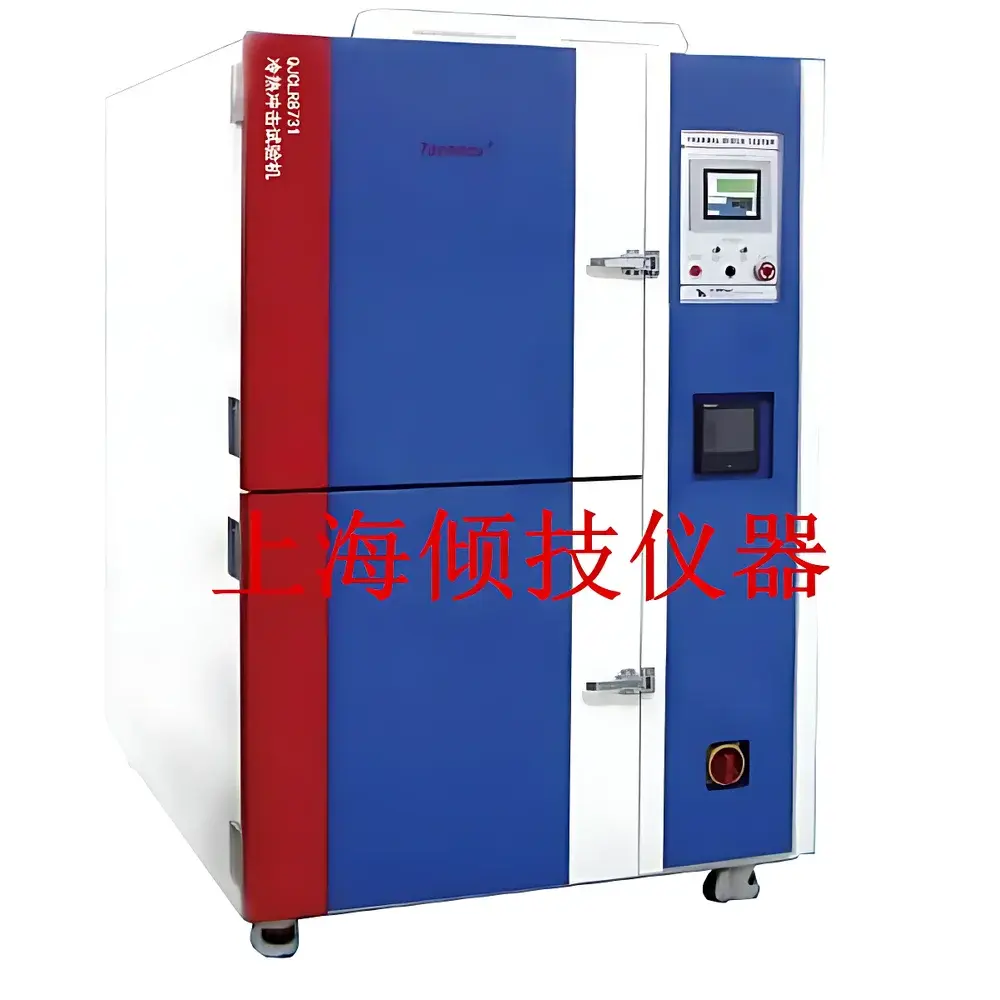
QJCLR8731 Three-Chamber Thermal Shock Testing Machine
| Origin | Shanghai, China |
|---|---|
| Manufacturer Type | Authorized Distributor |
| Origin Category | Domestic (PRC) |
| Model | QJCLR8731 |
| Quotation | USD 14,000 (FOB Shanghai) |
| Instrument Type | Hydraulic Actuated Thermal Shock Tester |
| High-Temp Chamber Range | +60 °C to +150 °C |
| Low-Temp Chamber Range | −10 °C to −40 °C |
| Temperature Stability | ±2 °C |
| Temperature Uniformity | ±2 °C |
| Recovery Time | ≤5 min |
| Heating Rate (Typical) | 40 min (−10 °C → +150 °C) |
| Cooling Rate (Typical) | 60–90 min (+150 °C → −40 °C) |
| Controller | Imported 7.5″ TFT LCD Touchscreen Controller (256-color, wide viewing angle, adjustable backlight, bilingual English/Chinese interface) |
| Safety Protections | Fuseless circuit breaker, compressor high-pressure/overheat/overcurrent protection, chamber overtemperature cutoff, fan overload protection |
| Standard Accessories | Two sample racks, one Ø50 mm cable/port access hole |
Overview
The QJCLR8731 Three-Chamber Thermal Shock Testing Machine is an engineered solution for accelerated environmental stress screening (ESS) and reliability validation of materials and assemblies subjected to rapid thermal transients. Unlike single- or dual-chamber systems, this tri-chamber architecture physically isolates the ambient, high-temperature, and low-temperature zones—enabling true step-change thermal shock profiles without residual heat/cold carryover. It operates on the principle of rapid specimen transfer between thermally stabilized chambers via a motorized lift-and-shift mechanism, achieving defined dwell times and transition intervals per IEC 60068-2-14, MIL-STD-810H Method 503.5, and GB/T 2423.22–2012. The system is purpose-built for evaluating thermal expansion mismatch, interfacial delamination, solder joint fatigue, seal integrity degradation, and phase-transition-induced microcracking in electronic packages, aerospace composites, automotive power modules, and polymer-based enclosures.
Key Features
- Tri-chamber segregated design ensures zero cross-contamination of thermal environments during cycling—critical for reproducible ΔT magnitude and transition rate control.
- Hydraulic actuation system delivers precise, vibration-damped specimen transfer with sub-second positioning repeatability and mechanical longevity exceeding 500,000 cycles.
- High-efficiency dual-refrigeration circuitry (low-temp and ultra-low-temp stages) enables stable operation at −40 °C with minimal compressor cycling, reducing thermal drift during extended dwell periods.
- Imported 7.5″ color touchscreen controller supports programmable multi-segment profiles, real-time graphing of chamber temperatures, data logging at user-defined intervals (1–60 s), and USB export of CSV-formatted datasets.
- Integrated safety architecture complies with IEC 61000-6-2/6-4 EMC requirements and includes redundant overtemperature cutouts, pressure-switch monitored refrigerant circuits, and emergency stop with hardware-latched interlock.
- Structural frame fabricated from electrophoretically coated steel with stainless-steel interior cladding resists corrosion from condensate and thermal oxidation over 15+ years of laboratory use.
Sample Compatibility & Compliance
The QJCLR8731 accommodates specimens up to 400 mm × 400 mm × 300 mm (W×D×H) and 25 kg gross weight. Standard fixtures include two adjustable aluminum sample racks with non-slip rubber inserts and a Ø50 mm port for external sensor cabling or environmental monitoring. The system meets mandatory test condition specifications outlined in GB/T 2423.1–2021 (cold), GB/T 2423.2–2021 (dry heat), GB/T 2423.22–2012 (thermal shock), GJB 150.5A–2009 (military equipment), and ISO 16750-4:2010 (road vehicles). It supports GLP-compliant operation when paired with optional audit-trail-enabled firmware (Part 11-ready configuration available upon request).
Software & Data Management
The embedded controller runs proprietary firmware supporting up to 99 programmable test sequences, each with up to 99 steps—including dwell time, ramp rate, chamber selection, and alarm thresholds. Logged temperature data is timestamped with millisecond resolution and stored internally (≥1 million points) or streamed via USB to external PCs. Optional PC-based software (QJ-DataLink v3.2) provides statistical process control (SPC) charts, pass/fail threshold overlays, automated report generation (PDF/Excel), and integration with LIMS platforms via Modbus TCP. All firmware updates are digitally signed and installed via encrypted USB key to maintain integrity under FDA 21 CFR Part 11 Annex 11 requirements.
Applications
- Qualification testing of PCBAs prior to AEC-Q200 or JEDEC JESD22-A104 qualification.
- Evaluation of adhesive bond strength retention in multi-material EV battery housings after 500+ thermal shock cycles.
- Failure mode analysis of MEMS sensors exposed to −40 °C/+125 °C cycling per ISO 16750-4 severity level 4.
- Verification of hermetic seal integrity in medical implant housings using helium leak correlation with post-shock mass spectrometry.
- Material screening for space-grade conformal coatings under MIL-STD-1540D thermal vacuum shock protocols.
FAQ
What is the maximum thermal transition rate achievable between chambers?
The system achieves nominal transfer in <3 seconds; effective thermal shock rate is governed by specimen thermal mass and chamber stabilization—not transfer speed—and is validated per IEC 60068-2-14 definition of “transition time.”
Can the controller log data directly to a network drive?
No—internal storage and USB export are standard; network logging requires optional Ethernet module and QJ-DataLink software with SMB/CIFS client support.
Is calibration certification included with shipment?
Yes—a NIST-traceable temperature calibration certificate (per ISO/IEC 17025) covering all three chambers at five points across the operating range is provided with each unit.
What maintenance intervals are recommended for long-term reliability?
Compressor oil and filter replacement every 24 months; refrigerant charge verification every 36 months; annual verification of door gasket compression force and chamber uniformity per ASTM E744.
Does the system support custom chamber volume configurations?
Yes—custom internal dimensions and chamber volume ratios (e.g., 1:1:1 vs. 1:2:1) are available as OEM-engineered variants with lead time adjustment.



