
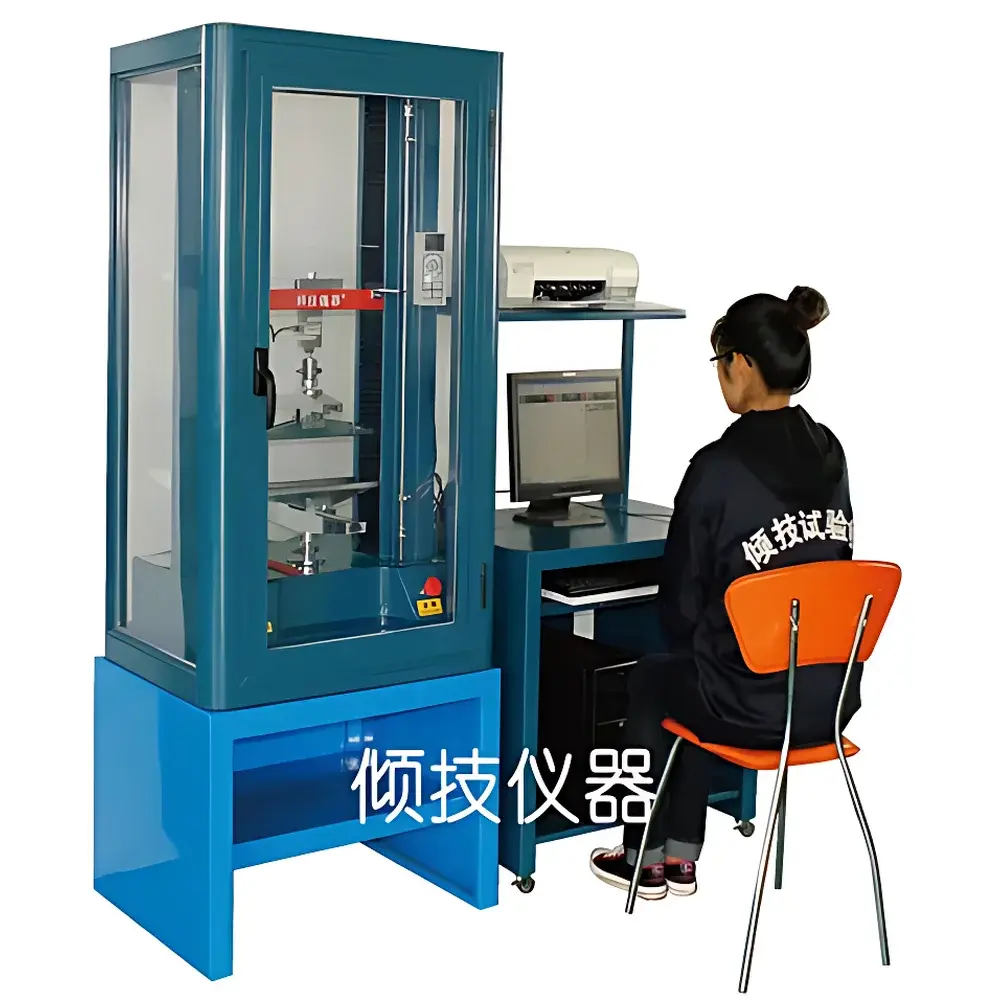
Qinji QJ211S Four-Point Bending Tester
| Brand | Qinji |
|---|---|
| Model | QJ211S |
| Maximum Load Capacity | 10 kN |
| Accuracy Class | 0.5 |
| Effective Test Width | 320 mm |
| Effective Tensile Stroke | 500 mm (optional 800 mm) |
| Test Speed Range | 0.01–300 mm/min |
| Speed Accuracy | ±0.5% of indicated value |
| Force Resolution | 500,000 counts (full-scale, no range switching) |
| Displacement & Strain Measurement Accuracy | ±0.5% of indicated value |
| Load Cell | High-precision U.S.-sourced sensor |
| Control System | Panasonic full-digital AC servo controller |
| Software | Windows-based closed-loop test management system supporting constant stress/strain/displacement control |
| Safety Protection | Electronic limit switches, software self-diagnosis, overload protection at 110% of full scale |
| Power Requirement | 2–5 kW |
| Net Weight | ~145 kg |
| Compliance | GB, ISO, ASTM, JIS, DIN, YB, YY, QC, HG, and other international and industry-specific standards |
Overview
The Qinji QJ211S Four-Point Bending Tester is a precision universal testing machine engineered for high-reproducibility mechanical characterization of brittle and semi-brittle planar materials—particularly tempered glass substrates used in consumer electronics displays (e.g., smartphone cover glass, tablet panels, OLED/LCD modules), optical lenses, architectural glazing, and medical device components. Unlike three-point bending configurations, the four-point arrangement eliminates shear force contribution within the central span, enabling pure bending moment distribution—critical for accurate flexural strength (modulus of rupture) and flexural modulus determination per ISO 178, ASTM D790, and GB/T 9341. The system integrates a rigid dual-column frame with high-stiffness crosshead guidance, ensuring axial alignment stability and minimizing parasitic moments during loading. Its core architecture complies with ISO 7500-1 Class 0.5 static force calibration requirements, validated traceably to national metrological standards.
Key Features
- Four-point bending configuration with independently adjustable upper support rollers and lower loading anvils—optimized for standardized span-to-thickness ratios (e.g., 16:1 per ASTM D790) and minimal edge-effect interference.
- Full-digital closed-loop control system powered by Panasonic AC servo drive and precision ball-screw actuation, delivering consistent speed fidelity across the entire 0.01–300 mm/min range (±0.5% accuracy).
- High-resolution force measurement using a calibrated U.S.-manufactured load cell with 500,000-count A/D resolution—no internal range switching ensures uniform sensitivity from 0.02% to 100% of 10 kN full scale.
- Integrated 7-inch industrial-grade capacitive touch interface with real-time graphical display of load–displacement curves, peak load capture, yield point detection, and automatic event marking (e.g., crack initiation, fracture).
- Dual-mode positioning: motorized fast approach (up to 100 mm/min) and fine-adjustment creep mode (0.01 mm/min) for precise specimen preloading and zero-contact initialization.
- Comprehensive hardware safety layer: electronic travel limits, software-based overload cutoff (triggered at 110% FS), and automatic return-to-home upon test completion or emergency stop activation.
Sample Compatibility & Compliance
The QJ211S accommodates flat, rectangular specimens up to 320 mm wide and 500 mm (or optionally 800 mm) in active span length—suitable for standard 150 × 10 × 5 mm glass strips per ISO 178 or custom-sized cover glass panels (e.g., 160 × 80 × 0.5–2.0 mm). With interchangeable fixture kits—including three-point bending, tensile grips (pneumatic/hydraulic), compression platens, and puncture probes—the instrument supports multi-modal mechanical evaluation under a single platform. All test protocols adhere to internationally recognized regulatory frameworks: data acquisition meets GLP audit-trail requirements (time-stamped, user-logged, non-editable raw files), while report generation satisfies FDA 21 CFR Part 11 electronic signature readiness when paired with validated Windows OS configuration and controlled user access rights.
Software & Data Management
The proprietary Windows-native test software provides ISO/IEC 17025-aligned data integrity controls. It enables real-time curve overlay of multiple tests, dynamic zoom/pan navigation, numerical derivative calculation (e.g., tangent modulus), and customizable report templates exportable to PDF, Excel, or XML. Raw data files are stored in binary-encoded .qdt format with embedded metadata (operator ID, calibration date, environmental conditions), preventing unauthorized modification. Audit logs record all parameter changes, test starts/stops, and calibration events—essential for quality assurance departments operating under ISO 9001 or IATF 16949. Optional integration with LIMS via TCP/IP API allows automated result ingestion into enterprise laboratory databases.
Applications
- Flexural strength and modulus evaluation of chemically strengthened aluminosilicate glass (e.g., Gorilla Glass®, Dragontrail™) per ASTM C158 and ISO 9335.
- Fracture toughness screening of thin-film coated substrates through controlled crack propagation analysis in bending mode.
- Quality conformance testing of AR/AG/AF-coated optical lenses subjected to thermal cycling or humidity exposure.
- Mechanical reliability validation of foldable display hinge-integrated glass assemblies under cyclic bending fatigue (with optional servo-hydraulic upgrade).
- R&D benchmarking of novel transparent ceramics (e.g., spinel, sapphire composites) against incumbent soda-lime silicate formulations.
FAQ
What standards does the QJ211S natively support for four-point bending tests?
ASTM D790, ISO 178, GB/T 9341, JIS K7203, and DIN EN ISO 178—all implemented via preconfigured test methods with auto-calculated pass/fail criteria based on specimen geometry and material class.
Can the system perform cyclic fatigue testing?
Yes—when equipped with optional high-cycle servo-hydraulic actuation and waveform generator module, it supports sinusoidal, trapezoidal, or user-defined load profiles up to 5 Hz, compliant with ASTM D671 for glass fatigue life assessment.
Is third-party calibration certification available?
Yes—factory calibration includes NIST-traceable certificates for force, displacement, and speed; annual recalibration services are offered with ISO/IEC 17025-accredited documentation.
How is data integrity ensured for regulated environments?
The software enforces role-based access control, electronic signatures, immutable audit trails, and encrypted raw data storage—fully aligned with FDA 21 CFR Part 11 and EU Annex 11 requirements for computerized systems in GMP settings.
What maintenance intervals are recommended for long-term accuracy?
Biannual verification of load cell linearity and crosshead alignment; annual recalibration of encoder and servo tuning parameters—detailed in the included GLP-compliant maintenance logbook.



