
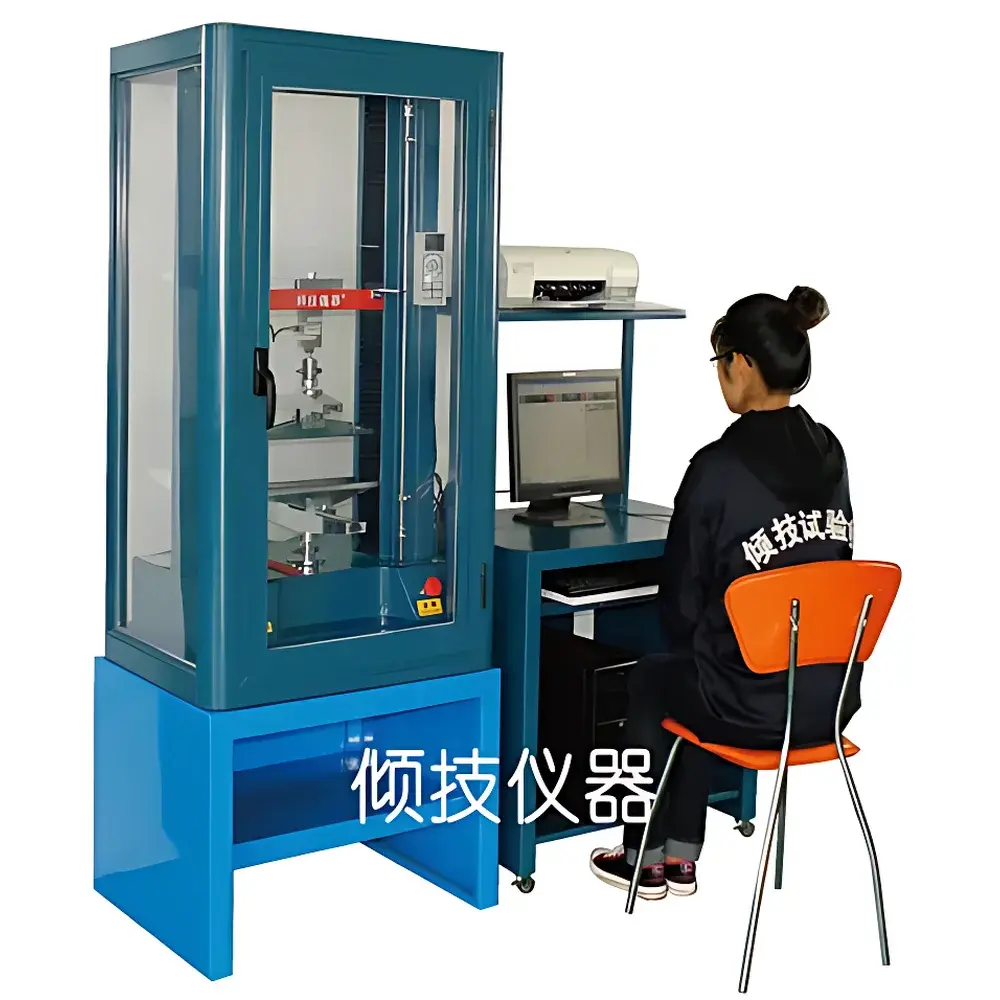
QJ211S2 Four-Point Bending Tester for Cover Glass and Flat Panel Displays
| Origin | Shanghai, China |
|---|---|
| Manufacturer Type | Authorized Distributor |
| Origin Classification | Domestic (China) |
| Model | QJ211S2 |
| Price Range | USD 7,000 – 14,000 |
| Max Load Capacity | 10 kN |
| Load Accuracy | Class 0.5 |
| Force Resolution | 500,000 counts (full-scale, no range switching) |
| Effective Test Width | 320 mm |
| Effective Tensile Stroke | 500 mm (extendable to 800 mm) |
| Test Speed Range | 0.01–300 mm/min |
| Speed Accuracy | ±0.5% of indicated value |
| Displacement & Strain Measurement Accuracy | ±0.5% of indicated value |
| Load Cell | High-Precision Transducer (USA-sourced) |
| Controller | Panasonic Full-Digital AC Servo System |
| Control Software | Windows-based Closed-Loop System Supporting Constant Load, Constant Strain, and Constant Displacement Modes |
| Safety Features | Electronic Limit Switches, Real-Time Software Diagnostics, Overload Protection (110% F.S.), Manual/Automatic Return |
| Fixture Customization | Application-specific tooling available per sample geometry |
| Optional Accessories | Lenovo LCD PC + HP Color Inkjet Printer |
| Motor Power | 2–5 kW |
| Net Weight | ~145 kg |
Overview
The QJ211S2 Four-Point Bending Tester is a high-precision universal mechanical testing system engineered for the quantitative evaluation of flexural strength, modulus of rupture (MOR), fracture toughness, and elastic behavior in thin, brittle planar substrates—particularly cover glass used in smartphones, tablets, laptops, televisions, AR/VR optics, and ophthalmic lenses. Unlike three-point bending configurations, the four-point arrangement applies two symmetrically spaced loading points between two outer support points, generating a uniform bending moment zone with zero transverse shear stress across the central span. This eliminates localized stress concentration at the mid-span and enables highly reproducible measurement of intrinsic material failure behavior under pure bending conditions—critical for quality assurance and R&D validation of chemically strengthened (e.g., Gorilla Glass®), thermally tempered, or laminated glass substrates. The system complies with ASTM C1499 (Standard Test Method for Monotonic Quasi-Static Strength of Advanced Ceramics at Ambient Temperature), ISO 178 (Plastics — Determination of Flexural Properties), and GB/T 232 (Metallic Materials — Bend Test), while its modular architecture supports adaptation to additional mechanical test modes including tensile, compression, shear, puncture, and peel.
Key Features
- Class 0.5 force accuracy certified per ISO 7500-1, ensuring traceable metrological performance for GLP/GMP-regulated environments.
- Full-scale load resolution of 500,000 digital counts without auto-ranging—maintaining consistent resolution from 0.02% to 100% of 10 kN capacity.
- Panasonic digital AC servo motor drive with closed-loop position and speed control, delivering stable velocity regulation (±0.5% accuracy) across the full 0.01–300 mm/min range.
- Dual-speed crosshead actuation: rapid positioning (up to 300 mm/min) for setup efficiency; precision testing speed (down to 0.01 mm/min) for creep or slow-fracture analysis.
- Integrated safety architecture: hardware limit switches, real-time software diagnostics, automatic overload shutdown (>110% F.S.), and programmable electronic end-stops.
- Modular fixture interface compatible with ISO 26203-compliant bending jigs, custom-designed ceramic support rollers, and low-profile load noses optimized for sub-1 mm thick glass specimens.
Sample Compatibility & Compliance
The QJ211S2 accommodates flat, rigid, and semi-rigid specimens up to 320 mm wide and 800 mm long, with thickness ranging from 0.1 mm (ultra-thin display cover glass) to 25 mm (structural laminated panels). It supports standardized specimen geometries defined in ASTM C158 (Glass Flexure), JIS R3205 (Tempered Glass), and YY/T 0313 (Medical Device Packaging Films). All mechanical and software functions are designed to meet requirements for audit-ready documentation under FDA 21 CFR Part 11 (electronic records/signatures), ISO/IEC 17025 (testing laboratory competence), and ICH Q5E (comparability of biopharmaceutical products where packaging integrity is critical). Calibration certificates include NIST-traceable reference standards and uncertainty budgets compliant with ISO/IEC 17025 Annex A.
Software & Data Management
The Windows-native test control platform provides real-time synchronized visualization of force-displacement, stress-strain, and time-dependent curves. Raw data acquisition operates at ≥1 kHz sampling rate, with timestamped metadata (operator ID, environmental temperature/humidity, calibration status, test sequence number) embedded in each dataset. Users may perform post-test operations—including curve overlay, differential analysis, tangent modulus calculation, and fracture energy integration—without exporting to third-party tools. Reports conform to ASTM E1391 (Standard Guide for Preparation of Specifications for Mechanical Testing) and can be exported as PDF, Excel, or XML for LIMS integration. Audit trails record all parameter changes, data edits, and user logins—fully compliant with GLP and GMP documentation protocols.
Applications
- Flexural strength validation of alkali-aluminosilicate cover glass (e.g., Corning®, SCHOTT Xensation®) before and after ion exchange treatment.
- Comparative evaluation of edge strength retention following CNC grinding, laser scoring, or chemical etching processes.
- Fracture initiation analysis in OLED and microLED display modules under simulated drop impact loading profiles.
- Long-term reliability assessment via static fatigue (stress corrosion cracking) tests at controlled humidity levels (optional environmental chamber integration).
- Qualification of adhesive interlayers in laminated safety glass for automotive HUDs and medical imaging displays.
FAQ
What standards does this tester support for cover glass qualification?
ASTM C1499, ASTM C158, ISO 178, ISO 23742 (Glass in building — Determination of flexural strength), GB/T 15764 (Flat glass for architectural use), and JIS R3205.
Can the system perform both four-point and three-point bending on the same specimen?
Yes—the base frame includes interchangeable support and loading fixture mounts; switching between configurations requires <5 minutes and no recalibration.
Is the software validated for regulated pharmaceutical or medical device testing?
The control software supports 21 CFR Part 11 compliance when deployed with Windows domain authentication, electronic signatures, and audit trail logging enabled.
What is the typical lead time for custom fixture design?
Standard bending fixtures ship with the system; application-specific tooling (e.g., curved substrate holders, multi-layer stack clamps) typically requires 3–4 weeks from final drawing approval.
Does the system require external air supply or cooling water?
No—it operates as a self-contained electromechanical unit; only standard 220 VAC / 50 Hz power and ambient lab ventilation are required.



