
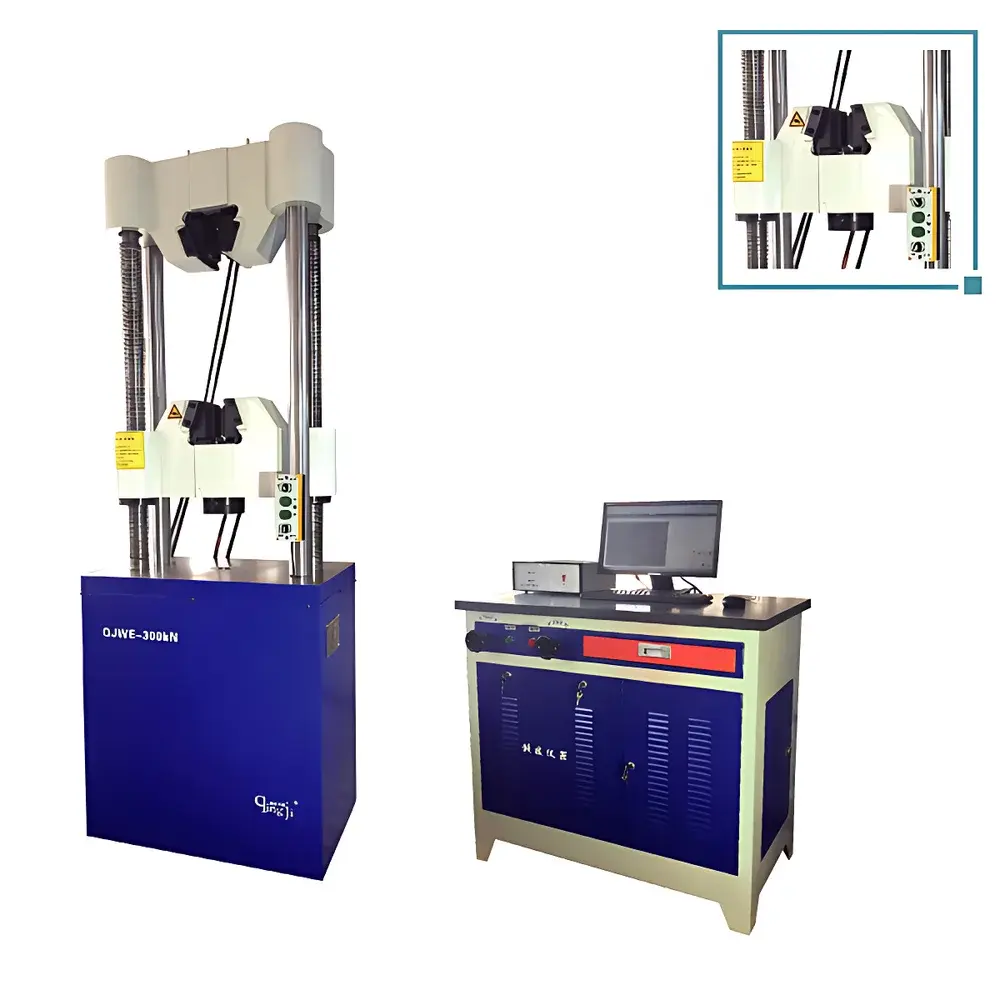
QJWE Series Microcomputer-Controlled Electro-Hydraulic Servo Roadbed and Pavement Material Testing Machine
| Origin | Shanghai, China |
|---|---|
| Manufacturer Type | Authorized Distributor |
| Origin Category | Domestic (China) |
| Model | QJWE Series |
| Price | ¥55,000 CNY |
| Instrument Type | Electro-Hydraulic Servo Testing Machine |
| Load Capacity Options | 50 kN, 100 kN, 300 kN, 600 kN, 1000 kN, 2000 kN |
| Force Measurement Accuracy | ±1% of full scale |
| Resolution | ≤0.5% of full scale |
| Compression Space | 550–700 mm |
| Tension Space | 550–700 mm |
| Round Specimen Grip Range | φ6–12 mm to φ20–70 mm (model-dependent) |
| Flat Specimen Grip Thickness | 0–15 mm to 0–40 mm |
| Piston Stroke | 200–250 mm |
| Bending Span Adjustment | 400–1000 mm |
| Shear Specimen Diameter | φ10–φ30 mm |
| Overall Dimensions (L×W×H) | 640×550×1800 mm to 1255×866×4700 mm |
| Motor Power | 1.5 kW or 3.25 kW, 3-phase |
| Machine Weight | 1200 kg or 6600 kg |
Overview
The QJWE Series Microcomputer-Controlled Electro-Hydraulic Servo Roadbed and Pavement Material Testing Machine is a high-precision universal testing system engineered for structural integrity evaluation of civil infrastructure materials. Based on electro-hydraulic servo actuation with proportional control valves and closed-loop digital feedback, it delivers precise force and displacement control across tension, compression, flexure, and shear loading modes. The machine implements ASTM E4, ISO 7500-1, and GB/T 228.1-compliant load train architecture—featuring a bottom-mounted hydraulic cylinder, adjustable test zones, and dual-range high-accuracy load cells calibrated to traceable national standards. Its design prioritizes long-term mechanical stability, thermal drift compensation, and repeatable loading profiles essential for QA/QC in highway construction, municipal engineering laboratories, and pavement material R&D centers.
Key Features
- Electro-hydraulic servo control system with real-time PID tuning for dynamic load regulation and constant-rate stress/strain ramping
- Modular grip configurations supporting round specimens (φ6–70 mm) and flat specimens (up to 40 mm thickness), compliant with ASTM E8/E9 geometry requirements
- Adjustable vertical test space (550–700 mm compression; 550–700 mm tension) and bending span (400–1000 mm), enabling standardized beam tests per ASTM C78 and EN 12390-5
- High-fidelity data acquisition at ≥1 kHz sampling rate, synchronized with position transducers and extensometer inputs (optional)
- Robust structural frame with reinforced crosshead guidance and low-friction piston seals, minimizing hysteresis and ensuring ≤0.5% relative resolution
- Integrated safety interlocks including overload cutoff, emergency stop circuitry, and hydraulic pressure monitoring per ISO 13850
Sample Compatibility & Compliance
The QJWE platform accommodates standard civil engineering specimens: asphalt mixtures (Marshall specimens), concrete cylinders (150 × 300 mm), cement mortar prisms (40 × 40 × 160 mm), stabilized soil cores, geosynthetic-reinforced layers, and polymer-modified bituminous binders. All configurations meet the dimensional and alignment tolerances specified in AASHTO T22, T23, T106, and GB/T 50081. Force measurement uncertainty is validated annually against NIST-traceable deadweight standards. The system supports GLP-compliant operation through audit-trail-enabled software logging, user access levels, and electronic signature workflows aligned with FDA 21 CFR Part 11 requirements when configured with certified software modules.
Software & Data Management
Bundled with Windows-based test control and analysis software, the system provides real-time graphical display of load–displacement, stress–strain, and time-history curves. Users define multi-step test protocols—including preload hold, ramp-to-load, creep, and cyclic fatigue—with programmable dwell times and termination conditions. Raw data exports to CSV, Excel, and XML formats; curve overlays support comparative analysis across batches or material grades. Built-in report templates generate ASTM/ISO-formatted documentation with automatic inclusion of calibration certificates, environmental conditions, operator ID, and test metadata. Network connectivity enables centralized data archiving via SQL Server or cloud-hosted repositories, with role-based permissions for lab managers and technicians.
Applications
- Unconfined compressive strength (UCS) testing of subgrade soils and stabilized base courses per AASHTO T208
- Flexural strength evaluation of concrete beams under third-point loading (ASTM C78) or center-point loading (ASTM C293)
- Indirect tensile (Brazilian) strength determination for asphalt-aggregate composites (ASTM D6931)
- Shear resistance characterization of pavement interfaces using double-shear fixtures (ASTM D7386)
- Modulus of elasticity derivation from linear-elastic region analysis in compression or tension
- Creep compliance and relaxation behavior assessment for polymer-modified binders under sustained loads
FAQ
What standards does this machine comply with for road construction material testing?
It supports ASTM, AASHTO, ISO, and GB/T standards including ASTM E4 (load verification), ASTM C39 (concrete compression), ASTM D6931 (asphalt tensile), and AASHTO T22/T23.
Is the system compatible with external extensometers or strain gauges?
Yes—dedicated analog and digital input channels accept signals from clip-on extensometers (e.g., ASTM E83 Class B), LVDTs, and bonded strain gauges for localized deformation measurement.
Can test data be exported to LIMS or enterprise QA systems?
Absolutely—the software supports ODBC connectivity and HL7-compliant data exchange protocols for seamless integration into laboratory information management systems.
What maintenance intervals are recommended for hydraulic components?
Hydraulic oil replacement every 2,000 operating hours, filter changes every 500 hours, and annual recalibration of load cells and displacement transducers are advised per manufacturer guidelines.
Does the system support automated batch testing for production QA environments?
Yes—script-driven test sequences allow unattended execution of identical protocols across multiple specimens, with auto-naming, pass/fail flagging, and summary dashboard generation.



