
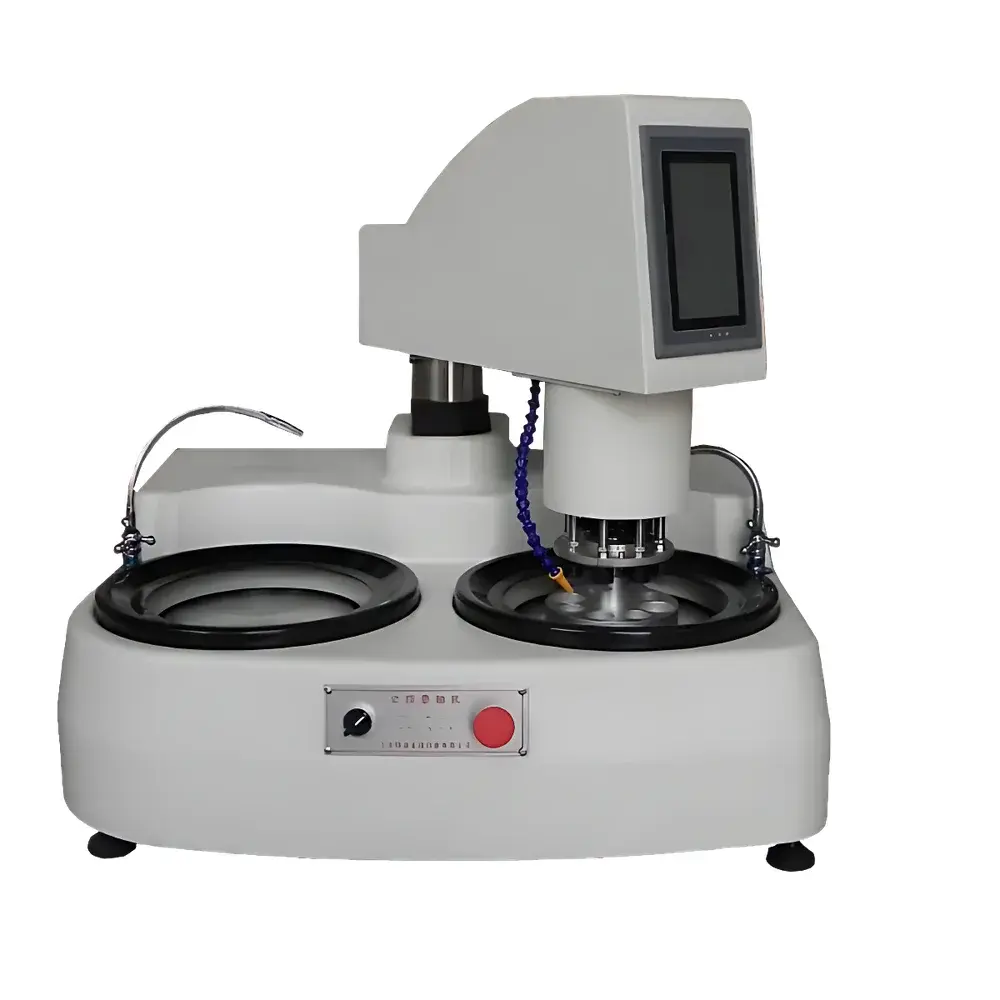
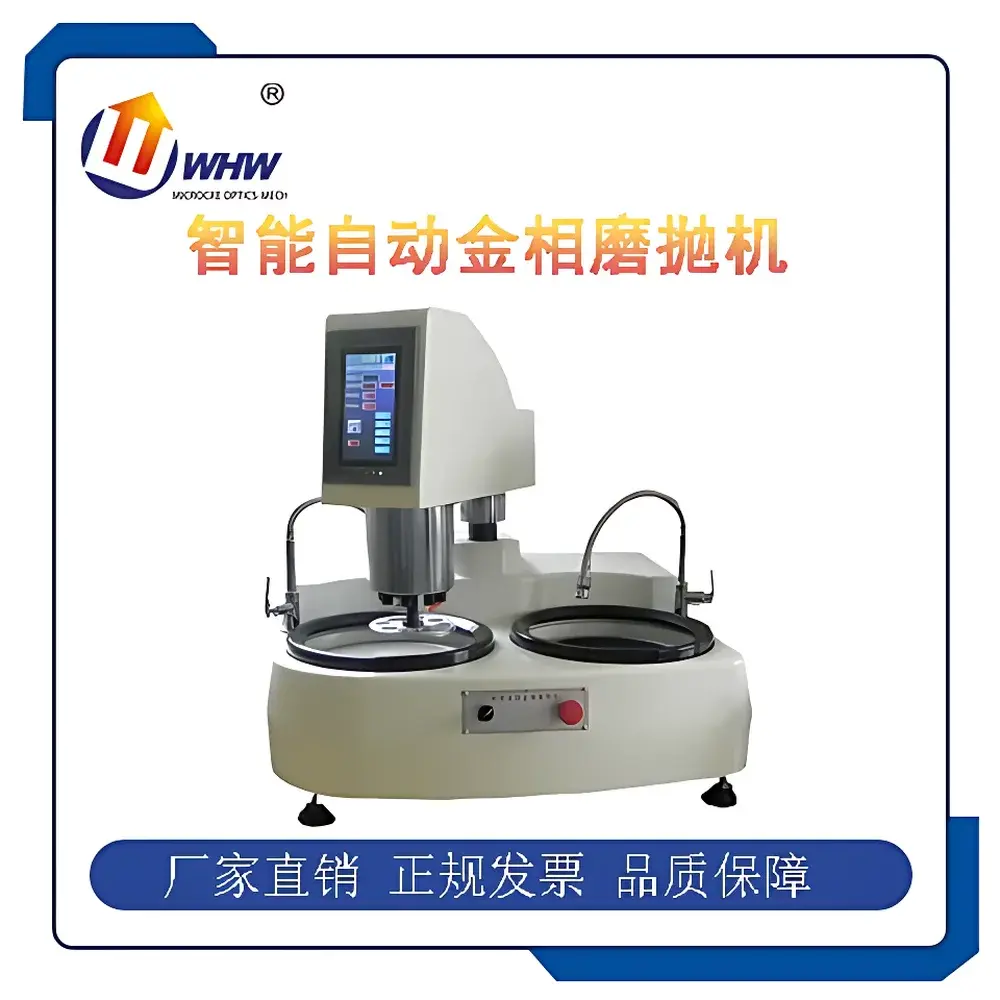
YANRUN ZMP-2000S Intelligent Automated Metallographic Grinding and Polishing System
| Brand | YANRUN |
|---|---|
| Origin | Shanghai, China |
| Manufacturer Type | Direct Manufacturer |
| Model | ZMP-2000S |
| Speed Range | 50–1500 rpm (intelligent auto-adjustable) |
| Platen Diameter | φ230 mm (optional: 200 / 250 / 300 mm) |
| Number of Platens | 2 |
| Dimensions (L×W×D) | 870 × 800 × 700 mm |
| Pressure Control | Pneumatic (0.5 MPa), center load up to 300 N, single-point load 1–40 N × 8 |
| Sample Capacity | 8 specimens (6 × Ø30 mm + 2 × Ø40 mm) |
| Control System | PLC with 8-inch color touchscreen |
| Grinding/Polishing Time | 0–9999 s × 2 stages |
| Abrasive Delivery | Dual-channel intelligent spray system (min. interval: 0.1 s |
| min. duration | 0.1 s) |
| Motor Power | 750 W × 2 (servo motors, torque: 2.39 N·m) |
| Head Movement | Motorized vertical lift with one-touch locking |
| Rotation | Bidirectional, independently adjustable platen and head speed (platen: 50–1500 rpm |
| head | 20–160 rpm) |
Overview
The YANRUN ZMP-2000S Intelligent Automated Metallographic Grinding and Polishing System is an industrial-grade, dual-platen, pneumatically actuated sample preparation instrument engineered for high-reproducibility metallographic specimen preparation. It operates on the principle of controlled mechanical abrasion—using precisely regulated rotational motion, programmable pressure application, and synchronized abrasive delivery—to achieve planar, scratch-free, deformation-minimized surfaces required for optical microscopy, electron backscatter diffraction (EBSD), scanning electron microscopy (SEM), and quantitative image analysis. Designed for compliance with ASTM E3, ISO 13077, and GB/T 13298 standards for metallographic specimen preparation, the ZMP-2000S integrates deterministic process control to eliminate operator-dependent variability—a critical requirement in accredited QC laboratories, R&D centers, and failure analysis facilities handling ferrous/non-ferrous alloys, ceramics, composites, geological samples, and advanced electronic packaging materials.
Key Features
- PLC-based 8-inch color touchscreen interface with menu-driven navigation and multilingual support (English, Chinese, Spanish)—enabling intuitive workflow configuration without programming expertise.
- Dual independent platens (grinding + polishing) with fully decoupled speed control: platen rotation (50–1500 rpm) and specimen holder rotation (20–160 rpm), both bidirectional and auto-synchronized per stage.
- Pneumatic pressure actuation system (0.5 MPa supply) delivering precise, repeatable loading: center-force mode (up to 300 N) for uniform bulk removal; single-point mode (1–40 N × 8 positions) for individual specimen control.
- Dual-channel intelligent abrasive dispensing system with microsecond-level timing resolution—programmable spray intervals (0.1 s minimum) and durations (0.1 s minimum) to match slurry viscosity, particle size, and material removal rate requirements.
- Automated protocol storage for up to 100 multi-stage grinding/polishing recipes—including speed, pressure, time, spray parameters, and direction—recalled instantly via alphanumeric naming or barcode scanning (optional).
- Motorized head lift with one-touch mechanical lock ensures repeatable Z-axis positioning and eliminates manual alignment drift between sessions.
- Modular sample mounting plate accommodating eight specimens (standard: six Ø30 mm + two Ø40 mm holes); custom fixture interfaces available for irregular geometries (e.g., thin foils, cylindrical rods, PCB cross-sections).
Sample Compatibility & Compliance
The ZMP-2000S supports a broad spectrum of materials requiring structural integrity preservation during preparation: carbon steels, stainless alloys, aluminum/magnesium/titanium grades, copper-based conductors, tungsten carbide tooling, silicon wafers, fused silica optics, sintered ceramics (Al₂O₃, SiC, ZrO₂), geological thin sections, and polymer-matrix composites. Its programmable pressure profiles and low-vibration servo drive architecture minimize subsurface deformation—critical for hardness testing (ASTM E384) and grain boundary analysis. The system conforms to GLP documentation requirements via audit-trail-enabled software logging (timestamped parameter changes, user ID, execution logs). Optional integration with LIMS supports 21 CFR Part 11-compliant electronic signatures when paired with validated authentication modules.
Software & Data Management
Embedded firmware supports full-cycle traceability: every run generates a timestamped .CSV log file containing all active parameters, real-time pressure/speed feedback, spray event timestamps, and operator ID. USB export enables direct import into laboratory information management systems (LIMS) or statistical process control (SPC) platforms. Firmware updates are performed via secure HTTPS download and digital signature verification. No cloud dependency—the system operates in air-gapped environments. Protocol backups and restore functions ensure continuity after maintenance or relocation. Optional RS-485/Modbus TCP interface allows centralized fleet monitoring in multi-unit installations.
Applications
- Routine QC labs preparing ASTM E407-compliant specimens for microstructural assessment of castings, forgings, and weldments.
- Materials science departments performing phase quantification (e.g., ferrite/austenite ratio in duplex steels) via image analysis on polished surfaces.
- Fatigue and fracture mechanics studies requiring artifact-free surfaces for crack-tip characterization.
- Failure analysis laboratories preparing cross-sections of solder joints, die-attach layers, and MEMS devices.
- Geological core analysis where mineral grain orientation and porosity must be preserved across polishing stages.
- Academic research involving novel high-entropy alloys or additive-manufactured metals, where thermal/strain-induced artifacts must be eliminated prior to TEM lamella preparation.
FAQ
Does the ZMP-2000S support automated endpoint detection?
No—endpoint detection requires external optical sensors or in-process SEM imaging; the ZMP-2000S provides deterministic, time- and pressure-controlled abrasion only.
Can the system be integrated into a cleanroom environment?
Yes—its sealed pneumatic actuation, drip-proof touchscreen, and optional HEPA-filtered exhaust manifold meet ISO Class 7 cleanroom compatibility requirements.
Is remote diagnostics supported?
Local Ethernet port enables technician-assisted troubleshooting via encrypted VNC session; no outbound telemetry or persistent internet connection is required.
What safety certifications does the unit carry?
CE-marked per EN 61000-6-2 (EMC immunity) and EN 61000-6-4 (EMC emission); meets IEC 60204-1 for electrical safety and ISO 13857 for guarding clearance distances.
Are consumables supplied with validated calibration certificates?
Diamond suspensions and alumina powders may be ordered with CoA (Certificate of Analysis) per ISO/IEC 17025; calibration of internal load cells is performed at factory and documented in the device’s traceable metrology record.



