
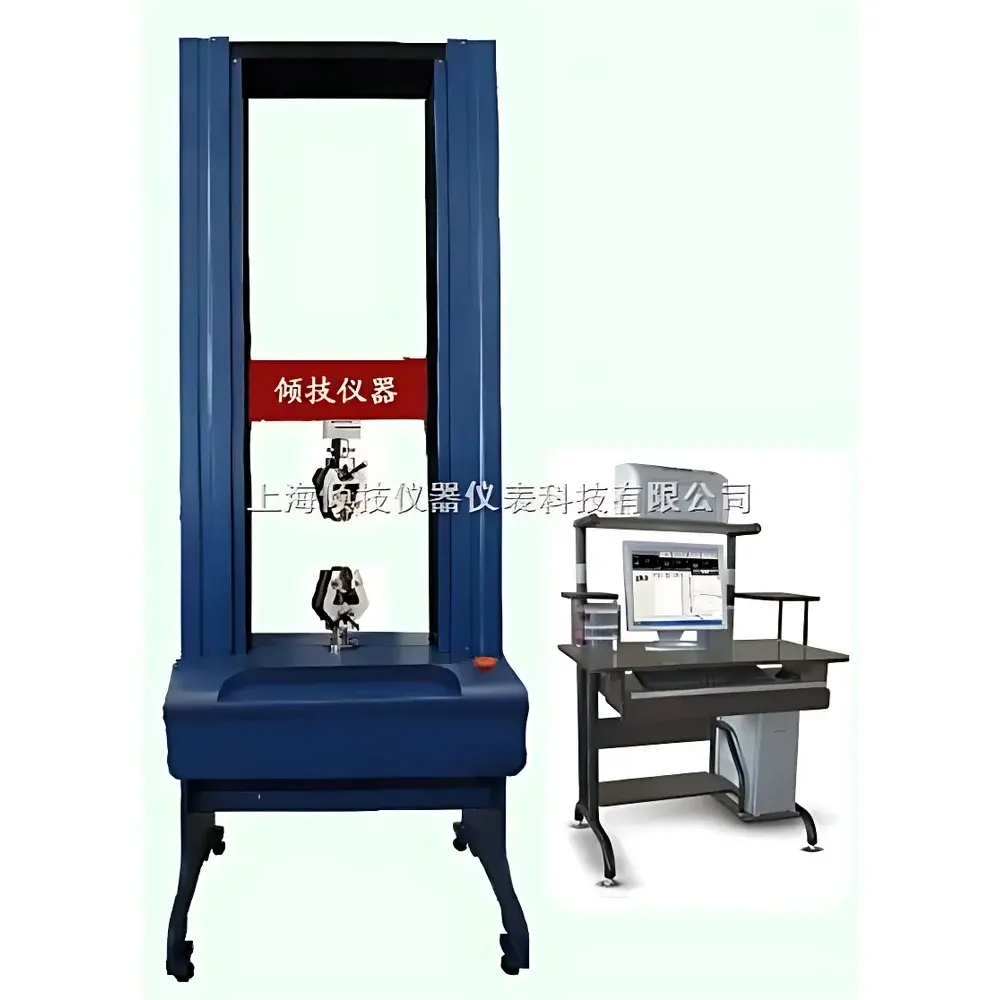
QJ211 Universal Testing Machine for Wood Modulus of Rupture (MOR) and Physical Property Evaluation
| Brand | Qinsun |
|---|---|
| Origin | Shanghai, China |
| Model | QJ211 |
| Max Load Capacity | 30 kN |
| Load Cell Accuracy | ±0.5% FS |
| Measurement Accuracy | < ±0.5% |
| Control System | Full Digital Display Controller |
| Effective Test Width | ~420 mm |
| Effective Stroke | ~800 mm |
| Test Speed Range | 0.01–500 mm/min |
| Speed Accuracy | ±0.5% |
| Displacement Accuracy | ±0.5% |
| Safety Features | Electronic Limit Switches, Emergency Stop Button |
| Unit Weight | ~2650 kg |
Overview
The QJ211 Universal Testing Machine is an electromechanical static testing system engineered for precise determination of mechanical properties in solid wood, engineered timber, laminated veneer lumber (LVL), plywood, particleboard, MDF, and other cellulosic structural materials. It operates on the principle of controlled displacement-driven loading under ASTM D143, ISO 3133, EN 310, and JIS Z 2101 standards—specifically calibrated for modulus of rupture (MOR), modulus of elasticity (MOE), proportional limit, and ultimate bending strength in three-point or four-point static bending configurations. The machine integrates a high-rigidity dual-column frame, precision ball-screw actuation, and a microprocessor-based digital control unit to ensure stable load application and real-time force–displacement synchronization. Designed for laboratory and quality assurance environments, it supports both manual and programmable test sequences with dynamic on-screen data visualization, enabling direct acquisition of peak load, yield point, deflection at failure, and stress–strain curve derivatives.
Key Features
- Robust dual-column steel frame with reinforced base plate, optimized for torsional stability during high-moment bending tests on dimensional lumber (e.g., 2×4, 4×4 specimens).
- High-accuracy load cell (±0.5% full scale) compliant with ISO 7500-1 Class 0.5, traceable to national metrology institutes.
- Adjustable crosshead travel (up to 800 mm) accommodates standard specimen lengths per ASTM D143 (760 mm minimum span) and ISO 3133 (span-to-depth ratios of 20:1 or 24:1).
- Wide-speed-range drive system (0.01–500 mm/min) with closed-loop servo control ensures consistent strain rates across bending, compression, and tensile modes.
- Digital display controller with intuitive interface enables real-time plotting of load vs. displacement, automatic calculation of MOR (MPa) and MOE (GPa), and export-ready data logging.
- Integrated safety architecture including dual-channel electronic limit switches, hardware-based emergency stop circuitry, and overload cutoff protection—fully aligned with EN ISO 12100 risk assessment requirements.
Sample Compatibility & Compliance
The QJ211 accommodates rectangular, square, and round wood specimens up to 150 mm in width and 200 mm in depth. Standard test fixtures include three-point bending supports with hardened steel rollers (diameter ≥ 10 mm), compression platens with self-aligning spherical seats, and wedge-type tensile grips with serrated jaws. All mechanical configurations conform to ISO/IEC 17025 calibration traceability pathways. The system supports full compliance with ASTM D143 (wood bending), ASTM D1037 (panel materials), ISO 3133 (density and MOR of solid wood), and EN 310 (MOR and MOE of wood-based panels). Optional accessories enable shear testing per ASTM D143 Annex C and cleavage testing per ASTM D905.
Software & Data Management
While the base configuration employs embedded firmware with real-time digital readouts, optional PC-integrated software (Qinsun TestSuite v3.x) provides extended functionality: automated test method templates (ASTM/ISO preloaded), GLP-compliant audit trails, user-level access control, electronic signature support, and 21 CFR Part 11–ready data archiving. Raw data exports as CSV or XML are timestamped and include metadata such as operator ID, environmental conditions (optional hygrometer integration), calibration certificate IDs, and instrument serial number—facilitating seamless integration into LIMS or ERP platforms used in certified timber laboratories and third-party certification bodies (e.g., APA, PEFC, FSC-accredited labs).
Applications
- Determination of static bending strength (MOR) and stiffness (MOE) in hardwood and softwood species for grading and specification compliance (e.g., visually graded lumber per ANSI A19.1 or machine-evaluated timber per ASTM D1990).
- Quality control of engineered wood products including glulam beams, CLT panels, and I-joists under sustained load and creep evaluation protocols.
- Research-grade characterization of thermally modified wood, acetylated timber, and bio-composite laminates for building code acceptance (e.g., ICC-ES ESR evaluations).
- Validation of adhesive bond integrity in plywood and laminated veneer lumber via face-peel and block-shear testing per ASTM D906 and D1761.
- Compression parallel-to-grain testing per ASTM D143 Method B for density–strength correlation modeling in forest product economics studies.
FAQ
Does the QJ211 meet ASTM D143 requirements for static bending tests on solid wood?
Yes—the machine’s stroke range, support spacing adjustability, load resolution, and speed control fidelity satisfy all mechanical and procedural clauses in ASTM D143-22, including span-to-depth ratio verification and deflection measurement tolerances.
Can the system be calibrated to ISO/IEC 17025 standards?
Yes—Qinsun provides factory calibration certificates traceable to CNAS-accredited reference standards; end-user calibration intervals and procedures align with ISO 17025 Clause 6.5 and ILAC-G24 guidance.
Is third-party verification available for CE or UKCA marking?
While the QJ211 is not CE-marked as a standalone medical or machinery directive device, its structural design and safety circuits comply with EN 61000-6-2/6-4 EMC requirements and EN ISO 13857 guarding principles—supporting OEM integration into CE-certified production lines.
What maintenance is required to sustain measurement accuracy over time?
Annual verification of load cell linearity, crosshead alignment, and encoder resolution is recommended; Qinsun supplies NIST-traceable calibration kits and offers remote diagnostic support for firmware updates and sensor drift correction.



