
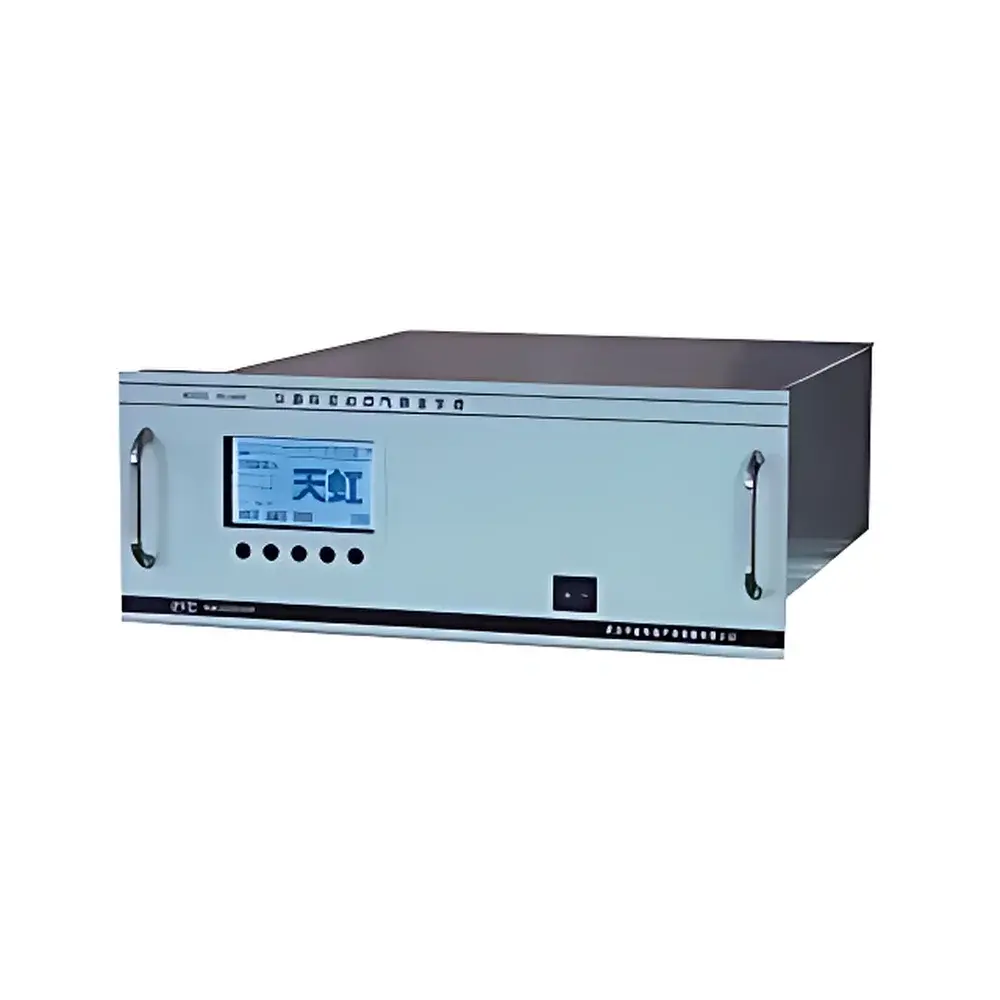
Tianhong TH-2008 Dynamic Gas Calibration Generator
| Brand | Tianhong |
|---|---|
| Origin | Hubei, China |
| Model | TH-2008 |
| Diluent Inlet Count | 1 |
| Source Gas Inlet Count | 3 |
| Diluent Mass Flow Controller Range | 0–10 L/min (expandable) |
| Standard Gas Mass Flow Controller Range | 0–100 mL/min (expandable) |
| Flow Accuracy | ±1.0% of reading |
| Flow Repeatability | ±0.15% F.S. |
| Linearity | ±0.15% F.S. |
| Operating Pressure Range | 100–200 kPa |
| Response Time (T90) | ≤60 s |
| Dilution Ratio | 100:1 to 1000:1 (standard) |
| Output Channels | 3 |
| Operating Ambient Temperature | 0–40 °C |
Overview
The Tianhong TH-2008 Dynamic Gas Calibration Generator is a precision-engineered instrument designed for the on-demand generation of trace-level, dynamically diluted calibration gas mixtures. It operates on the principle of mass flow-controlled blending—using independent, high-stability thermal mass flow controllers (MFCs) to meter both diluent (e.g., zero air or nitrogen) and source gases (e.g., certified standard gas cylinders)—to produce stable, reproducible gas concentrations across wide dilution ranges. Unlike static permeation or diffusion-based generators, the TH-2008 enables real-time, programmable concentration adjustment without cylinder swaps or manual mixing, making it suitable for dynamic calibration of gas analyzers used in environmental monitoring, industrial emission compliance, laboratory reference systems, and sensor validation protocols.
Key Features
- Triple-source gas inlet architecture supports simultaneous introduction of up to three different standard gases (e.g., CO, NO, SO₂), enabling multi-component calibration sequences without hardware reconfiguration.
- Dual-range MFC system: a high-flow diluent controller (0–10 L/min) and low-flow standard gas controller (0–100 mL/min), both with factory-calibrated traceability to NIST-traceable standards.
- Guaranteed flow accuracy of ±1.0% of reading and repeatability of ±0.15% F.S., verified per ISO 6145-7 (gas mixture preparation by dynamic blending) and aligned with ASTM D6348 practices for gaseous standard generation.
- Fast T90 response time ≤60 s ensures rapid transition between target concentrations—critical for dynamic linearity verification and ramp testing of continuous emission monitoring systems (CEMS).
- Three independently controlled output channels allow parallel delivery to multiple analyzers or sequential calibration across instrument clusters, reducing downtime in multi-analyzer laboratories.
- Robust pressure regulation (100–200 kPa operating range) maintains consistent laminar flow conditions across variable backpressure scenarios, minimizing pulsation-induced concentration drift.
Sample Compatibility & Compliance
The TH-2008 is compatible with non-corrosive, non-condensing calibration gases—including hydrocarbons (e.g., CH₄, C₂H₆), acid gases (NO, NO₂, SO₂, HCl), CO, CO₂, O₃, and volatile organic compounds (VOCs) when delivered via inert carrier lines. It complies with fundamental requirements of ISO/IEC 17025:2017 for calibration gas generation in accredited testing laboratories. Its flow control architecture meets the metrological criteria outlined in EPA Method 205 (dynamic dilution verification) and supports GLP-compliant audit trails when integrated with validated software (see Software & Data Management). The unit is not rated for use with hydrogen sulfide (H₂S), chlorine (Cl₂), ammonia (NH₃), or highly reactive halogenated species unless equipped with optional chemically resistant wetted materials (e.g., electropolished 316L SS, Kalrez seals)—a configuration available upon request.
Software & Data Management
The TH-2008 interfaces via RS-232 or optional Ethernet (Modbus TCP) to host PC-based control software, supporting automated calibration sequence scripting, real-time flow monitoring, and digital logging of all operational parameters—including timestamped MFC setpoints, actual flows, pressure readings, and dilution ratios. Data export is compliant with CSV and XML formats for integration into LIMS or ELN platforms. When deployed under 21 CFR Part 11–compliant environments, optional audit-trail-enabled firmware provides user authentication, electronic signatures, and immutable event logs—including parameter changes, start/stop events, and calibration history—fully traceable for FDA, EMA, or CNAS audits.
Applications
- Dynamic calibration and linearity verification of UV-DOAS, FTIR, and electrochemical gas analyzers.
- Zero/span validation and multi-point calibration of CEMS installed at power plants, cement kilns, and waste incinerators per EN 15267 and EPA PS-18.
- Reference gas generation for sensor development labs validating metal oxide (MOx), NDIR, and photoionization detectors (PID).
- Trace gas exposure studies in inhalation toxicology and indoor air quality research requiring precise, repeatable ppm–ppb level dosing.
- Support of ISO 14001 and ISO 50001 internal audit programs through documented, traceable gas standard delivery.
FAQ
Can the TH-2008 generate sub-ppb concentrations?
Yes—when paired with certified 1 ppm or 10 ppm primary standards and operated at maximum dilution (1000:1), the system achieves theoretical lower limits of ~1 ppb; actual achievable detection limits depend on analyzer sensitivity and background contamination control.
Is external pressure regulation required?
No—the TH-2008 incorporates an integrated pressure regulator and buffer volume to stabilize inlet pressure within its specified 100–200 kPa range; however, upstream supply pressure must remain ≥300 kPa for optimal MFC performance.
Does the unit support automatic calibration sequence scheduling?
Yes—via the optional Tianhong Calibration Manager software, users can define time-stamped, multi-step dilution profiles with conditional logic (e.g., “hold at 5 ppm for 120 s, then ramp to 25 ppm over 60 s”).
What maintenance intervals are recommended?
MFC recalibration is advised annually against traceable reference standards; filter replacement (part number TH-FIL-01) every 6 months under continuous operation; full system leak check before each accreditation audit.
Is the TH-2008 suitable for Class 1 Div 1 hazardous locations?
No—it is rated for general laboratory and industrial control room use (IP20 enclosure); explosion-proof variants require custom engineering and third-party ATEX/IECEx certification—not available as standard.
Related Products







