
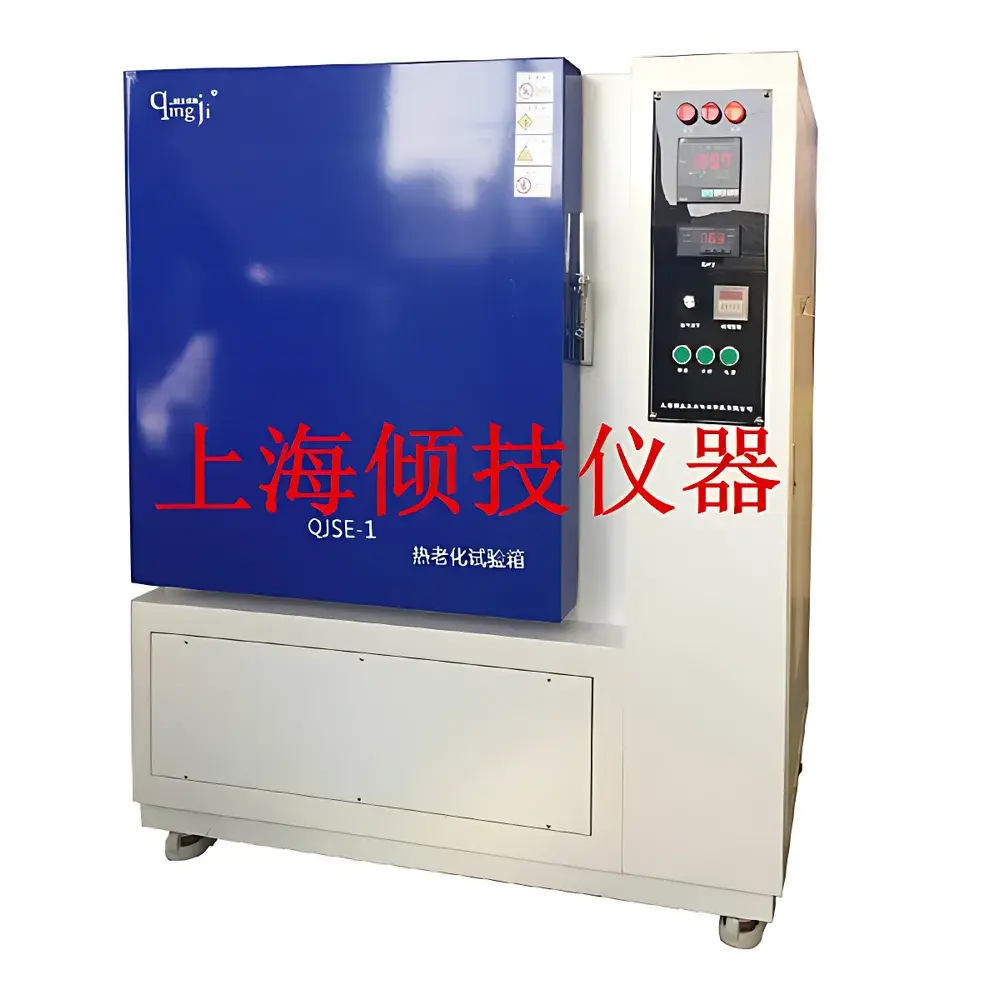
QJSE-1 Thermal Aging Test Chamber for Cables and Electrical Insulation Materials
| Origin | Shanghai, China |
|---|---|
| Manufacturer Type | Authorized Distributor |
| Origin Category | Domestic (China) |
| Model | QJSE-1 |
| Price | USD 4,200 (FOB Shanghai) |
| Temperature Range | RT+20 °C to 300 °C |
| Temperature Uniformity | ≤ ±2 °C |
| Temperature Fluctuation | ≤ ±0.5 °C |
| Heating Rate | ≤60 min from RT+20 °C to 200 °C |
| Total Power Consumption | 6.7 kW (Heating: 6 kW |
| Auxiliary Systems | 0.7 kW) |
| Sound Pressure Level | ≤65 dB(A) |
| Compliance | IEC 60540 (Ed. 2.0, 2021), GB/T 2951.12–2008, ASTM D573–22 |
Overview
The QJSE-1 Thermal Aging Test Chamber is an engineered environmental simulation system designed specifically for accelerated thermal aging evaluation of polymeric insulating materials used in electrical and cable applications. It operates on the principle of controlled convective heat transfer within a dual-airflow circulation architecture—comprising independent upper and lower ducted air paths—to ensure uniform thermal distribution across test specimens per IEC 60540 Clause 8.2 and GB/T 2951.12 Annex A. The chamber maintains stable setpoint temperatures between ambient +20 °C and 300 °C, with real-time monitoring via a calibrated digital PID controller featuring imported sensing elements (Pt100 Class B, traceable to NIM). Its structural design incorporates double-wall insulated stainless steel construction (inner 304SS, outer cold-rolled steel with powder coating), minimizing thermal leakage and supporting long-duration exposure tests required for lifetime prediction modeling under Arrhenius-based degradation kinetics.
Key Features
- Dual-channel forced-air circulation system with adjustable axial fans, enabling consistent airflow velocity (≥0.5 m/s at specimen level) and reducing thermal stratification across the working volume (500 × 500 × 500 mm internal dimensions).
- Imported digital temperature controller with RS485 Modbus RTU interface, supporting programmable ramp-soak profiles and data logging at user-defined intervals (1–60 sec resolution).
- Dual-stage overtemperature protection: electronic limit controller (independent of main PID) + mechanical bimetallic cut-off switch, both triggering audible/visual alarms and automatic heater shutdown.
- Front-access observation window with double-layer heat-resistant glass (tempered + coated IR-reflective layer) and internal LED illumination for non-intrusive visual inspection during operation.
- Integrated grounding terminal and EMI-filtered power input meeting IEC 61000-6-3 emission limits, ensuring electromagnetic compatibility in shared laboratory environments.
Sample Compatibility & Compliance
The QJSE-1 accommodates standard test specimens defined in IEC 60540, including flat strips (2–4 mm thick, 100 mm length), extruded cable sections (up to Ø25 mm), and molded insulation pellets. Specimen support fixtures are supplied in non-reactive anodized aluminum to prevent catalytic surface reactions during prolonged exposure. All operational protocols align with ISO/IEC 17025:2017 requirements for testing laboratories, and the system supports audit-ready documentation for GLP-compliant aging studies. Calibration certificates for temperature sensors are provided with each unit, traceable to China National Institute of Metrology (NIM) standards. The chamber satisfies mandatory clauses of GB/T 2951.12–2008 (equivalent to IEC 60811-502) for aging duration tolerance (±1%), temperature stability verification (per ISO 17025 Clause 6.4.6), and post-test mechanical property correlation workflows.
Software & Data Management
While the base configuration utilizes embedded firmware for local control, optional PC-based software (QJSE-Control Suite v3.1) enables remote monitoring, multi-chamber synchronization, and automated report generation compliant with FDA 21 CFR Part 11 Annex 11 requirements. Audit trails record all parameter changes, user logins, alarm events, and calibration actions with time-stamped digital signatures. Export formats include CSV (for statistical analysis in Minitab or JMP), PDF (formatted per ISO/IEC 17025 reporting guidelines), and XML (compatible with LIMS integration via HL7 or RESTful API endpoints). Data integrity is preserved through cyclic redundancy check (CRC-32) validation and write-once-read-many (WORM) archive mode.
Applications
- Accelerated life assessment of cross-linked polyethylene (XLPE), ethylene propylene rubber (EPR), and thermoplastic elastomer (TPE) insulation systems per IEEE 98–2017.
- Validation of thermal endurance class (e.g., Class 90, 105, 125, 150 per IEC 60216) for low-voltage power cables and building wiring.
- Pre-qualification testing of halogen-free flame-retardant (HFFR) compounds prior to UL 1581 or CSA C22.2 No. 0.3 certification.
- Material screening for nuclear-grade cable applications under IEEE 383–2019 environmental qualification protocols.
- Supporting ASTM D573–22 rubber aging studies where gravimetric, tensile, or elongation-at-break metrics are tracked pre/post exposure.
FAQ
What international standards does the QJSE-1 explicitly support for cable insulation aging?
It is configured and validated for IEC 60540 (Ed. 2.0, 2021), GB/T 2951.12–2008, and ASTM D573–22, with documented uncertainty budgets for temperature uniformity and stability.
Is third-party calibration included with delivery?
Yes — each unit ships with a NIM-traceable calibration certificate covering the working temperature range (RT+20 °C to 300 °C) at three points (100 °C, 150 °C, 250 °C), performed per ISO/IEC 17025 accredited procedures.
Can the chamber be integrated into an existing laboratory quality management system (QMS)?
Fully compatible with ISO 13485 and IATF 16949 QMS frameworks via configurable electronic records, change control logs, and 21 CFR Part 11–compliant user access hierarchy.
What maintenance intervals are recommended for sustained accuracy?
Biannual verification of airflow velocity and temperature uniformity is advised; annual recalibration of the primary Pt100 sensor is recommended, with optional on-site service contracts available.
Does the system support multi-step aging profiles with dwell times?
Yes — the optional QJSE-Control Suite allows up to 99 programmable segments, including ramp, soak, and hold functions, with real-time deviation alerts and automatic profile suspension on alarm activation.



