
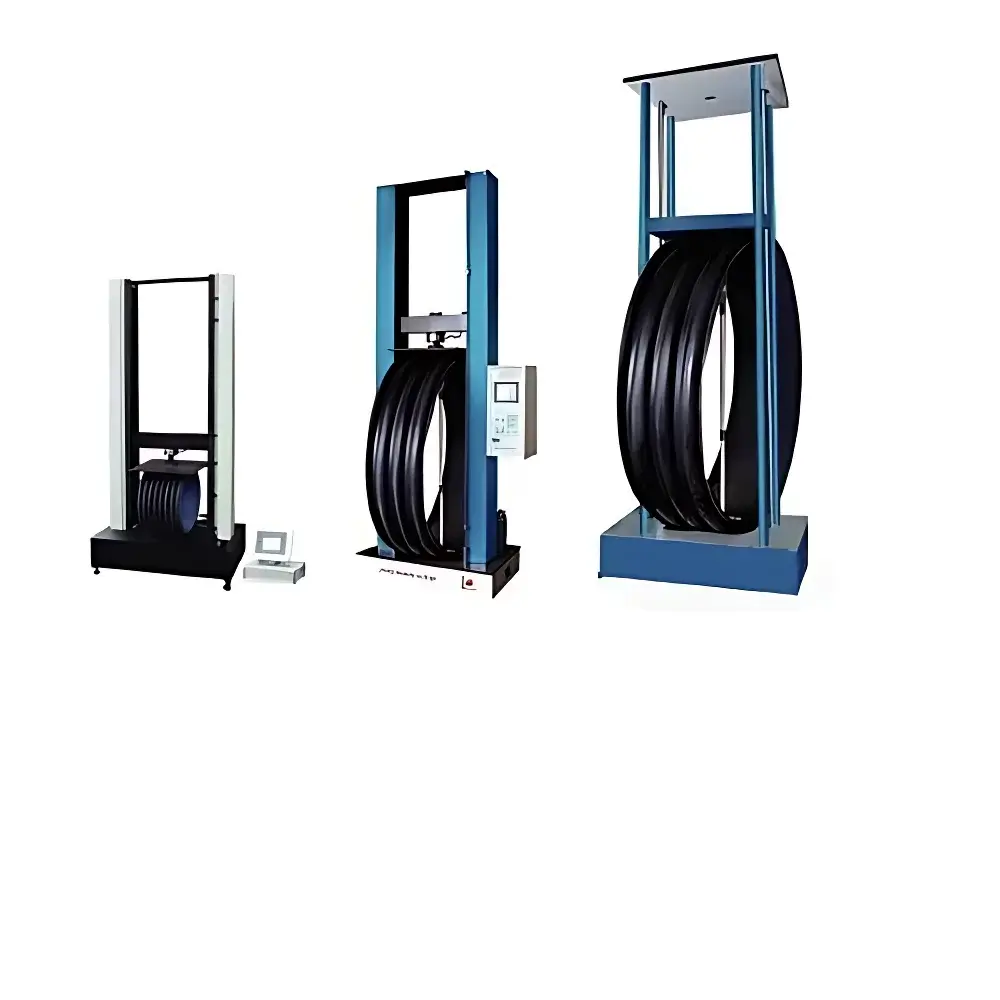
Qinji QJ215 Ring Stiffness Testing Machine
| Brand | Qinji |
|---|---|
| Origin | Shanghai, China |
| Model | QJ215 |
| Load Capacity Options | 50 kN / 100 kN / 200 kN / 300 kN / 500 kN |
| Maximum Test Diameter | ≤ Φ5000 mm |
| Accuracy Class | Class 1 / Class 0.5 |
| Load Accuracy | ±0.5% of reading |
| Speed Range | 0.01–1000 mm/min (standard speed: 300 mm/min) |
| Speed Accuracy | ±0.15% of reading |
| Displacement Resolution | 0.01 mm |
| Control Interface | Full Chinese GUI with PC-integrated real-time curve display, data logging, and report generation |
Overview
The Qinji QJ215 Ring Stiffness Testing Machine is a specialized universal testing system engineered for structural mechanical evaluation of rigid and semi-rigid tubular specimens—primarily plastic pipes (e.g., HDPE, PVC-U), fiberglass-reinforced polymer (FRP) conduits, concrete-lined ducts, and composite pipe systems. It operates on the principle of diametral compression per ASTM D2412 and ISO 9969, applying controlled radial force to a supported pipe segment while measuring load-deflection response to calculate ring stiffness (kN/m² or N/mm²). Unlike general-purpose tensile testers, the QJ215 integrates dedicated support cradles, internal deformation measurement fixtures (for both smooth-wall and corrugated profiles), and compliance-optimized loading geometry to ensure reproducible, standardized ring deflection measurements under defined boundary conditions. Its modular four- or six-column frame architecture provides high rigidity and minimal axial deflection during high-load compression cycles, supporting consistent test repeatability across large-diameter specimens up to Φ5000 mm.
Key Features
- Modular column configuration (four- or six-post) optimized for lateral stability during diametral compression tests on large-diameter pipes
- Dual-mode operation: fully compliant ring stiffness testing per ASTM D2412, ISO 9969, GB/T 9647, and concurrent universal mechanical testing (tensile, compressive, flexural) with optional accessories
- Integrated internal deformation measurement system—including dial gauge or LVDT-based inner-diameter displacement sensors—for precise detection of radial deformation in both smooth-wall and profiled (e.g., corrugated, ribbed) pipes
- High-resolution displacement feedback (0.01 mm) and load transducer accuracy of ±0.5% of reading, certified to ISO 7500-1 Class 0.5
- Wide-speed actuation range (0.01–1000 mm/min), programmable via PC interface with speed accuracy maintained within ±0.15% of setpoint
- Full Chinese-language HMI with intuitive navigation; all test parameters, real-time load-displacement curves, and calculated outputs (ring stiffness, yield load, ultimate load, deformation at 3% diameter reduction) displayed synchronously
Sample Compatibility & Compliance
The QJ215 accommodates pipe specimens ranging from small-diameter utility conduits (≥Φ50 mm) to large-diameter drainage and sewer mains (up to Φ5000 mm), including thermoplastic, thermoset, metallic, and hybrid composites. Its support cradle design conforms to the three-point bending geometry specified in ASTM D2412, ensuring uniform load distribution across the pipe arc. For regulatory traceability, test reports include full metadata (operator ID, timestamp, environmental conditions, calibration certificate IDs) and support audit-ready documentation aligned with GLP and ISO/IEC 17025 laboratory requirements. While not inherently FDA 21 CFR Part 11-compliant out-of-the-box, the PC-based control software permits integration with validated electronic signature and audit trail modules upon customer request.
Software & Data Management
The embedded Windows-based control software enables complete test automation: pre-defined test methods (e.g., “ASTM D2412 Ring Stiffness – 3% Deflection Protocol”), real-time graphical overlay of load vs. displacement and ring stiffness derivation, automatic identification of key inflection points (linear region onset, yield plateau, failure point), and export of raw data in CSV and XML formats. All test files are time-stamped and stored with checksum-verified integrity. Report templates comply with ISO 14689 and EN 13476 annexes, generating PDF outputs containing specimen ID, test standard reference, equipment calibration status, raw curve plots, tabulated results (including ring stiffness S = (F × L³) / (0.083 × Δy × D²)), and operator verification fields. Data backups are configurable to network drives or encrypted USB media.
Applications
- Quality assurance of buried plastic piping systems used in municipal water, wastewater, and stormwater infrastructure
- Validation of ring stiffness claims per manufacturer datasheets and procurement specifications (e.g., AWWA C900, EN 1446)
- R&D evaluation of novel pipe wall geometries, material blends, or reinforcement architectures
- Third-party certification testing for CE marking (EN 13476-3), WRAS approval, or NSF/ANSI 61 compliance
- Mechanical property benchmarking of non-pipe cylindrical structures—such as culverts, silo sections, or composite pressure vessels—under radial loading
FAQ
What standards does the QJ215 support for ring stiffness testing?
It natively implements ASTM D2412, ISO 9969, GB/T 9647, and EN 13476-3, with method templates preloaded and editable for custom protocols.
Can the machine test corrugated pipes with high-precision deformation measurement?
Yes—the integrated inner-diameter deformation sensor system includes adjustable probe arms and low-profile contact tips designed specifically for accurate radial displacement capture on multi-peak corrugated profiles without slippage or local buckling artifacts.
Is calibration traceability provided with the system?
Each unit ships with a factory calibration certificate traceable to CNAS-accredited national metrology institutes; annual recalibration services and uncertainty budgets are available upon request.
Does the software support multi-user access with role-based permissions?
Standard deployment supports single-operator mode; enterprise-level deployments can be configured with Windows Active Directory integration and hierarchical user roles (e.g., operator, supervisor, administrator) for GxP environments.
What maintenance intervals are recommended for long-term accuracy retention?
Biannual mechanical inspection (guide rail lubrication, load cell zero-check, encoder alignment) and annual full-system recalibration are advised; consumables such as load cell mounting hardware and cradle padding kits are stocked and supplied globally.
Related Products



