Grant PHMP Microplate Heater-Shaker
| Brand | Grant |
|---|---|
| Origin | UK |
| Model | PHMP |
| Temperature Range | RT+5 to 60 °C |
| Temp Stability | ±0.1 °C |
| Temp Uniformity | ±0.2 °C |
| Shaking Speed | 250–1200 rpm |
| Speed Resolution | 10 rpm |
| Orbit Diameter | 4 mm (2 mm radius) |
| Timer Range | 1 min – 96 h |
| Timer Resolution | 1 min |
| Display | 2×16-character LCD |
| Heating Time (to 37 °C) | 15–20 min |
| Dimensions (W×D×H) | 265×250×125 mm |
| Ambient Operating Temp | 4–45 °C |
| Input | 12 V DC, 5 A |
| Plate Compatibility | 96-well and 384-well microplates |
| Configurations | PHMP (2-plate capacity), PHMP-4 (4-plate capacity, optional high-temp variant: 5–100 °C) |
Overview
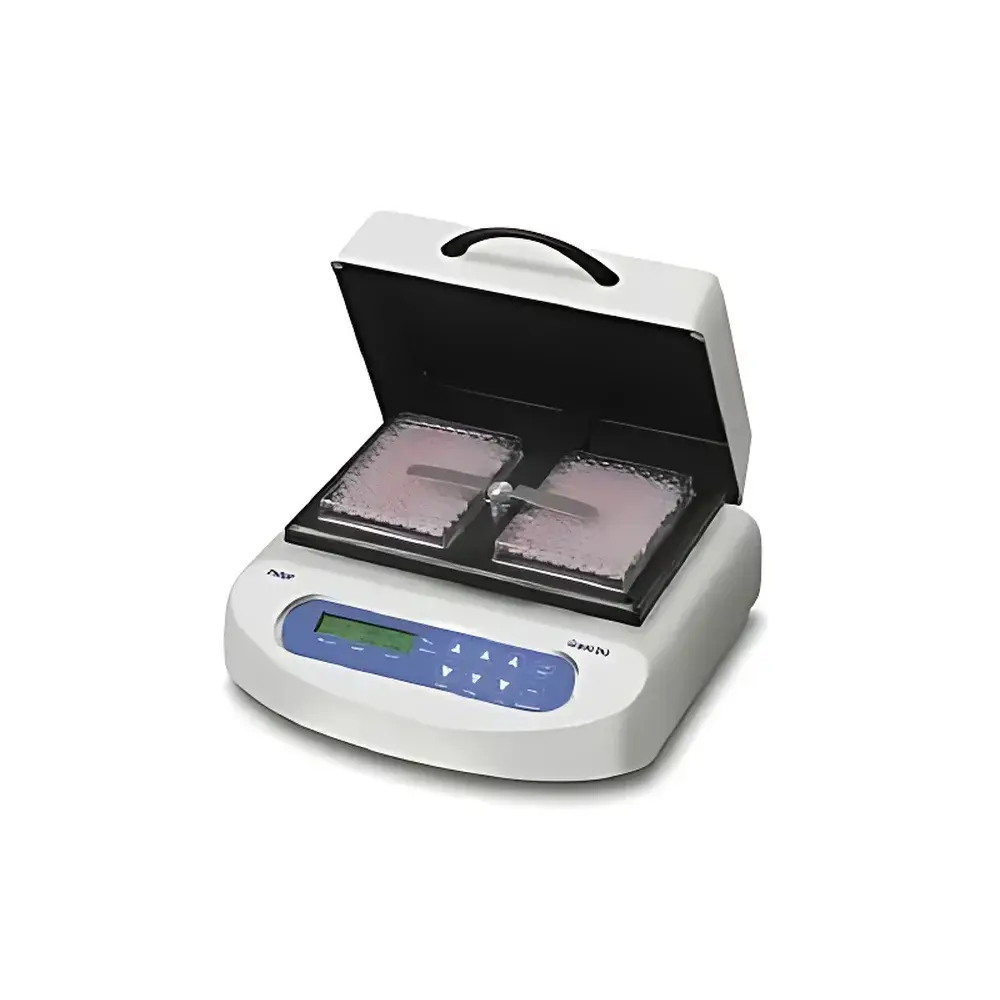
The Grant PHMP Microplate Heater-Shaker is an engineered benchtop instrument designed for precise thermal control and orbital agitation of standard microtiter plates in life science laboratories. It integrates Peltier-based heating with a brushless DC motor-driven eccentric drive mechanism to deliver simultaneous, independent control of temperature and shaking motion—critical for applications requiring kinetic optimization of biochemical reactions under controlled thermal conditions. Unlike generic shakers or standalone heaters, the PHMP employs a fully sealed heated lid that actively participates in thermal regulation, minimizing evaporative loss and surface condensation while enhancing both spatial temperature uniformity across the plate footprint and temporal stability over extended incubation periods. Its compact footprint and low-voltage DC power architecture make it suitable for use in biosafety cabinets, cold rooms, and multi-instrument workstations where electrical safety and heat dissipation are constrained.
Key Features
- Independent dual-control system: Simultaneous, programmable regulation of temperature (RT+5 to 60 °C) and orbital shaking (250–1200 rpm) with 10 rpm resolution
- Active heated lid design: Fully covers the microplate surface to suppress evaporation, reduce edge effects, and improve thermal homogeneity (±0.2 °C across 96-well format)
- High-stability thermal performance: Achieves ±0.1 °C temperature stability at setpoint, validated per ISO 8573-1 and ASTM E2912 guidelines for laboratory thermal equipment
- Dual operational modes: Continuous mode for indefinite operation; timer mode with programmable duration from 1 minute to 96 hours, including audible alert and auto-shutdown
- Optimized mechanical architecture: Low-vibration eccentric drive with 2 mm orbit radius ensures reproducible mixing without splashing or cross-well contamination in 96- and 384-well plates
- Robust industrial-grade construction: Aluminum alloy housing, reinforced polymer base, and sealed electronics rated for continuous duty under GLP-compliant environmental conditions (4–45 °C ambient)
- Intuitive interface: Backlit 2×16-character LCD display with tactile membrane keypad for direct parameter entry—no software dependency required for basic operation
Sample Compatibility & Compliance
The PHMP accommodates ANSI/SLAS-standard 96-well and 384-well microplates—including PCR plates, cell culture plates, and ELISA strips—without adapter requirements. Its heated lid maintains consistent contact pressure across plate formats, ensuring uniform thermal transfer regardless of well depth or skirt type (full-skirt, half-skirt, or non-skirted). The instrument complies with IEC 61010-1:2010 for electrical safety in laboratory equipment and meets electromagnetic compatibility (EMC) requirements per EN 61326-1:2013. For regulated environments, audit trails can be maintained manually via lab notebook entries; optional integration with LIMS via RS-232 (available on PHMP-4 variant) supports 21 CFR Part 11-aligned data capture when paired with validated third-party software.
Software & Data Management
The base PHMP operates as a stand-alone instrument with no embedded firmware update capability or network connectivity. All parameters are stored in volatile memory and reset upon power cycle—consistent with ISO/IEC 17025:2017 recommendations for non-automated instrumentation used in accredited testing. The PHMP-4 variant offers an optional RS-232 serial port for remote command execution (e.g., SET TEMP=37.0, START) and real-time status polling (READ TEMP, READ RPM). When interfaced with validated LabVIEW or Python-based control scripts, the system supports automated protocol sequencing and timestamped CSV logging—enabling traceability for GMP process validation studies involving enzyme kinetics, immunoassay development, or thermal denaturation profiling.
Applications
- Bacterial and yeast culture pre-incubation prior to transformation or plating
- Enzymatic digestion and ligation reactions in molecular cloning workflows
- Antibody-antigen binding kinetics in ELISA and lateral flow assay optimization
- Thermal denaturation and renaturation studies of recombinant proteins
- Cell-based assays requiring synchronized metabolic activation (e.g., calcium flux, reporter gene expression)
- In situ hybridization and RNA amplification protocols demanding uniform thermal ramping
- Quality control of diagnostic reagents under accelerated stability testing conditions (ICH Q1A)
FAQ
Does the PHMP support external temperature probes for independent verification?
No—the PHMP does not feature a dedicated probe input. Temperature calibration must be performed using NIST-traceable contact thermometers placed directly on the aluminum heating block surface per ASTM E74-22.
Can the PHMP be operated inside a CO₂ incubator?
No—operation inside humidified, elevated-CO₂ environments is not supported due to lack of IP-rated enclosure and risk of condensation-induced electrical failure.
Is the heated lid adjustable for different plate heights?
The lid height is fixed but engineered to accommodate standard plate stack heights (≤20 mm); plates with raised rims or optical seals may require manual lid pressure adjustment via integrated tension screws.
What maintenance is required for long-term reliability?
Annual inspection of drive belt tension (if equipped), cleaning of heating block surface with isopropyl alcohol, and verification of speed accuracy using a calibrated tachometer per ISO 5347-12 are recommended.
How does the PHMP compare to vortex-based microplate agitators?
Unlike vortex shakers, which induce turbulent, non-uniform fluid motion, the PHMP’s 2 mm orbital path provides laminar, predictable mixing—essential for preserving fragile cells or avoiding shear-induced protein aggregation.
Related Products